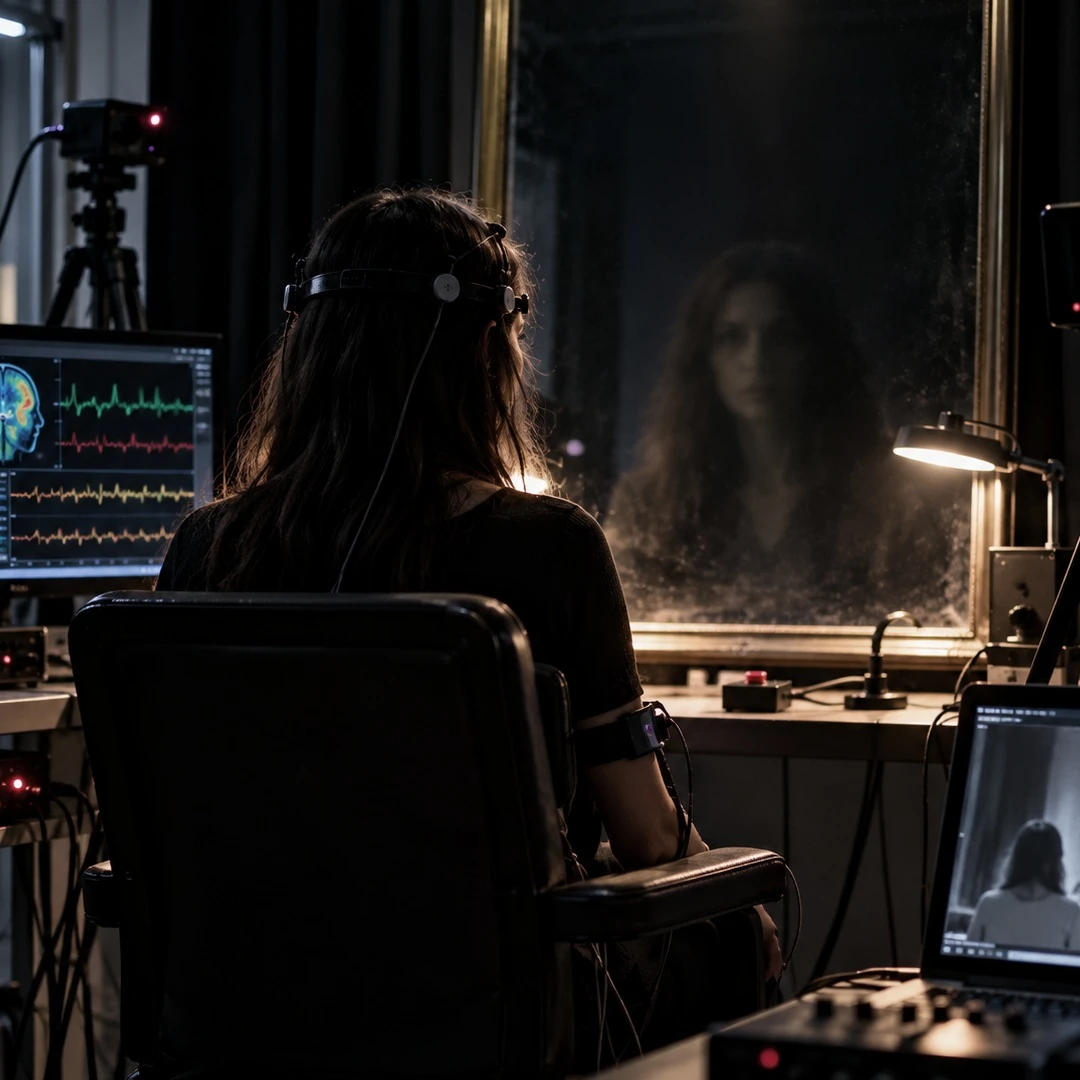
Mirrors have long been steeped in folklore for their supposed ability to reveal what the naked eye cannot see. Some traditions even viewed them as portals to the spirit world. But what happens when this ancient belief is put to the test in a scientific setting, when people who claim to have seen ghosts sit in a dark room facing a mirror, while their bodies and the environment are closely monitored? Do mysterious faces and apparitions appear before them, or is it all a product of the mind?
A recent study set out to explore these questions. Published on October 6, 2026, in the Journal of Anomalous Experience and Cognition, the research was led by Christine Simmonds-Moore in collaboration with Chase Oguinn, Michael Stidder, and Elena Mayfield. The team focused on experiences of apparitions and the sensation of an unseen presence, investigating how these relate to individual traits and environmental factors.
The Spirit Mirror Room
The researchers used a technique known as the 'Psychomanteum,' which involves sitting in front of a mirror in dim lighting and staring at it for an extended period. The goal is to evoke vivid mental images or a sense of presence from someone who isn't physically there.
Despite its name, the room isn't actually meant to summon spirits. Instead, it draws on an old tradition of attempting to contact the dead, a practice that has since become the subject of psychological and parapsychological experiments.
The team selected 30 participants, all of whom had previously experienced what they believed to be a ghost encounter. Half of the group had a neurological phenomenon known as synesthesia, where sensory experiences overlap for example, hearing a sound might trigger the perception of a color, or certain words might evoke additional sensory feelings.
The researchers wanted to find out whether people with synesthesia were more likely to experience apparitions or a sense of an unseen presence.
The experiment began with a 15-minute introductory session, followed by 45 minutes of mirror gazing. During this time, participants were asked to press a button whenever they sensed the presence of someone or something invisible, or when they experienced particularly vivid or unusual mental images.
The study didn't rely solely on participants' accounts. The team also monitored changes in heart rate, electromagnetic fields, and geomagnetic fluctuations, using infrared cameras and a random number generator. Baseline measurements were taken outside of the mirror sessions, and participants completed interviews and questionnaires after the experiment.
What did the experiment reveal?
The results showed that people with synesthesia were no more likely than others to have extraordinary experiences or to sense an invisible presence. There were also no significant differences between the two groups in terms of how vivid or real their mental images seemed.
However, the researchers did find a link between creativity and the vividness of mental imagery. Participants who scored higher on creativity tests tended to describe more detailed and convincing images, as if their imagination brought these visions closer to reality.
This finding raises an important question: Could a strong imagination, combined with prolonged mirror gazing in dim light, create an experience that feels like a genuine encounter with an unseen presence?
The findings weren't limited to psychological factors. The team also identified statistical links between certain electromagnetic and geomagnetic changes and participants’ physical responses, as well as the way some described their experiences especially among those with heightened sensory perception.
There was also a statistical correlation between the random number generator’s output and how this group rated their experiences. Infrared cameras picked up visual anomalies, but these occurred both during the mirror sessions and the baseline measurements, making it impossible to consider them evidence of a mysterious entity.
However, these correlations don’t prove that magnetic fields caused the experiences, or that the random number generator was influenced by an unknown force. The study is exploratory, involved a small sample size, and its results require independent replication before drawing broader conclusions.
Do mirrors create ghosts in our minds?
It’s well known that staring at faces or reflections for an extended period especially in dim lighting can lead to strange visual effects. Features may appear distorted or altered, and sometimes it can even seem as if you’re looking at someone else.
Some researchers explain these phenomena as the visual system adapting to a static image, combined with the roles of attention, expectation, and the brain’s methods for interpreting incomplete sensory information.
But the 'spirit mirror' experience isn’t just about seeing odd images. It can also involve a strong sense of an unseen presence, an impression that can feel very real, even when there’s no external evidence of anyone being there.
This is where the new study stands out: rather than trying to prove the existence of ghosts, it explores the circumstances that might lead someone to sense a mysterious presence, and how personal psychological traits interact with environmental factors.
Between ancient beliefs and scientific explanations
We’ve previously discussed the role of mirrors in folklore and mythology, including their supposed ability to reveal spirits or open windows to hidden worlds. The new study shifts the focus from inherited beliefs to the individual’s own experience: what do people see, what do they feel, and how can some of the conditions surrounding these experiences be measured?
The study didn’t provide evidence that spirits appear in mirrors, nor did it prove that supernatural forces affect equipment. Instead, it highlighted a phenomenon that deserves further research: some people can experience images and sensations so vivid that it’s hard for them to distinguish these from real-world events.
So the question remains: when someone sees a strange face in the mirror or senses a presence behind them, is the mirror revealing something outside their usual perception, or is it simply giving the brain unusual conditions that reshape reality?
So far, scientific explanations focus on how perception, expectation, and attention work. The idea that these experiences are caused by an external supernatural source remains unproven by current evidence.
About the Author