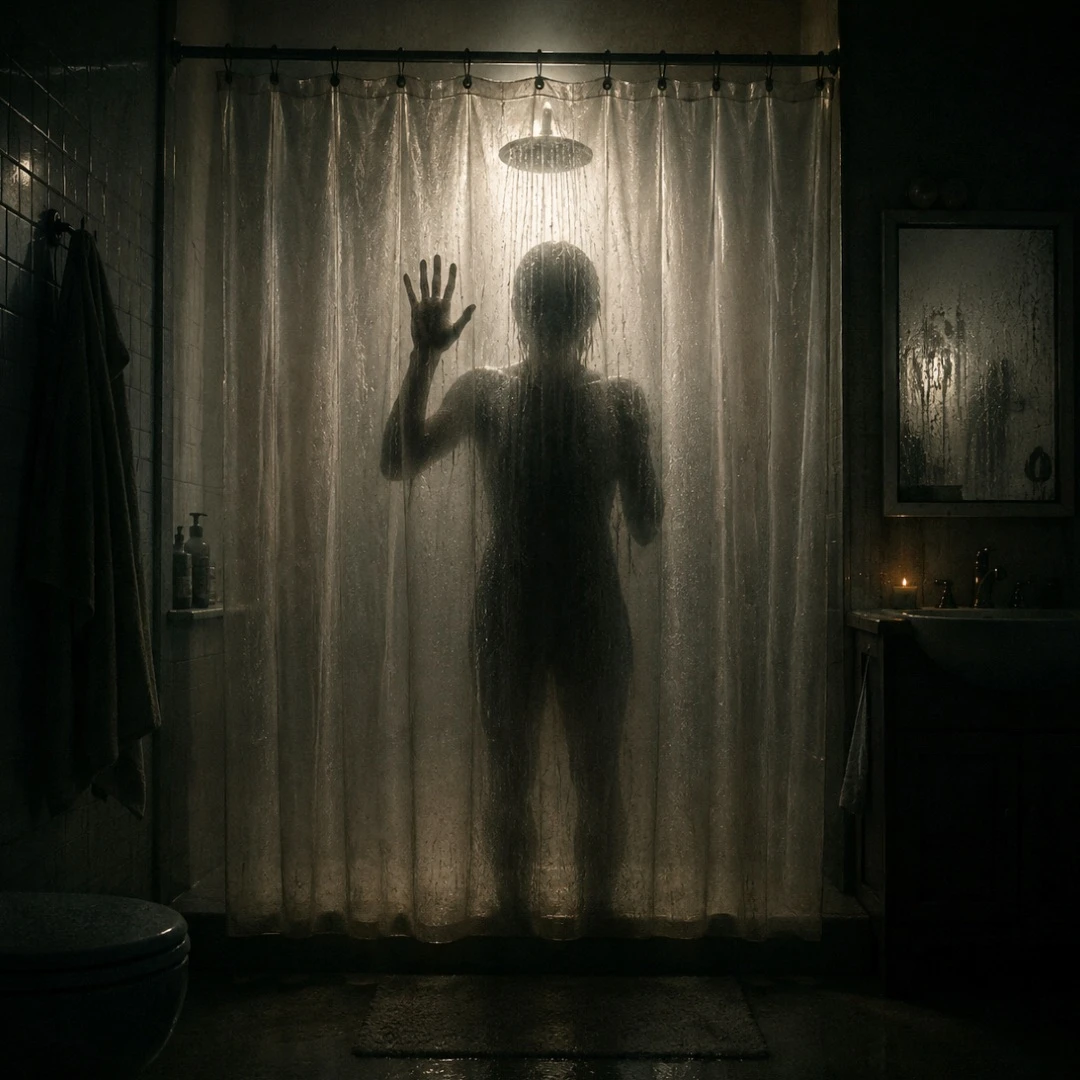
You don’t need to step into an abandoned house or an old cemetery to feel like something strange is watching you. Sometimes, all it takes is a late-night trip to the bathroom, closing the door behind you, and letting the water run over your head.
The usual sounds of the house fade away, leaving only the rush of the shower and the echo of droplets on the walls. Steam fogs up the mirror, and your view blurs behind wet glass or a shower curtain. As you wash your face and close your eyes, you might suddenly get the sharp feeling that someone has entered the room, is standing behind you, or is calling your name from outside the door.
You open your eyes and turn quickly, but no one is there. Still, the uneasy feeling lingers.
Stories like this are surprisingly common: unexplained knocks, fleeting shadows in the mirror, hearing your name called in the water, a curtain moving on its own, or the sensation of a hand touching your shoulder. But why is the bathroom such a frequent setting for these experiences? Is it something about the space itself—its psychological or architectural qualities, or is it centuries of stories and beliefs that have linked bathrooms to spirits, the supernatural, and unseen beings?
A moment of vulnerability
In the bathroom, we temporarily give up most of our usual defenses. We’re naked, barefoot, surrounded by water and slippery surfaces, and sometimes our eyes are closed because of soap. Even if we sense danger, we can’t move or leave as quickly as we could elsewhere in the house.
Vulnerability here isn’t just about being physically exposed, it’s a primal sense of lacking protection. Clothes, shoes, a phone, even the presence of others all provide a subtle sense of security, but the bathroom strips almost all of that away.
The closed bathroom door also isolates you from the rest of the house. Your family might be just a few feet away, but you can’t hear them clearly or know what’s happening outside. A small, familiar space suddenly feels cut off from the world, especially at night when the house is quiet.
Sounds shaped by water
The sound of running water creates a constant noise that drowns out other sounds and makes it harder to distinguish what you’re hearing. The hum of pipes, the air conditioner, or a distant door can blend together, making footsteps, knocking, or even whispered voices seem to emerge from the noise.
In this confusing soundscape, the brain tries to pick out familiar patterns. That’s why some people report hearing their names called in the shower, or think a family member is speaking to them—only to realize, once the water stops, that no one said a word.
It’s similar to hearing words in the hum of a fan or an appliance. Research into so-called paranormal perception has shown that expectation and suggestion can make us more likely to hear words or meanings in random, ambiguous sounds that don’t actually contain a clear message.
Water pipes expand and contract with temperature changes, sometimes making pops and knocks that seem to come from the walls or behind the door. If you’re already on edge or have heard scary stories about the place, your mind is quicker to interpret those sounds as signs of another presence.
The mirror that doesn’t always reflect you
The bathroom’s strangeness is heightened by the mirror, especially when the lighting is dim or steam partially obscures it.
When you wipe a small patch clear, your face appears surrounded by white mist, with blurred features and shifting outlines. As the steam moves and the light changes, your reflection might look larger, paler, subtly altered—or, for a moment, as if another face is hiding behind your own.
This isn’t just poetic exaggeration. Scientific studies have explored what’s called the 'strange-face illusion,' where healthy people report seeing their features change or unfamiliar faces appear when staring into a mirror for a long time in low light. A 2023 scientific review notes that these illusions are a common part of mirror-gazing experiments, though the exact mechanisms behind them are still being studied.
When you keep your gaze fixed on a single spot, your brain becomes less sensitive to certain unchanging details, while shadows and edges seem to stand out more. The mind tries to reconstruct the face it sees, but sometimes fills in the blanks incorrectly. In a moment of fear, these visual distortions can turn into the image of an old woman, a dead person, or a mysterious figure standing behind you.
This is why mirrors have become a perfect tool for spirit-summoning rituals in folklore.
Bloody Mary: The Ghost Born in the Mirror
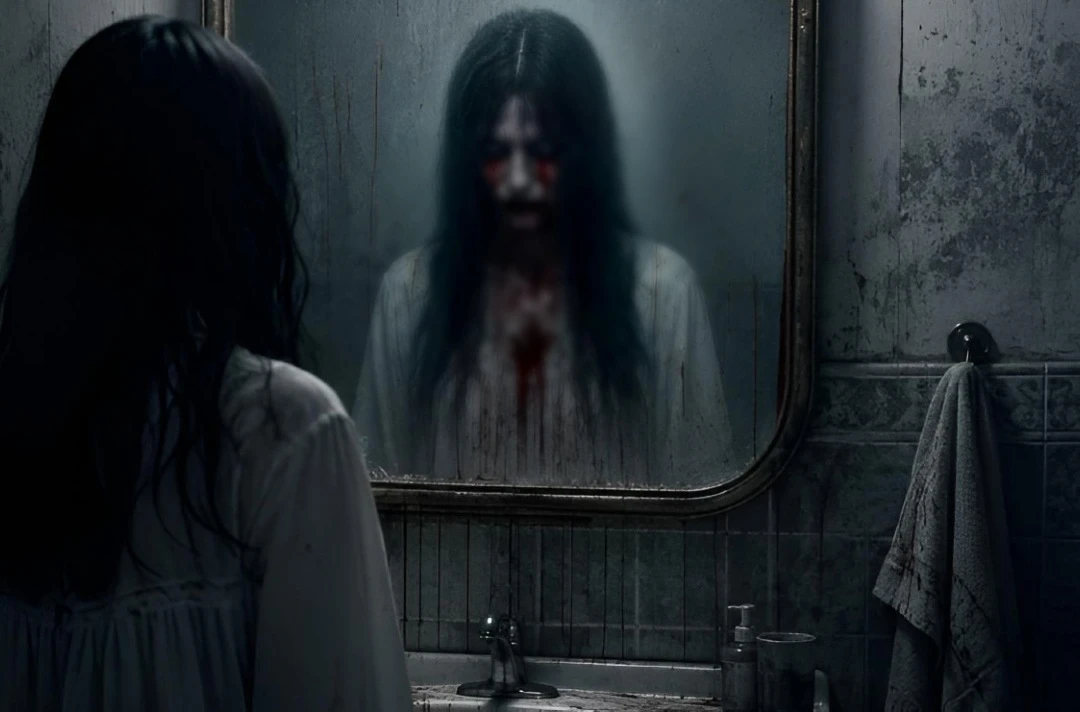
One of the most famous Western mirror legends is the "Bloody Mary" ritual. The details vary from place to place, but the most common version involves entering a dark bathroom, standing in front of the mirror, repeating Mary’s name several times, and then waiting for her face to appear.
This ritual is often performed by children and teenagers as a test of courage. According to the legend, Mary might appear as a bloodied woman, a witch, or an angry spirit who attacks whoever summoned her. Folklore researchers see this story as a clear example of 'ritual play,' combining group fear, psychological testing, and staring into a mirror under dim light.
There’s no single historical figure behind the legend. The name, story, and number of repetitions change from one version to another. But the consistent elements, the bathroom, darkness, and mirror—are no coincidence; they create the perfect setting for visual illusions, which the legend then gives a name and a face.
In this scenario, the child isn’t just seeing a random shadow; they enter the bathroom already expecting to see a bloodied woman. When their own reflection becomes distorted, fear completes the illusion.
Hanako-san: The Japanese Bathroom Ghost
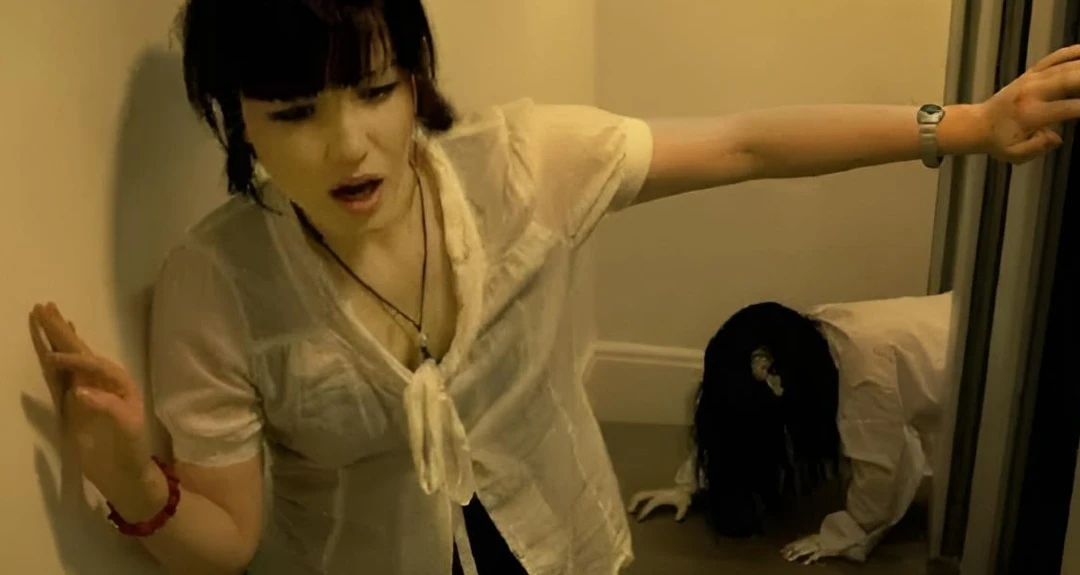
In Japan, school bathrooms are linked to one of the country’s most famous urban legends: Hanako-san, the spirit of a young girl said to haunt a bathroom stall—usually the third stall on the third floor.
According to the common ritual, a child knocks on the stall door three times and asks, "Are you there, Hanako?" If the spirit is present, she answers from inside. Sometimes a pale hand appears, or the child is pulled into the stall.
There’s no single story about how Hanako died. Some versions say she was killed during an air raid in World War II, others claim she was murdered at school, or died after being bullied.
Japanese folklore experts note that these changing endings are typical of urban legends, they evolve to reflect the fears of each generation and environment. Hanako has become a fixture in Japanese school culture for decades, and her story has spread to films, manga, and video games.
Like Bloody Mary, Hanako doesn’t appear randomly; children summon her through a ritual. They choose a quiet bathroom, approach a closed stall, knock, and wait for a response. After several tense minutes, any sound from the pipes or hallway can seem like an answer from within.
Aka Manto: The Choice That Offers No Escape
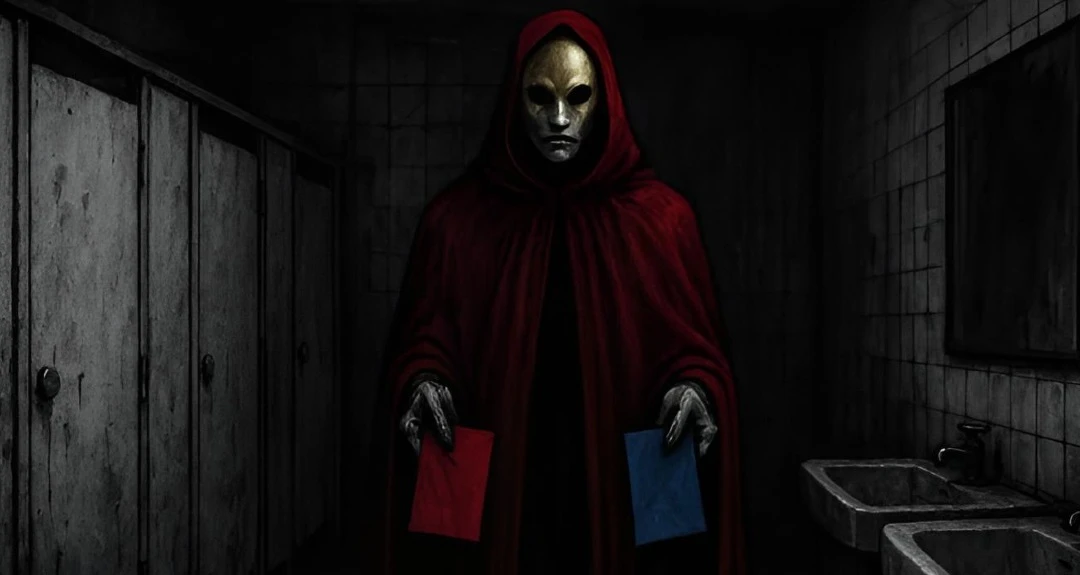
Japan is also home to the legend ofAka MantoThe Red Cloak is a masked figure said to appear in school bathrooms or public restrooms, asking its victim whether they want the color red or blue.
According to the most common versions of the story, choosing red leads to a gruesome death that leaves the victim's clothes soaked in blood, while choosing blue results in being strangled until their face turns blue. Trying to pick a third color doesn't guarantee safety, as some versions add new punishments depending on the region and storyteller.
This legend traces back to schoolyard rumors that spread across Japan in the first half of the twentieth century. The story centers on someone trapped in a confined space at a vulnerable moment, forced to choose between two equally disastrous options.
The tale taps into a deep fear of losing control. The victim can't see who's speaking, doesn't know where the voice is coming from, and has no right answer. It's a vivid metaphor for the human experience in a bathroom: alone, cornered, and unable to know what's lurking behind you.
Akaname: The Filth Monster
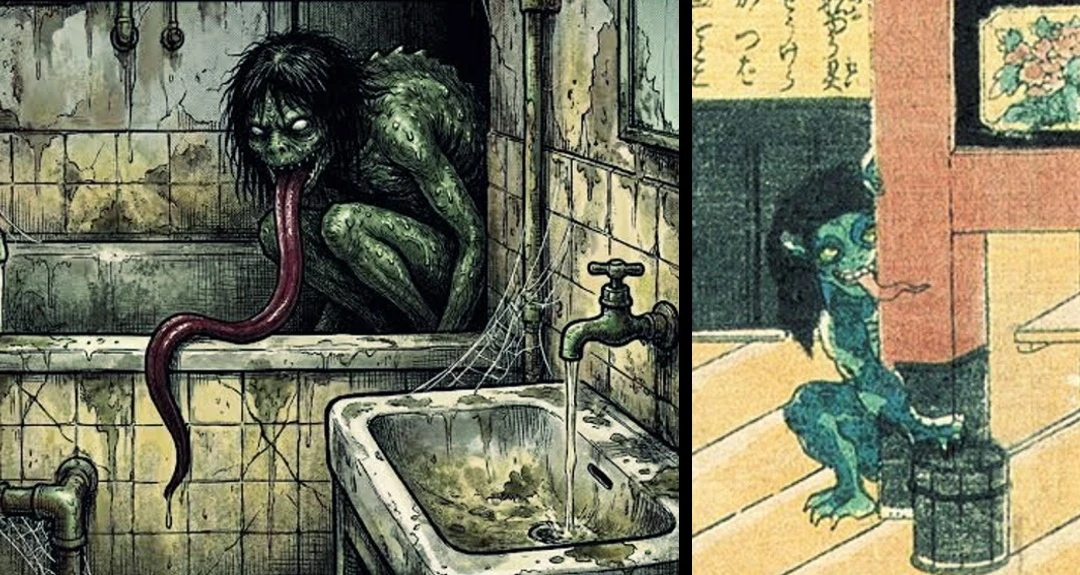
Not all Japanese bathroom creatures are spirits of the dead. In old Japanese folklore, there's the Akaname, a type of yokai described as having a long tongue used to lick up grime from dirty bathrooms and neglected bathtubs.
This creature appeared in illustrated yokai books from the eighteenth century, with references to similar beings going back even further. It served a clear educational purpose: scaring children and residents into keeping bathrooms clean, as if filth not only brought disease and bad smells, but also attracted a revolting nocturnal monster.
This is a recurring theme in folklore, where rules about cleanliness and safety become stories about hidden creatures. A child might ignore warnings about mold and germs, but won't easily forget a monster that comes out at night to lick the bathtub.
Bathrooms and Jinn in Islamic Tradition
In Islamic culture, there are specific prayers and etiquette for entering the bathroom. According to hadith, the Prophet Muhammad would seek God's protection when entering, asking to be shielded from 'evil and malevolent beings.'
Some scholars interpreted these words as seeking refuge from both male and female devils, while popular tradition expanded the idea further. Over time, bathrooms, dirty places, and ruins became widely associated with the presence of jinn. Religious and legal sources often mention that the belief in jinn inhabiting abandoned or unclean places is one reason for the recommended prayers and etiquette when entering such spaces.
It's important to distinguish between authentic religious texts and additions from popular culture. For example, there's no reliable evidence that every bathroom mirror is a gateway for jinn, that singing in the bathroom necessarily attracts them, or that leaving the door open lets them into the house. These are community beliefs where advice, fear, and family stories have blended together.
It's also worth noting the difference between the 'khala'—the traditional place for relieving oneself in older texts—and the modern bathroom, which combines a toilet and a clean bathing area in one room. Not everything said about unclean places in the past can be applied literally to every contemporary bathroom.
Still, bathrooms have long been seen as places where you shouldn't linger without reason, and where loud voices or playful behavior are discouraged , which over generations has given these spaces an air of silence and caution.
Jinn in Traditional Public Bathhouses
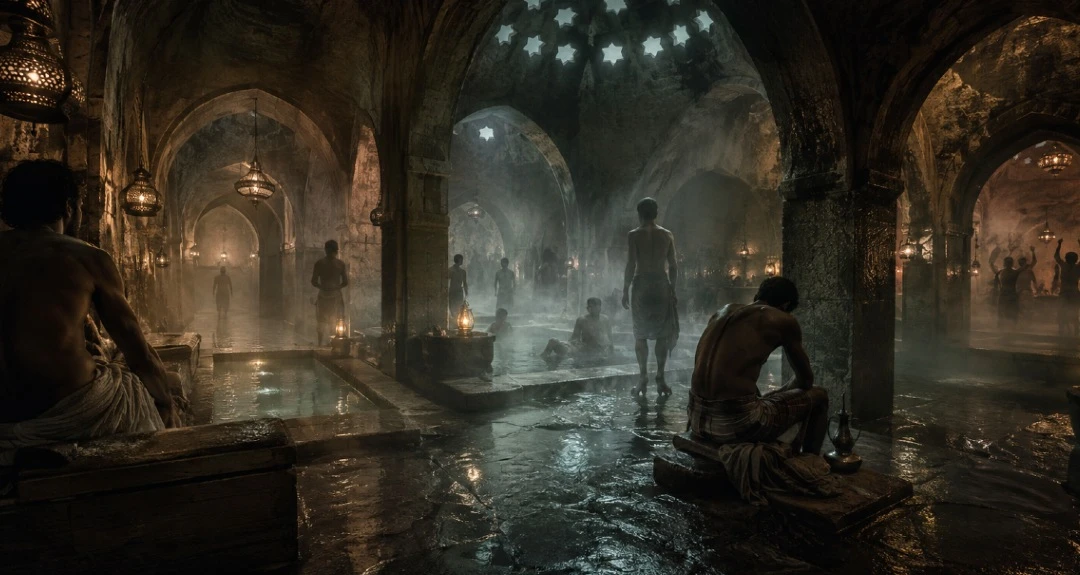
Before private bathrooms became common, public bathhouses were a central part of urban life in the Middle East, Iran, and Anatolia. They weren't just places to wash, but also social hubs where people gathered for rituals related to marriage, childbirth, and mourning.
Some bathhouses were built partially underground to retain heat, with winding corridors, domed halls, and dim lighting. At night, after workers and guests had left, the steam-filled, echoing chambers became the perfect setting for stories.
This is why many countries have tales of jinn inhabiting bathhouses after hours, celebrating at night or disguising themselves as ordinary bathers. In some stories, their true nature is revealed when someone notices hoof-like feet, sees that they cast no reflection in the water, or hears music and laughter coming from an abandoned bath.
These stories aren't historical evidence of jinn in bathhouses, but they do reveal the workings of popular imagination. The environment is hot, dark, and humid, with sounds echoing under domes, and people working nearly naked. Bathhouses are linked to cleanliness, birth, marriage, and death, making them liminal spaces in the collective mind: you enter stripped of your clothes and leave clean, as if passing through a small ritual of transformation.
Recurring Real-Life Experiences
Looking through personal accounts shared in paranormal communities, certain patterns emerge—often described in almost identical words, despite differences in culture and setting.
The most common story involves hearing a knock on the bathroom door while showering. The person turns off the water and asks who's there, but gets no answer. When they step out, they find that no one in the house came near the door.
The second pattern is hearing your name called. While under the water, someone distinctly hears the voice of their mother, spouse, or child calling them, but when they turn off the shower, there's only silence.
The third pattern is the feeling of a presence behind the shower curtain. You don't see anyone, but you sense that the bathroom is no longer empty, as if someone is standing silently on the other side.
Other accounts describe seeing a shadow in the mirror after wiping away the steam, glimpsing a dark shape passing behind them, or noticing a handprint on the glass that doesn't match their own.
These stories are real in the sense that people genuinely experienced them and were affected by them, but that doesn't mean the cause was supernatural. Honest experiences can be misinterpreted, especially in confusing sensory environments.
The Ghost Behind the Curtain
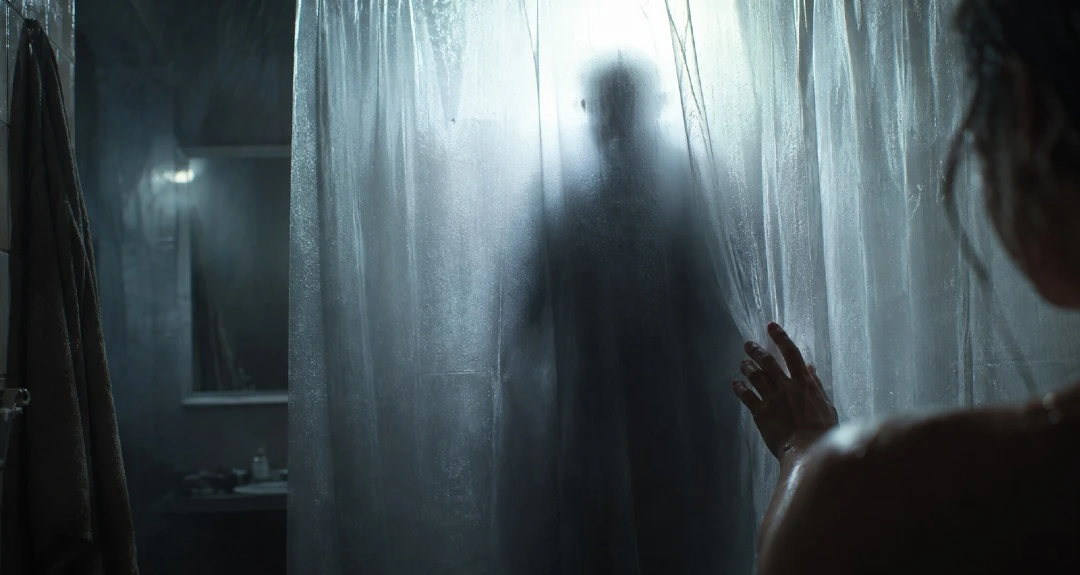
The shower curtain is one of the most unsettling features of the bathroom, because it hides a space just out of sight.
Logically, you know you entered the bathroom alone, but with your eyes closed, you can't watch the door or see behind the curtain. If the curtain moves because of air or a change in water pressure, it can feel as if something brushed against it.
What’s truly unsettling isn’t what you see, but what you can’t see. The shower curtain doesn’t reveal anything specific to inspect, it just hides an unknown emptiness behind it. When we’re tense, the human brain is wired to assume there’s a threat rather than believe there isn’t one, because from an evolutionary perspective, it’s safer to expect danger than to ignore a real risk.
This might explain why shower scenes are so effective in horror films. The audience knows the character can’t hear the intruder approaching because of the running water, can’t see them because of the curtain, and has their eyes closed at the very moment danger draws near.
Why does the experience feel more intense at night?
There’s nothing physically different about bathrooms at night compared to during the day, it’s our state of mind that changes.
At night, natural background noise fades, making even the smallest sounds stand out. You’re often tired, maybe just woken up before heading to the bathroom, caught in that hazy space between sleep and wakefulness. In this state, mental images can blend with what you perceive around you.
Our sense of vulnerability increases when we know everyone else is asleep, the house is dark, and we’re the only one awake. When the sound of water suddenly stops, the silence that follows feels heavier than usual, and the brain starts anticipating that it will hear something.
If you’ve ever watched a scary movie or read a story about spirits in the bathroom, those expectations become a ready-made lens for interpreting every sound or shadow. In this way, folklore actually helps create the very experiences it later claims to explain.
Steam, Shadows, and Pareidolia
The term "pareidolia" describes the brain’s tendency to see meaningful shapes in random or ambiguous images—like spotting a face in the clouds or in stains on the wall.
The same thing happens in the bathroom: water droplets on glass might form eyes and a mouth, a hanging towel can look like a person, or steam can make reflections seem like someone standing still. Faces are among the shapes our brains pick up on most quickly, even when the visual evidence is barely there.
Experiencing pareidolia doesn’t mean someone is ill or hallucinating—it’s a normal part of human perception. But fear and expectation can make these vague shapes feel more real, and people often remember the version their mind created, not the fleeting image they actually saw for a split second.
Water as a Boundary Between Worlds
Water’s connection to the bathroom goes beyond just noise and steam. Across many myths, water is seen as a boundary between two realms: life and death, impurity and purity, reality and dreams.
Newborns are washed, the dead are washed, and water is used in religious and symbolic purification rituals in many cultures. Wells, rivers, and springs have long been linked to countless spirits, beings, and legends.
Even the modern bathroom, for all its practical appearance, still carries some of this ancient symbolism. You enter dirty and leave clean, enter clothed and leave undressed, and the water envelops you in a way that feels cut off from the outside world.
Maybe that’s why showering can sometimes feel almost ritualistic, especially at night. Water muffles sound, steam blurs boundaries, the mirror changes your face, and being naked returns you to a state of primal vulnerability.
Between Psychological & Paranormal
Some experiences feel undeniably real to those who have them: a clear voice, a tangible touch, a door moving, or a shadow that appears again and again. Offering a general psychological explanation doesn’t mean every incident has actually been explained.
A fair approach starts by considering natural causes: drafts, expanding pipes, water pressure, mirror reflections, a small animal getting in, sleep disturbances, exhaustion, or simply the person’s own anxiety and expectations.
If the phenomenon keeps happening, you can try recording audio, checking the door, pipes, and ventilation, changing the lighting, removing objects that cast shadows, and making sure there are no leaks, mold, or electrical issues.
Not every fleeting fear should turn into a belief in ghosts or spirits. That only heightens anxiety, making someone enter the bathroom bracing for the next strange event—where every sound becomes evidence, every shadow a presence, and every dream part of the story.
Still, there will always be testimonies from people who aren’t convinced by any ordinary explanation, and experiences that end without clear proof one way or the other. This gray area is what keeps bathrooms so strangely prominent in paranormal tales.
A Place Where We Don’t Want to Feel Another Presence
Bathrooms may not be the most haunted places, but they’re certainly among the last places anyone wants to feel watched.
It’s a space of absolute privacy, so even the slightest hint of another presence feels like a deep violation of safety. You don’t need to see a full apparition; a sound behind the door, a movement in the mirror, or a sudden sense that you’re not alone is enough.
Most of these experiences probably come from a mix of isolation, noise, steam, dim lighting, and cultural stories. Still, some tales might hold something we haven’t yet explained.
What’s certain is that bathrooms combine, in a small space, elements rarely found together elsewhere: water, mirrors, nudity, echoes, a closed door, and the night.
That’s why, when someone closes their eyes underwater and senses movement nearby, the scariest thing isn’t what they might see...
It’s opening their eyes, turning around, and realizing the shower curtain isn’t where they left it.
About the Author