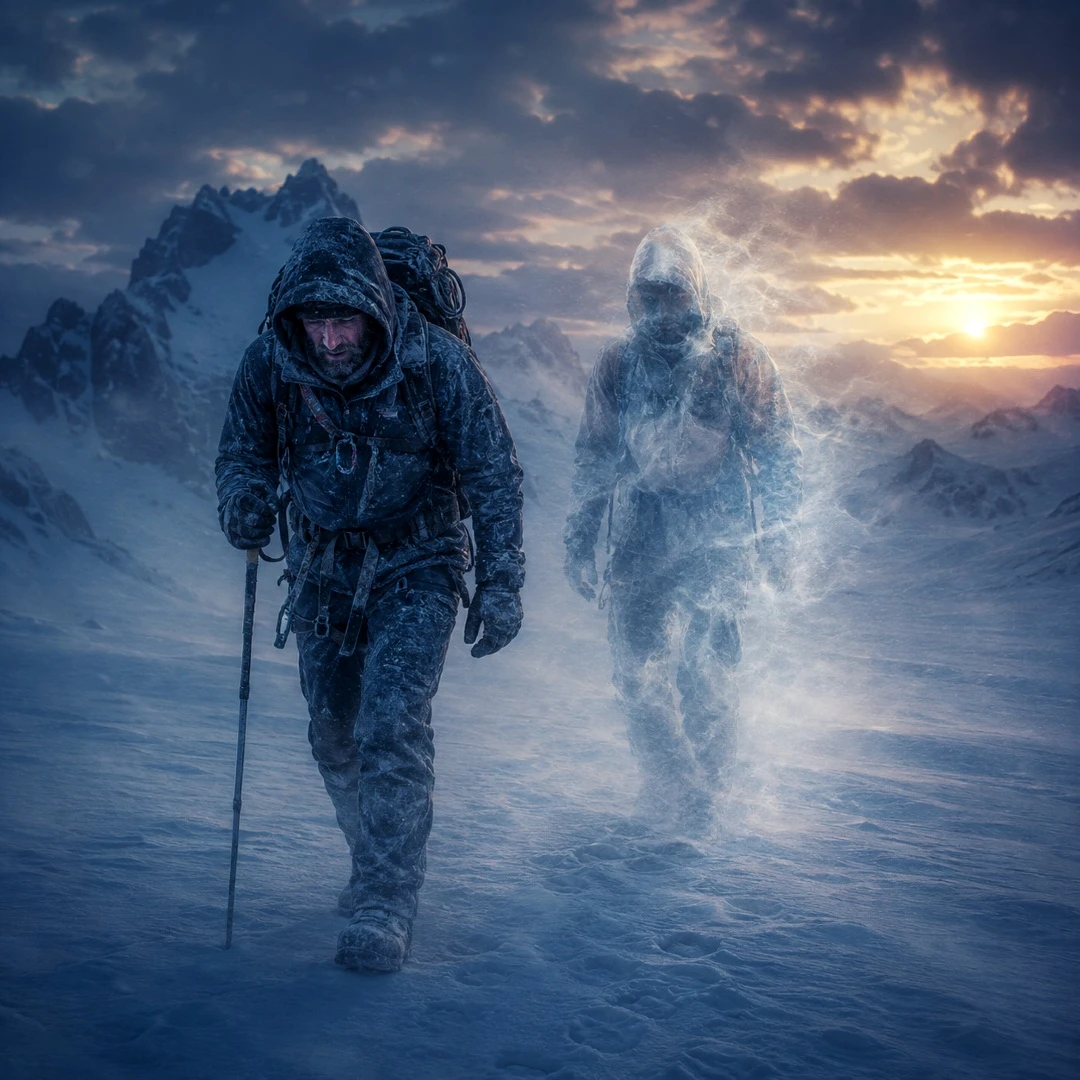
Imagine being completely alone in a place where help can't reach you. Your body is exhausted, the cold is biting, sleep feels like a distant dream, and every step could be your last. Then, suddenly, something changes: you're no longer alone, someone is walking beside you.
You might not see their face or hear their voice, but you're certain they're there, as real as any person. You sense them watching over you, accompanying you, sometimes guiding you or giving you the strength to keep going. When you finally reach safety and look around, you realize the strange truth: there was never anyone there.
This experience has been reported by mountain climbers, polar explorers, and disaster survivors so often that it has become known as Third Man Syndrome or the Third Man Factor.
But who is this mysterious companion? A hallucination created by a mind on the verge of collapse, or one of the brain's strangest survival mechanisms? And why does this presence appear at the very moment when someone needs another person more than ever?
The Fourth Man on the Polar Ice
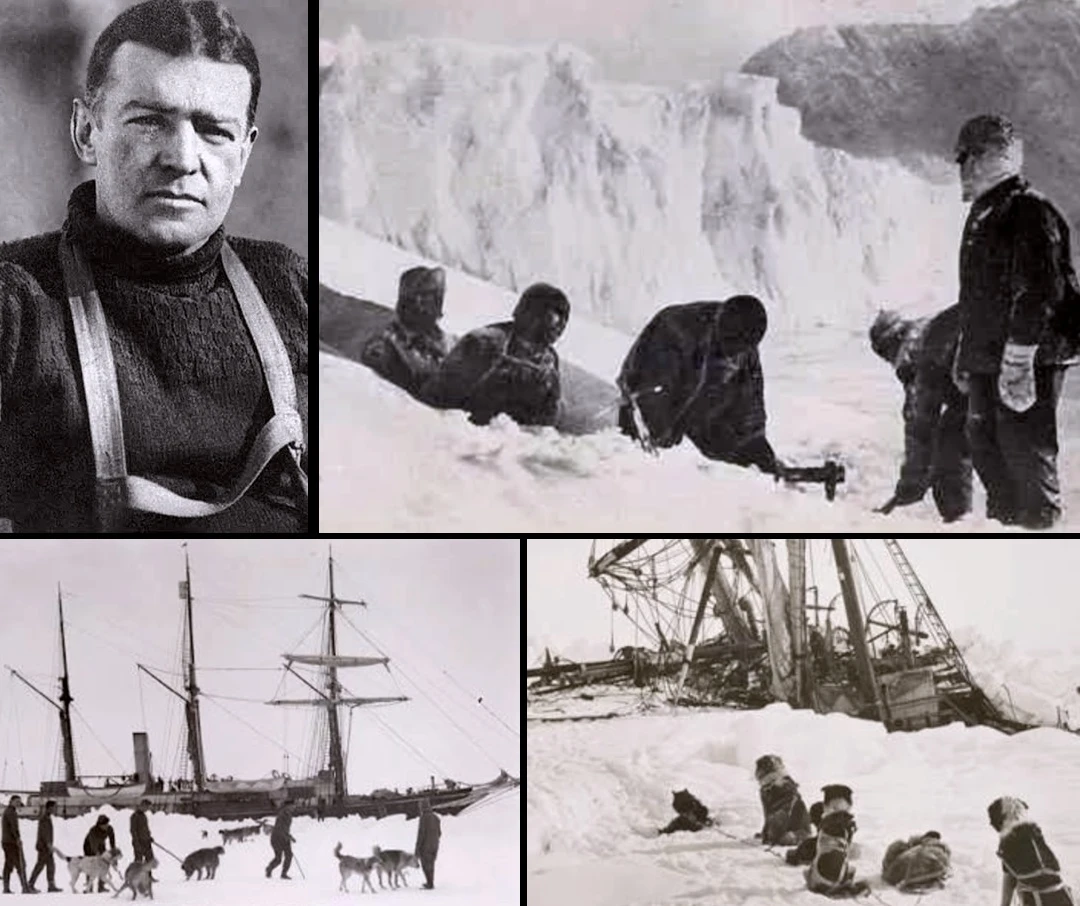
One of the most famous accounts of this phenomenon comes from British explorer Sir Ernest Shackleton and his ill-fated polar expedition that began in 1914.
After Shackleton's ship, the Endurance, was trapped and crushed by ice, the expedition members spent months struggling to survive in one of the harshest places on earth. In the final stage of their journey to seek help, Shackleton, along with Frank Worsley and Tom Crean, had to cross unknown mountains and glaciers on South Georgia Island. The men trekked for about 36 hours through intense cold, exhaustion, and sleep deprivation. Afterward, Shackleton wrote in his book "South" that he had a strange feeling during the journey: it seemed to him, repeatedly, that there were four people, not three. Even stranger, when he later spoke with his companions, he discovered that both Worsley and Crean had also felt that an extra person was with them. There was no fourth man, yet the sense of his presence was so real that it became part of history.
Why It's Called the "Third Man Syndrome"
Interestingly, Shackleton's experience was actually that of a "fourth man," since there were three in his group. The term that later became popular partly comes from literature, specifically T. S. Eliot's 1922 poem The Waste Land.
In the poem, Eliot describes two people walking together, with a mysterious third figure appearing beside them. In his notes, Eliot explained that the scene was inspired by a polar expedition—believed to be Shackleton's where the exhausted team members felt an extra presence with them. That's how the name "Third Man" took hold.
But Shackleton wasn't the only one.
The Everest Climber Who Tried to Feed a Ghost
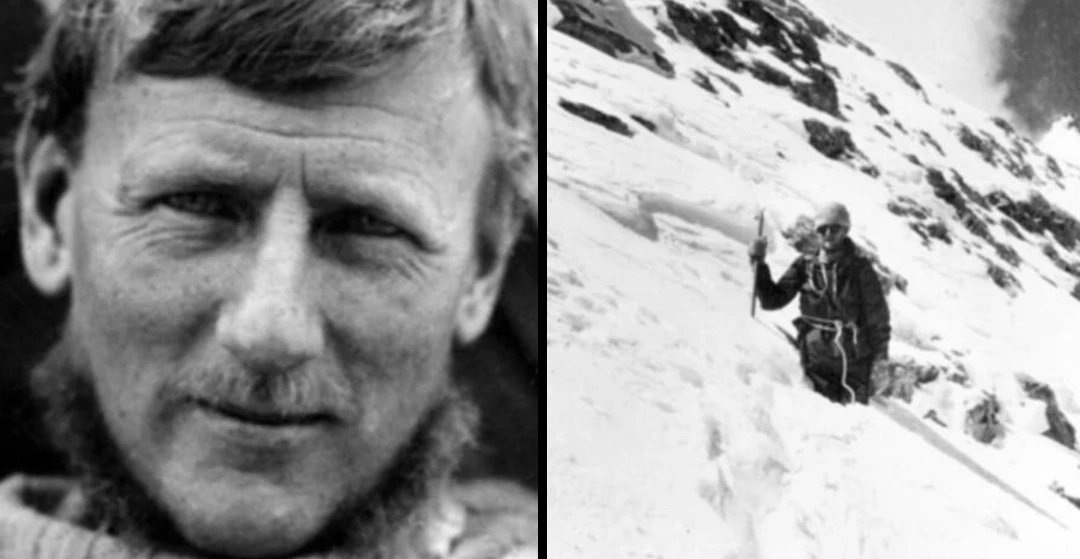
In 1933, British climber Frank Smythe was attempting to reach the summit of Everest, at a time when climbing gear and oxygen technology were nothing like they are today.
He reached a dangerously high altitude alone, exhausted, with little oxygen or food. As he pressed on, he began to feel that another climber was with him. It wasn't just a fleeting thought, the sensation was so strong that he felt as if a rope connected him to this companion, and that if he slipped, the other would catch him.
When he stopped to regain his strength, he took out a piece of Kendal Mint Cake, broke it in half, and instinctively turned to offer a share to his companion. Only then did he realize there was no one behind him—he had been alone the entire time.
This incident stands out as one of the clearest examples of the phenomenon’s power, because the 'other person' wasn’t just a vague feeling, it became a tangible part of the reality Smith’s mind was processing in that moment.
A Third Climber on Nanga Parbat
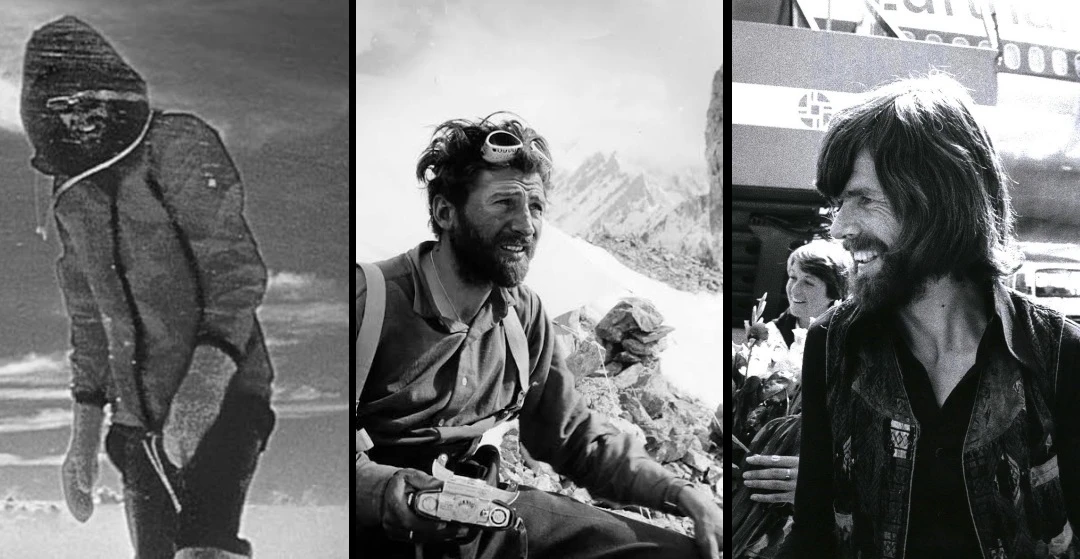
A similar experience happened to one of the most famous mountaineers in history: the Italian climber Reinhold Messner.
In 1970, Messner and his brother Günther were descending Nanga Parbat, a mountain in northern Pakistan at the western edge of the Himalayas. They were exhausted, freezing, starving, and at a dangerously high altitude. Tragically, Messner would later lose his brother in an avalanche. During their descent, Messner sensed the presence of a third climber walking alongside him at a steady distance, just outside his field of vision. According to Messner, he didn’t need to see this figure to believe it was there, he simply felt its presence.
Messner’s account later became a key case cited by neuroscientists studying the phenomenon known as the feeling of a presence.".
These stories share a striking detail: this mysterious companion tends to appear when a person is at the limits of exhaustion, isolation, and danger.
So is the mind responsible for creating this presence?
Not a 'Syndrome' in the Medical Sense
Although the term 'Third Man Syndrome' is widely used, it isn’t recognized as a distinct psychological syndrome or medical diagnosis. The closest scientific terms are 'feeling of a presence' (FoP) or sometimes 'presence hallucination.' This refers to the experience of sensing another being or person nearby, even though there’s no physical evidence to support it.
This phenomenon can occur in certain neurological or psychological conditions, but it’s also been documented in perfectly healthy people who have faced extreme isolation, exhaustion, sleep deprivation, cold, or high altitude. So, experiencing or sensing a presence doesn’t necessarily mean someone is suffering from a mental illness.
When 'Self' and 'Other' Blur
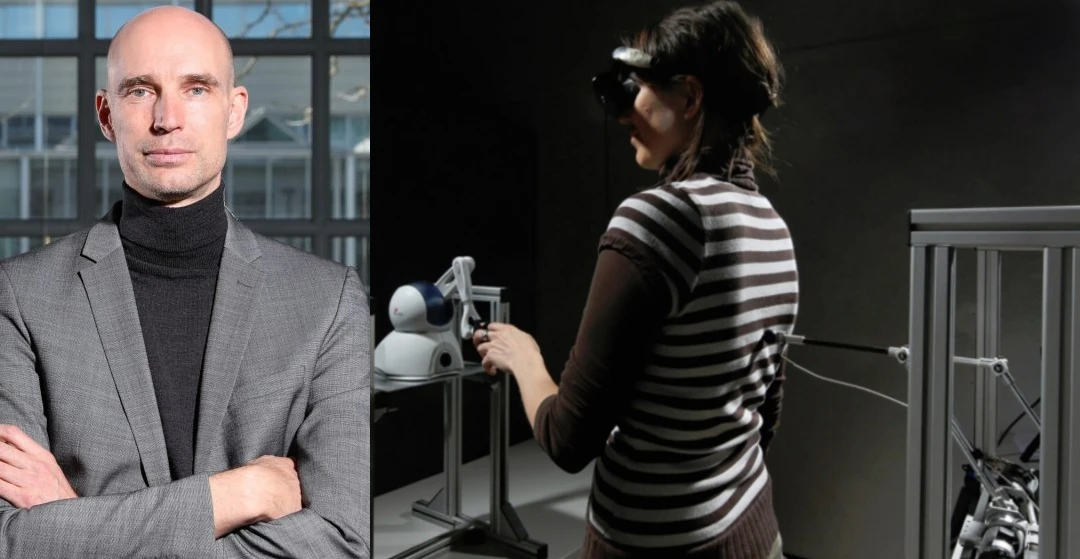
One of the most intriguing scientific explanations emerged in 2014, when neuroscientist Olaf Blanke and his team set out to study the phenomenon in a laboratory setting.
The researchers created a robotic setup where participants moved a device with their fingers in front of them, while another device simultaneously touched their back in sync with those movements.
When the touch and movement were perfectly synchronized, nothing unusual happened. But when the scientists introduced a slight delay between the hand movement and the touch on the back, some participants began to feel as if someone else was standing behind them, even though no one was there.
The brain itself was reinterpreting signals from the body, attributing some of them to another person. The researchers linked this phenomenon to a temporary disruption in how the brain integrates sensory and motor information about the body’s position, involving areas in the frontal-parietal, temporal-parietal, and insular cortices.
Put simply, our brains are constantly building a silent map to answer two basic questions: Where is my body? And which signals belong to me?
When this process is disrupted, something remarkable can happen: a part of the sense of 'self' is interpreted as coming from 'someone else.' Instead of feeling an extension of oneself, a person may sense the presence of a separate companion walking or standing beside them.
Why mountains and the poles?
If this idea holds true, then harsh exploration environments seem like the perfect laboratory for this phenomenon to occur.
Climbers and explorers may experience all of the following at once:
- Sleep deprivation.
- Extreme physical exhaustion.
- Cold, hunger, and dehydration.
- Prolonged isolation.
- Sensory monotony amid snow and fog.
- Psychological stress and fear of death.
- And lack of oxygen at high altitudes.
All of these conditions can disrupt normal perception.
A 2017 study led by Katharina Höffner at the Medical University of Innsbruck analyzed 83 documented incidents involving mountaineers at altitudes above 3,500 meters. The results revealed cases of temporary psychosis, hallucinations, and sensations of unseen presences. These symptoms typically disappeared once the climbers descended, which may explain why mountaineering memoirs are filled with accounts of imaginary companions, voices, and figures that vanish as soon as the danger passes.
Does the mind create a companion to help us survive?
But the neurological explanation alone doesn't answer the most intriguing aspect of the phenomenon.
Why does this presence often seem friendly in so many accounts ?
Rarely is the 'third person' described as an attacker or a monster chasing the survivor. On the contrary, the companion often appears calm and reassuring, sometimes walking alongside the person or encouraging them to keep going.
This has led to an intriguing psychological hypothesis: in some cases, the experience may serve as a coping mechanism in extreme survival situations.
Humans are deeply social beings who rely on others for support. When someone is completely alone, frightened, and exhausted, simply feeling that another presence is nearby can be enough to ease their loneliness and fear, helping them regain the ability to make decisions.
However, it's important to note that this idea remains a 'theoretical explanation' rather than a proven evolutionary mechanism that the brain deliberately activates to save a person. The mind doesn't just flip a switch called the 'third person' when death is near, despite what some popular internet sources might claim.
Most likely, what we're seeing is a complex interaction between the body, the brain, exhaustion, fear, sensory deprivation, and the surrounding environment.
An inner voice or an external presence?
This 'third person' presence doesn't always appear as a clear human figure. Some survivors don't see anything at all, but simply sense that 'someone is there.' Others hear a voice urging them to get up, move, or make a specific decision. Sometimes, the mysterious presence takes on a specific identity, a deceased loved one, a friend, or a figure with religious or spiritual significance.
This phenomenon overlaps with other experiences, such as hallucinations caused by extreme stress and near-death experiences, and distinct inner dialogues, but it doesn't exactly match any of them.
People who go through this experience are often fully conscious, making decisions and trying to survive, while this mysterious presence seems to accompany them in the same reality.
Between neurological and spiritual explanations
It's natural for some to see these stories as evidence of a guardian angel, the spirits of the dead, or an invisible force that appears in times of danger. For those who have lived through it, accepting that it was just a hallucination can be difficult, because to them, it didn't feel like a dream or fantasy, they genuinely felt that someone was there.
But neurological studies have shown something important: it's possible to create a strong sense of another presence, even in healthy people, simply by disrupting the way the brain integrates signals from the body and movement.
This offers a possible explanation for much of the phenomenon, but it can't account for what each person felt in every case, or why the 'presence' sometimes takes the form of a specific individual or brings a deep sense of comfort and meaning.
Science can study how the sensation arises, but the question of what it means to the person experiencing it is much more complex.
When the self splits in two
The third person syndrome may be one of the strangest windows into the nature of human consciousness. We tend to think of our sense of 'self' as something fixed and unquestionable, but these experiences reveal that our feeling of being a single person in a single body is actually a highly complex construction, built by the brain moment by moment. In extreme situations, the boundaries between inside and outside, between 'me' and 'the other,' can blur.
About the Author