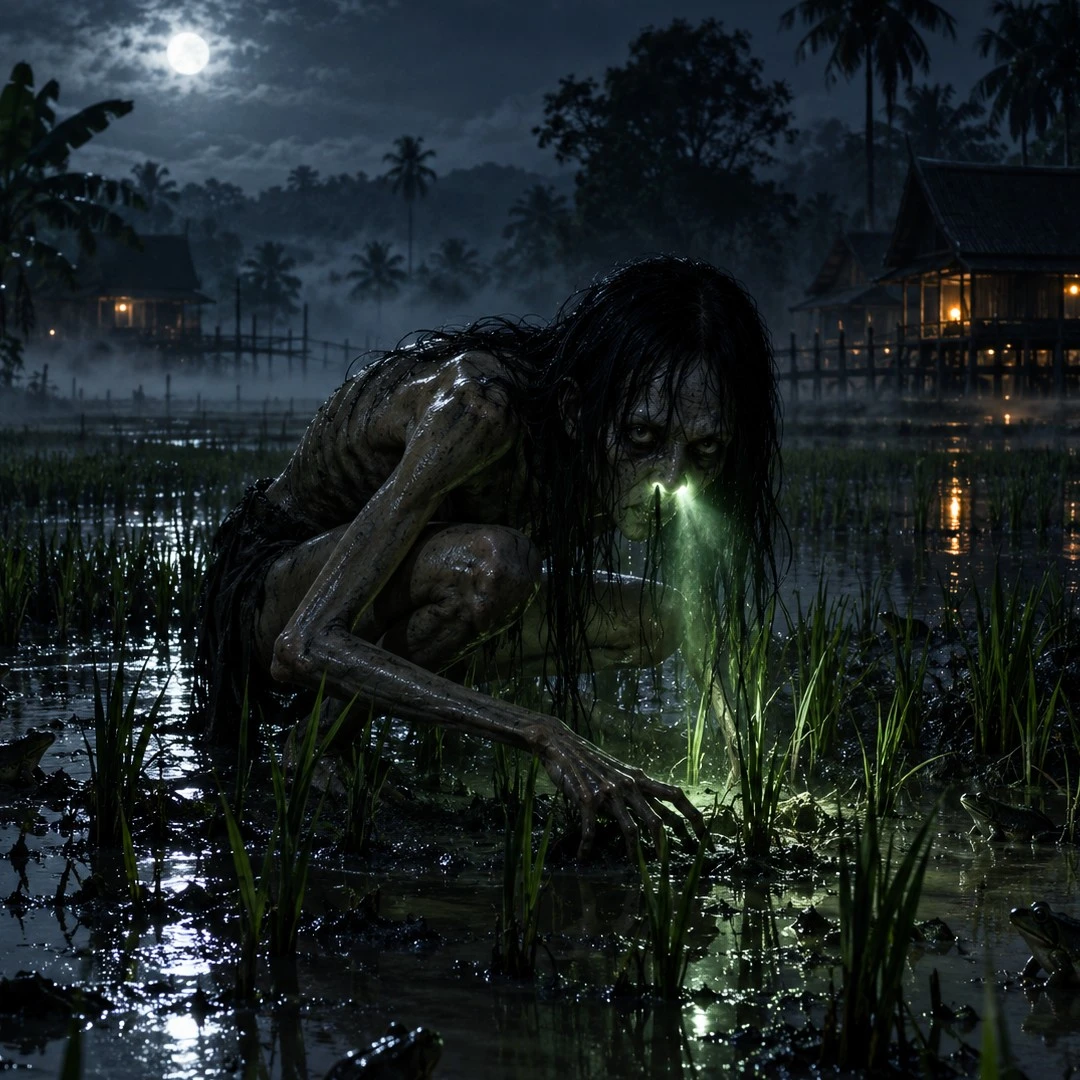
On dark nights in the Thai countryside, especially when a gentle rain falls over the rice fields, local legends tell of a mysterious light drifting across the swamps. Sometimes, it draws near to wooden houses, only to vanish before dawn. In the past, villagers believed this was no ordinary fire, but a sign of a supernatural being known as 'Phi Phong', an evil spirit that inhabits the body of a human, blending in unnoticed among the community.
The story becomes even stranger when you learn that, according to local beliefs, this creature isn’t a typical ghost returning from the dead. Instead, it could be a neighbor or relative who lives a completely normal life by day, but is compelled by a mysterious force to roam the night in search of food no human would desire.
So where did this legend originate? Why is the creature associated with lights, rain, and frogs? And how did people in Thailand imagine the curse being passed from one person to another?
Origins of the Legend in Lanna Culture
In Thai, the creature is called Phi Phong (ผีโพง), and sometimes appears as 'Phi Phrong' (ผีโพรง) in local dialects. Its folkloric home is the Lanna region, a cultural and historical area covering much of northern Thailand, especially Chiang Mai and its surroundings.
Belief in spirits was a central part of daily life in Lanna. People thought some spirits protected homes and villages, while others inhabited trees and fields, and some were malevolent, bringing illness or misfortune. These beliefs blended with Buddhism and local traditions, creating a rich world of invisible beings and rituals meant to appease them or ward off their harm.
Within this world, Phi Phong stood out as a being unlike the spirits that haunt abandoned places or appear as the dead. The core of the legend is that the creature can live inside a living person, who continues to look and act completely normal within the community.
A 2021 publication from the Office for the Promotion of Arts and Culture at Chiang Mai University describes Phi Phong as a spirit that possesses a person, driving them to go out at night in search of raw animal matter especially the sticky secretions of frogs and toads.
This connection between human and possessing spirit is similar to some other Asian folklore creatures, where the line between human and monster is blurred. The belief is that a person can become a source of evil without any outward change in appearance.
How does someone become a Phi Phong?
Folk tales don’t offer a single explanation for the origin of Phi Phong, but rather a variety of stories reflecting the diversity of beliefs across villages and regions.
In one version, the condition is hereditary, a person is born into a family with a history connected to the creature, inheriting a mysterious force they can’t easily escape. In another, someone becomes a Phi Phong by accepting a gift from a suspected host, as if the present carries the curse or allows the spirit to transfer to its new owner.
A third explanation ties the fate to actions in a previous life, echoing the popular concept of karma. In this view, becoming a Phi Phong is punishment for an old wrongdoing the person no longer remembers.
Other stories mention practitioners of black magic who sought supernatural powers but failed to control them or broke the rules of their craft, resulting in the powers turning against them and transforming them into beings possessed by forces they can no longer master.
These different explanations reveal an important aspect of the legend: becoming a Phi Phong isn’t always a matter of choice. It can be seen as a spiritual illness, a family curse, or a supernatural punishment, ideas that echo tales of possession and inherited curses found in other cultures.
The Magical Plant That Grants Mysterious Powers
One of the strangest stories linked to the creature involves a plant called 'Wan Phi Phong.' This tale is part of Thai folk beliefs about magical plants.
Some stories describe this plant as having white parts and a sharp smell or taste. When it matures, it reportedly develops unusual properties, including a strange glow. This glow is sometimes attributed to a mercury-like substance or an inner force within the plant.
According to these tales, some practitioners of magic would plant it near their homes to use its supposed powers in rituals and spells. However, mishandling the plant could have consequences—those who did so might gradually transform into a 'Phi Phong.'
Other accounts link the mysterious light seen on the creature’s body to this plant, suggesting it’s the source of the power that possesses and changes a person. These details shouldn’t be taken as botanical or chemical facts—there’s no reliable scientific evidence for a plant with such supernatural abilities, and the folk name alone isn’t enough to identify a known species. Instead, the story reflects the longstanding connection between mysterious plants and magical practices in local folklore.
A Double Life: Day and Night
In the most common version of the legend, someone inhabited by 'Phi Phong' appears completely normal during the day. They might be a farmer, a neighbor, or a family member, showing no obvious signs of their secret. But at night especially on dark, rainy nights, their hidden nature begins to emerge.
One story tells of how, before leaving home, the person arranges pillows under their blanket to look like someone sleeping. Then, using magical powers, they put the rest of the family into a deep sleep so no one notices their absence.
Next, they head to the wooden staircase, rubbing their nose against the steps until a strange light begins to glow from their face. Once the light appears, they slip out into the fields and marshes.
The stories describe the light as white with a greenish tint, flickering and moving in the darkness. From a distance, it’s about the size of a grapefruit. Some tales even mention tiny sparks falling from it as the creature moves along the paths between rice fields. This glowing light is the most distinctive feature that sets 'Phi Phong' apart from other legendary beings in Thai folklore.
Why Does It Feed on Frogs and Toads?
One of the strangest parts of the legend is that 'Phi Phong' doesn’t crave human blood or flesh, but rather the slimy substance covering frogs and toads. According to the stories, it goes out at night to the flooded fields, catches these animals, and sucks out their secretions before tossing their bodies aside. Some storytellers imagine that finding dead frogs without visible wounds could be a sign of its presence. Other local tales say it might also eat raw fish, waste, or decaying matter, though these details vary from region to region.
The connection between the creature and frogs makes sense both environmentally and culturally. Wet fields and marshes are full of amphibians, especially during the rainy season. In the old rural nights, with little light and poor visibility, mysterious sounds and movements in the fields provided fertile ground for supernatural stories.
Returning to bed before dawn and acting as if nothing happened in the morning, 'Phi Phong' leads a double life, hiding its mysterious nature behind a familiar human face.
What Happens If Someone Discovers Its Identity?
Folk tales offer a clear warning: if you encounter 'Phi Phong' during its nightly wanderings, don’t call its name or try to expose it. Instead, quietly walk away. The creature, according to belief, feels shame and fear at being discovered, and may try to harm or appease anyone who learns its secret.
Some stories claim that the witness is offered money or gold in exchange for their silence, but the gift later turns out to be nothing more than stones or clumps of dirt. Only then does the person realize they've been deceived by a supernatural force. Another, even more unsettling version suggests that anyone who sees 'Phi Phong' might inherit its condition after the creature dies, as if the curse is passed on by chance from its original host to an unsuspecting bystander.
Here, the legend shifts from a tale about a creature searching for food to a social warning: a caution against uncovering secrets that are best left hidden, and against confronting forces believed to be lurking behind human appearances.
His method of revenge: a banana stalk thrown onto the roof.
People's fears weren't limited to seeing the creature in the fields; they also worried about its revenge on anyone who tried to expose or harm it. One of the strangest stories claims that if someone flipped over the wooden ladder of a house where 'Phi Phong' lived while it was out at night, the creature would be unable to return inside. If it discovered who was responsible, it might retaliate in a supernatural way.
According to the tale, it uses a long banana stalk or a heavy wooden pole, hurling it onto the roof of its enemy's house. This act is believed to bring illness or death to the residents. This belief wasn't just part of a scary story, it also became a household warning passed down through generations. People were advised not to leave long banana stalks intact after removing the leaves, but to cut them into small pieces so that evil spirits couldn't use them.
As strange as this idea may seem, it reflects a common function in folklore: supernatural stories become guidelines for everyday behavior, turning ordinary household chores into symbolic ways to ward off evil.
Does it have a single form?
There’s no universally agreed-upon appearance for this creature. Descriptions vary from one region or village to another. Some stories say it’s a woman possessed by a strange spirit, others describe it as a man. Some accounts mention a greenish-white light coming from its nose, while others say the light is red or doesn’t appear at all. There’s also disagreement about its diet: some say it feeds only on frog secretions, while others claim it craves various animal substances or decaying remains. This diversity suggests we’re not dealing with a mythological figure defined by a single sacred text, but with a long oral tradition whose details have changed and evolved as stories were passed down through generations and across regions.
It's important not to confuse 'Phi Phong' with other figures in Thai folklore, such as 'Phi Pop,' which is associated with possession and predation, or 'Krasue,' often depicted as a flying woman's head trailing internal organs.
These creatures share themes of possession, unnatural hunger, and nighttime appearances, but each is distinct, with its own local stories and traditions.
A village still haunted by ghostly memories
The legend of 'Phi Phong' hasn't completely faded with urban development and social change in Thailand. Its traces remain in place names and stories told by the older generations.
In September 2016, Thai media reported on a residential area known as 'Ban Nong Phi Lok,' which translates roughly to 'Ghost Swamp Village,' located in Nakhon Ratchasima province.

According to a 77-year-old local resident, the name has been passed down for generations and is linked to an old swamp that once bordered a road used by traditional carts.
He recalled hearing from his ancestors that travelers often saw mysterious lights near the swamp, believed to be caused by creatures like 'Phi Phong' and 'Phi Bong.' Some passersby were reportedly chased or frightened, leading people to avoid the area at night.
Over time, the popular name became the official name of the settlement, even though the old swamp has since dried up and the landscape has changed.
This story doesn't prove the existence of supernatural beings, but it does show how legends can leave a lasting mark on a place, with the fears of past generations becoming part of a community's inherited identity.
Mysterious lights in the fields: between belief and scientific explanation
The mysterious lights are perhaps the most intriguing aspect of the 'Phi Phong' legend, as they connect the creature to a tangible phenomenon that people claim to witness unlike many spirits that leave no visible trace.
However, simply seeing a moving light in the dark isn't enough to prove the existence of a supernatural being. Various natural or human-made sources can create lights that seem mysterious from a distance, such as fireflies, light reflections, handheld lamps, and other sources that are hard to identify without examining the circumstances.
Directly linking these sightings to swamp gas or spontaneous combustion requires independent evidence and can't be considered a universal explanation for every account.
A 2025 report by Thai PBS, Thailand's public broadcaster, noted that popular entities like 'Phi Phong' lack clear scientific evidence for their existence. The report emphasized that interpreting mysterious lights or objects requires careful examination of their characteristics and the conditions in which they appear, rather than attributing them to supernatural forces.
From a psychological and social perspective, expectations and prior beliefs can shape how people interpret mysterious sightings. Someone raised on stories of 'Phi Phong' might see an unexplained light in a dark field as confirmation of what they've heard since childhood, while another person might look for a natural or human-made source.
In this way, the legend can persist even as the circumstances that gave rise to it change, because it becomes more than just a scary story, it serves as a cultural framework for making sense of the unknown.
A creature that frightens because it looks human
The most unsettling part of the 'Phi Phong' legend isn't the light shining from its nose or its bizarre eating habits, but rather the belief that an evil spirit could be hiding inside an ordinary person. The familiar face you see by day might lead a terrifying secret life after dark.
This idea helps explain the legend's enduring appeal, it ties the unknown to what is close and familiar: neighbors, relatives, even family members. It raises the unsettling possibility that everyday trust could turn into suspicion.
But this belief also has a social side. Fear of possession or spirits can lead to accusations against people who behave unusually or suffer from health or psychological issues. Traditions that help communities make sense of the unknown can also become a way to stigmatize individuals if stories are treated as fact.
The legend has recently resurfaced in modern pop culture through the series Delusion which premiered on Netflix in 2026. The show uses the idea of a creature inhabiting a human body to explore themes of dementia, memory, paranoia, and collective fear.

Ultimately, the 'Phi Phong' story offers a window into Thailand's world of folk beliefs, where spirits, magic, and nature intertwine in tales passed down through generations. Sometimes, a mysterious light flickering over a rice field was enough to spark a legend that would outlast the night it first appeared.
About the Author