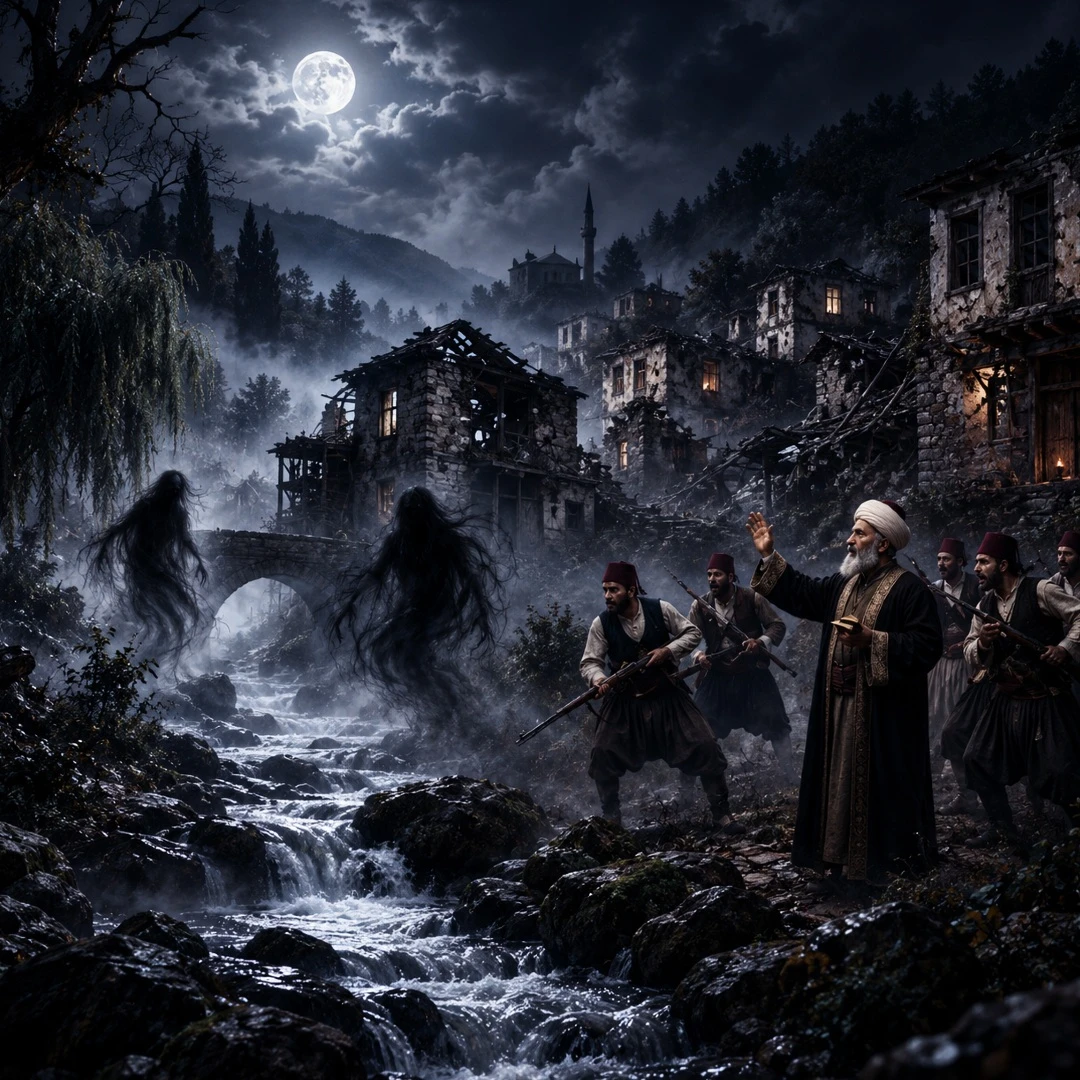
In one mysterious tale dating back to the late Ottoman era, the people of Çınarcık weren’t afraid of cemeteries or abandoned houses, instead, their fears centered on a stream that flowed past an old mill.
According to the story, some who ventured near the stream after dark returned home completely changed. Some suffered nervous breakdowns, others were suddenly paralyzed or bedridden, and a few began to speak and act in ways that terrified their families.
As these incidents became more frequent, the villagers started to believe that something beyond ordinary illness was at play.
The Night at the Mill
The story recounts that the villagers called on a man known as Salih Efendi, who was famous for dealing with cases people believed were caused by spirits or possession.
He set out at night toward the mill, accompanied by about ten armed men. There, according to the tale, they saw two mysterious shadows shifting shape in the darkness.
One of the men tried to fire his gun, but it suddenly jammed. He then began screaming and acting wildly, only calming down after Salih Efendi recited prayers and verses over him.
The men thought the danger had passed, but what happened the following night was even stranger.
When Dozens Collapsed
The story goes that a large group of villagers gathered near the stream, perhaps out of curiosity or to make sure the area was safe. Suddenly, around 35 people began screaming, convulsing, and losing control of their bodies, some even started to harm themselves until the village imam intervened and recited verses from the Quran over them.
Some versions of the tale add that Salih Efendi later tried to "bind" the alleged entity to a person. After that, families began to leave the area one by one, until the village was deserted.
But when we step away from the story and look at the historical record, a different picture emerges.
A Village Truly Lost
Çınarcık itself hasn’t disappeared; today, it’s a populated area in Yalova province on the coast of the Sea of Marmara. Nearby, however, there was once an old village called Engere, located within the same region. Remnants of a settlement, a church, a sacred spring, and some ancient structures still remain. Notably, Engere suffered a disaster in the late Ottoman era.
In December 1895, a severe cholera outbreak struck the village. Ottoman records indicate that around twenty people died within just two or three days, and the death toll eventually rose to 25 out of 32 infected.
The outbreak alarmed authorities because of Yalova’s proximity to Istanbul. The village was quarantined, and medical teams, medicines, and sanitation equipment were sent in. Later sources describe Engere as a village that suffered such extensive destruction it became uninhabitable.
This raises an intriguing possibility: could memories of the epidemic, death, and the villagers’ departure have blended with other local stories, eventually evolving into tales of a 'curse' and mass possession?
Why the mill and the stream?
The presence of a mill and water in the story isn’t unusual in Anatolian folklore. In Turkish popular beliefs, mills, streams, springs, and isolated places at night are often associated with spirits and supernatural beings. Early 20th-century researcher George Edward White documented Anatolian tales attributing illness, madness, and paralysis to these hidden entities, often placing them in similar settings. Turkish folklore also holds that some mills are inhabited by spirits at night, and that approaching these places after dark can be dangerous. So, the story’s setting fits perfectly with the region’s traditional imagination, regardless of whether the events themselves are factual.
Can mass possession be explained?
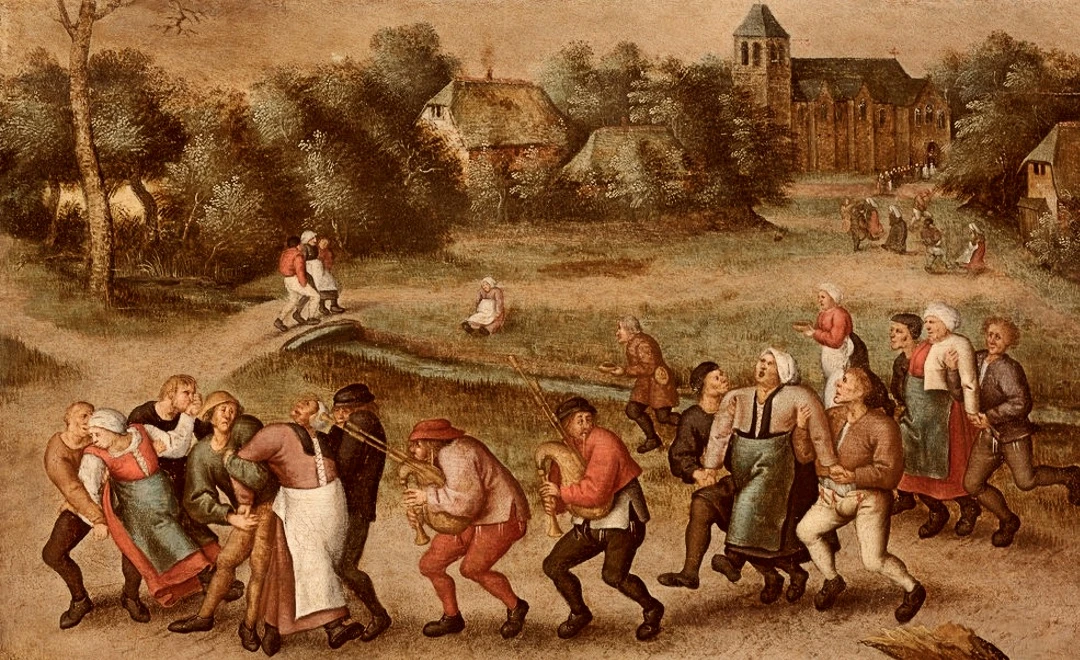
If dozens of people really did collapse, there’s a well-known medical phenomenon called Mass Psychogenic Illness. In such cases, real physical symptoms appear among groups of people, without any clear organic cause. Symptoms can include convulsions, trembling, dizziness, numbness, weakness, and involuntary movements.
This doesn’t mean the sufferers are faking; the symptoms occur involuntarily. Fear, witnessing others collapse, and believing in an unseen threat can all contribute to the spread of symptoms within a group.
A recent, culturally similar case was documented in a Lebanese village in 2007 (the village’s name was withheld for privacy). It began with a 16-year-old girl experiencing episodes of shortness of breath, dizziness, numbness, and trembling. Similar symptoms soon appeared in seven other villagers. One family called in a spiritual healer who blamed an 'evil spirit,' while others speculated about toxic fumes or poisoning. After medical investigations involving the Lebanese Ministry of Health, researchers diagnosed the incident as Mass Psychogenic Illness, and the episodes stopped within about six weeks. Still, it’s essential to rule out organic causes, poisoning, or shared environmental exposure before settling on a psychological explanation.
Where does the truth lie?
The main problem is that the most sensational parts of the story lack any independent historical source. There’s no evidence so far for the involvement of Salih Efendi, armed men, mysterious shadows near the mill, a malfunctioning rifle, or 35 people being possessed in a single night.
On the other hand, there are real historical elements that can’t be ignored: an old village near Çınarcık, a deadly epidemic during the Ottoman era, rapid deaths, destruction, and the dispersal of the population, all set in a folkloric context where mills and streams have long been linked to spirits.
So, are we looking at a modern horror story built from elements of folklore, or a confused memory of a real disaster that later generations reinterpreted through their own beliefs and language?
There’s no document that settles the matter. Perhaps the real secret of the story lies in the space between history and legend: behind the tale of possession that can’t be proven, there’s a lost village, a real mass death, and a local memory that turned to spirits and curses to explain what it couldn’t understand.
About the Author