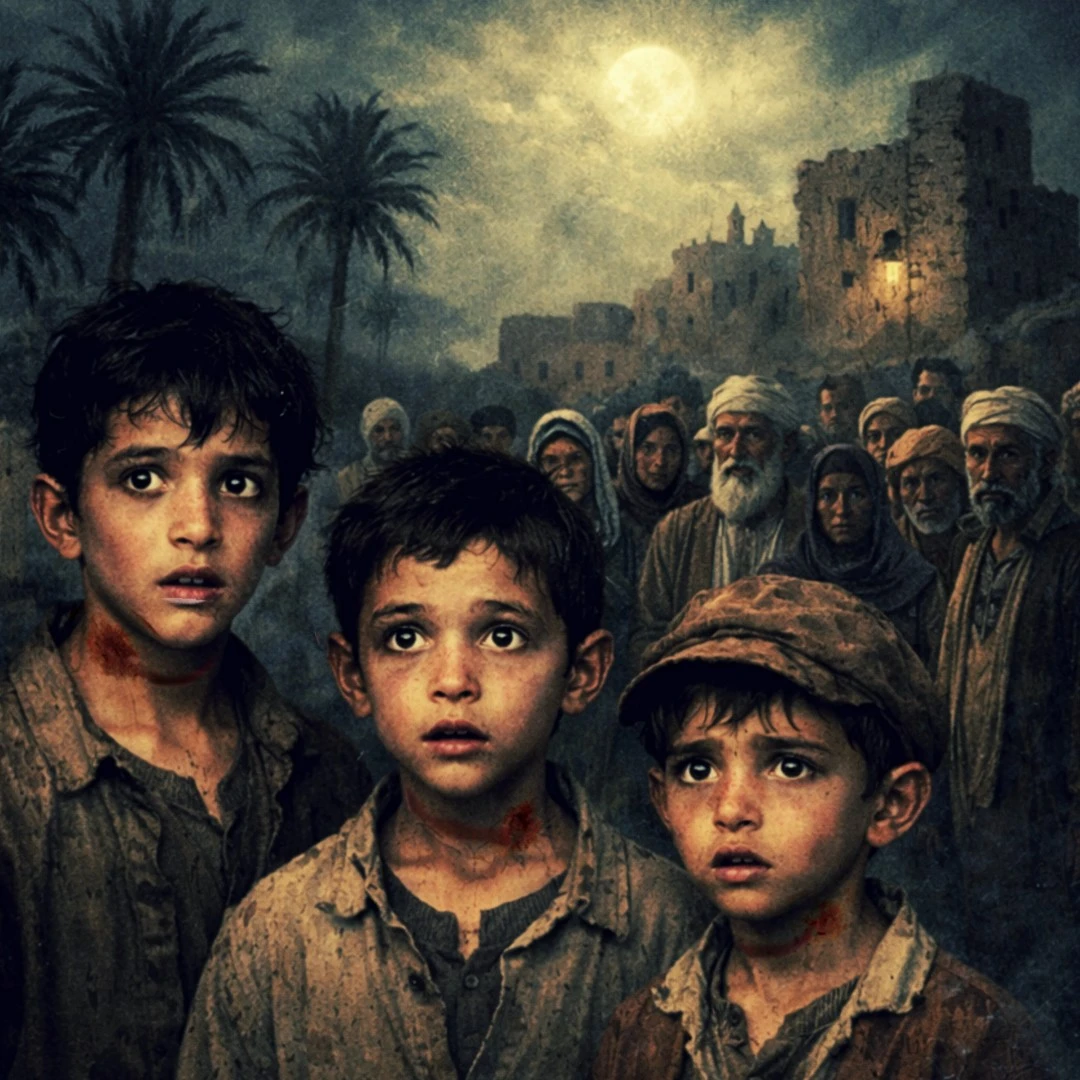
On the outskirts of certain Algerian oases, where the valley stretches across the land like a dry wound and palm trees mingle with the early morning mist, a story has lingered—told in hushed tones, as if it’s reluctant to be spoken aloud.
Locals say that three children, each of a different age, vanished in one of those valleys said to be 'inhabited.' A few days later, they returned. They didn’t scream or run to their families; instead, they emerged slowly from the depths of the valley, faces pale and eyes fixed on something no one else could see.
Villagers gathered around them—some reached out, others stepped back in silence, fear overtaking understanding. The children bore no visible injuries, no signs of struggle, but one detail turned whispers into panic: red marks encircled their necks, as if left by an invisible collar or a tight grip. A doctor was called to examine them, but he left quickly and refused to explain what he had seen. Since then, people mention the valley only with caution—if at all.
Between Story and Evidence: Where Do Doubts Begin?
Told this way, the story feels almost too complete—impressive and unsettling at once. It doesn’t just present a mysterious event; it unfolds with a careful narrative logic: disappearance, return, physical marks, a rational witness, and a heavy silence that lingers over everything. But when you try to treat it as a historical incident, cracks begin to show.
The timeline is usually set in the late 19th century and sometimes described as taking place during 'Ottoman Algeria.' But this doesn’t hold up to scrutiny, since Algeria was under French rule at the time. This isn’t a minor detail—it reveals that the story isn’t grounded in historical accuracy, but rather in a general sense of 'oldness,' a feeling often used in modern tales to give them a sense of authority they don’t actually possess.
The location is equally vague—sometimes called an 'oasis,' other times a 'valley,' but never with any specific geographic details. There’s no clear village name, no administrative record, not even conflicting accounts as you’d expect with real-life incidents. This ambiguity adds to the story’s eerie atmosphere, but it also weakens its credibility as a documented event.
An Almost Too Perfect Structure
What stands out about this story isn’t just what it tells, but how it’s told. It feels assembled from familiar elements of horror fiction: missing children, an unsettling return, a physical mark, a fleeing doctor, and a place people are afraid to name. This isn’t random—it closely resembles a ready-made narrative template.
In real-life cases, details are usually messier and less polished. Contradictions emerge, testimonies vary, and not every detail fits the plot. Here, though, every element falls neatly into place, as if the story was crafted to be told rather than recorded. That doesn’t necessarily mean there’s no distant origin, but the version we have now feels more like a modern retelling than an old record.
The Mark on the Neck: Physical Evidence or a Key to Imagination?
The detail of the red marks around the necks is what gives the story its strongest visual and psychological impact. These marks serve as tangible evidence suggesting that what happened wasn't just imagined, yet they remain mysterious enough to invite every possible interpretation.
Popular belief might see these marks as signs of a 'possession' or pressure from an unseen entity, while medical explanations could point to things like strangulation, spasms, or even insect bites. In stories like this, the mark isn't so much proof as it is a narrative device, creating a space between scientific and supernatural explanations.
It's precisely this space that allows the legend to endure, because it leaves every possibility open.
The Silent Doctor: A Witness Who Deepens the Mystery
The presence of a doctor in the story seems to lend it a sense of balance, as if to say what happened wasn't just mass hysteria. But the way this doctor is portrayed—as someone who saw something, fled, and refused to speak—feels more like a dramatic role than a credible eyewitness account.
In real historical context, you’d expect such a doctor to leave some trace—a report, a testimony, or at least a rumor attached to his name. His complete absence, despite being a central figure in the story, only strengthens the sense that this is a narrative device meant to heighten the mystery rather than resolve it.
Collective Memory: The Soil Where the Story Grew
Despite all these doubts, the story can't simply be dismissed as pure invention. It clearly resonates with deep elements of Algerian collective memory, where certain places—especially valleys and oases—are seen as anything but neutral, believed to be inhabited by invisible presences.
In this culture, fear isn't always tied to a specific 'being,' but often to the idea of the place itself—a threshold between two worlds. That's why tales of children who 'went there and came back changed' feel like a natural extension of this worldview, even if the specific incident never happened exactly as told.
Where Do We Stand?
Investigating this story leads to a conclusion that won't satisfy anyone looking for a definitive answer, but it's the most honest one: there's no evidence that this was a documented historical event, nor is there any official record to confirm it.
Even so, the story fits perfectly within a cultural context that sees certain places as sensitive boundaries between the visible and the invisible. That's the real power of this tale—it doesn't need to have happened exactly as described to leave its mark. It's enough that it reflects an old fear that still finds its way into modern storytelling, taking on new forms as it does.
About the Author