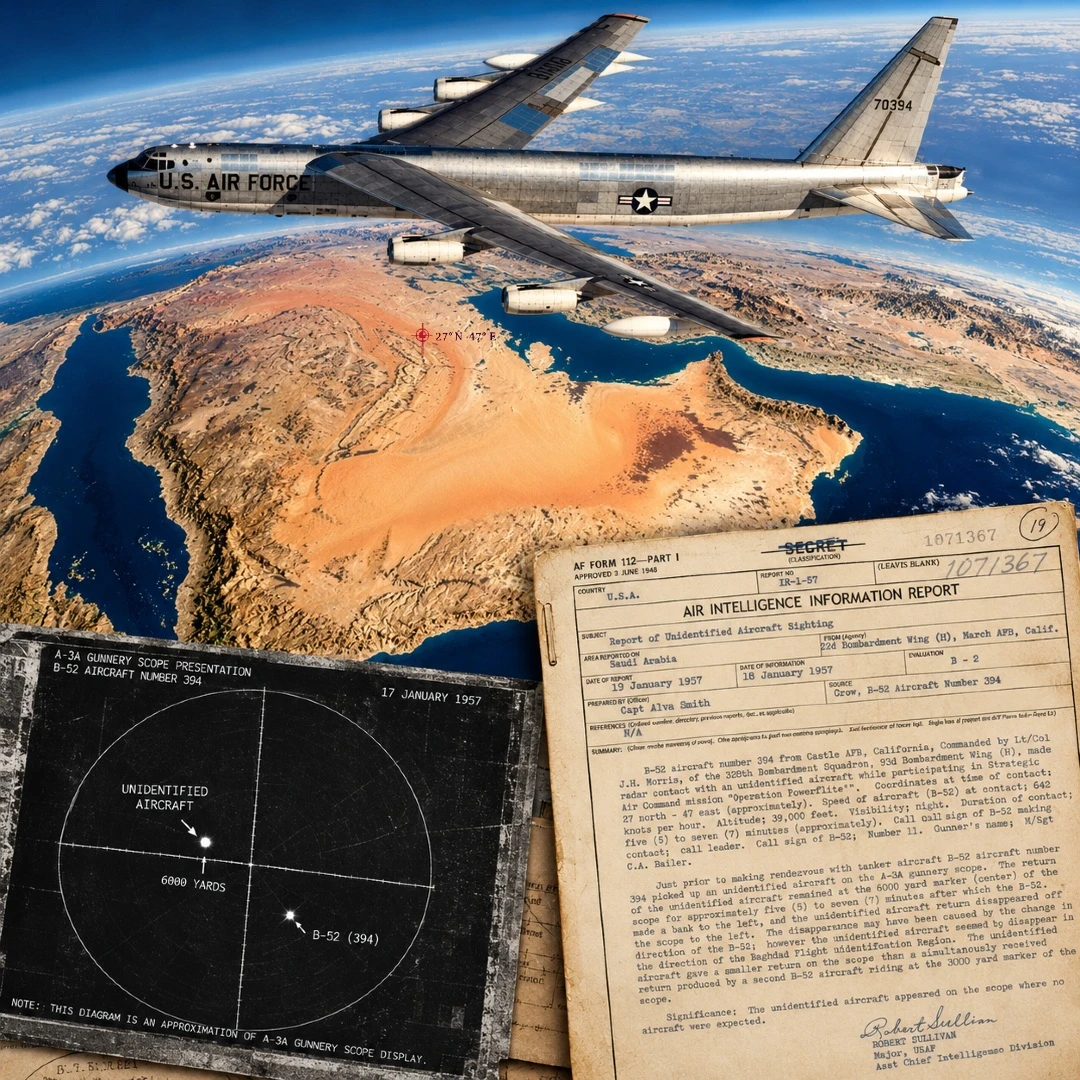
On the night of January 18, 1957, as a US B-52 bomber was flying over northeastern Saudi Arabia, its radar picked up an unidentified aerial target in an area where no other aircraft were expected.
The object remained visible for several minutes at a distance of about 5.5 kilometers from the bomber before disappearing after the plane made a turn. Nearly 69 years later, the US Department of Defense declassified an intelligence report that sheds light on this incident, which occurred during one of the most notable air missions of the Cold War.
The disclosure came as part of the seventh release of Unidentified Aerial Phenomena (UAP) files on October 23, 2026. Among them was a document labeled DOW-UAP-D155, titled 'Air Intelligence Information Report, Saudi Arabia, 1957', a five-page intelligence report prepared on January 19, 1957, just one day after the event.
Unknown Target During a Round-the-World Flight
The US bomber, tail number 394, was participating in a military operation called Power Flite, conducted by the US Strategic Air Command to demonstrate the B-52's ability to circumnavigate the globe without landing, relying on aerial refueling.
The mission began on January 16, 1957, from Castle Air Force Base in California, with five bombers taking part. Three of them successfully completed the journey, covering about 39,000 kilometers in 45 hours and 19 minutes.
As one of the bombers passed over Saudi territory, near coordinates 27°N and 47°E, its crew detected an unknown reflection on the rear A-3A radar screen.
The aircraft was flying at night at an altitude of 39,000 feet (approximately 11.9 kilometers), under the command of Lt. Col. J. M. Morris from the 93rd Bombardment Wing of the US Air Force.
According to the report, the unidentified target appeared just before the bomber was scheduled to rendezvous with an aerial refueling plane. The radar reflection stayed at the 6,000-yard mark—about 5.5 kilometers—for five to seven minutes.
For comparison, another B-52 bomber was also visible on the radar at the same time, but the unidentified target's reflection was smaller than that of the accompanying bomber. This doesn't necessarily mean the object was smaller, as radar reflection strength also depends on the shape, orientation, and materials of the target.
Disappearance Toward the Baghdad Airspace Zone
The object remained on radar until the bomber made a left turn, at which point it vanished from the screen. The report noted that this disappearance could have been due to the bomber's change in direction, but also mentioned that the object seemed to disappear toward the Baghdad air identification zone.
This observation is particularly significant because the incident took place near Iraqi airspace. However, the document does not provide independent evidence that the object actually entered that area.
The most striking statement appears in the intelligence significance section, where the report's author notes that the object showed up on radar in an area where no aircraft were expected.
The report was prepared by Captain Alva Smith, based on the bomber crew's account. It included a source and information reliability rating, indicating that the source was generally considered trustworthy and the information likely to be accurate.
Radar diagram from the classified document
The document does not include a photograph of the object or an original electronic radar recording. Instead, it contains a diagram illustrating what the crew saw on the A-3A radar screen, showing the unknown target's position relative to the accompanying aircraft.
This diagram helps visualize how the object appeared during the incident, but it doesn't provide enough information to determine its actual shape, size, or speed.
The document also does not indicate that the pilots saw the object visually; it appears the detection was limited to the radar screen. The published pages do not confirm that any follow-up investigation identified the object.
Was it really an UFO ?
From a documentation standpoint, the incident represents a contemporary military report of an unidentified radar target. However, it does not provide evidence of a craft with extraordinary characteristics.
Possible explanations include the presence of another aircraft unknown to the crew, an unusual radar reflection, or an effect related to the radar's operation and the bomber's movement. These remain interpretive possibilities, not conclusions established by investigation.
The fact that the radar return persisted at a specific distance marker does not, by itself, prove that the object was escorting the bomber or matching its speed. Additional information about its direction, movement, and original radar data would be needed.
Without that data, it's difficult to conduct an independent technical analysis of the incident nearly seventy years later. Still, the real value of the document lies in its preservation of a direct military account of an unusual sighting over Saudi Arabia during a highly significant strategic mission at the height of the Cold War.
While the identity of the object seen on the bomber's radar in January 1957 remains unresolved, the release of the report in October 2026 brought a forgotten incident back into the record of unidentified aerial phenomena, leaving an open question: What did the American bomber crew detect over Saudi Arabia nearly 69 years ago?
About the Author