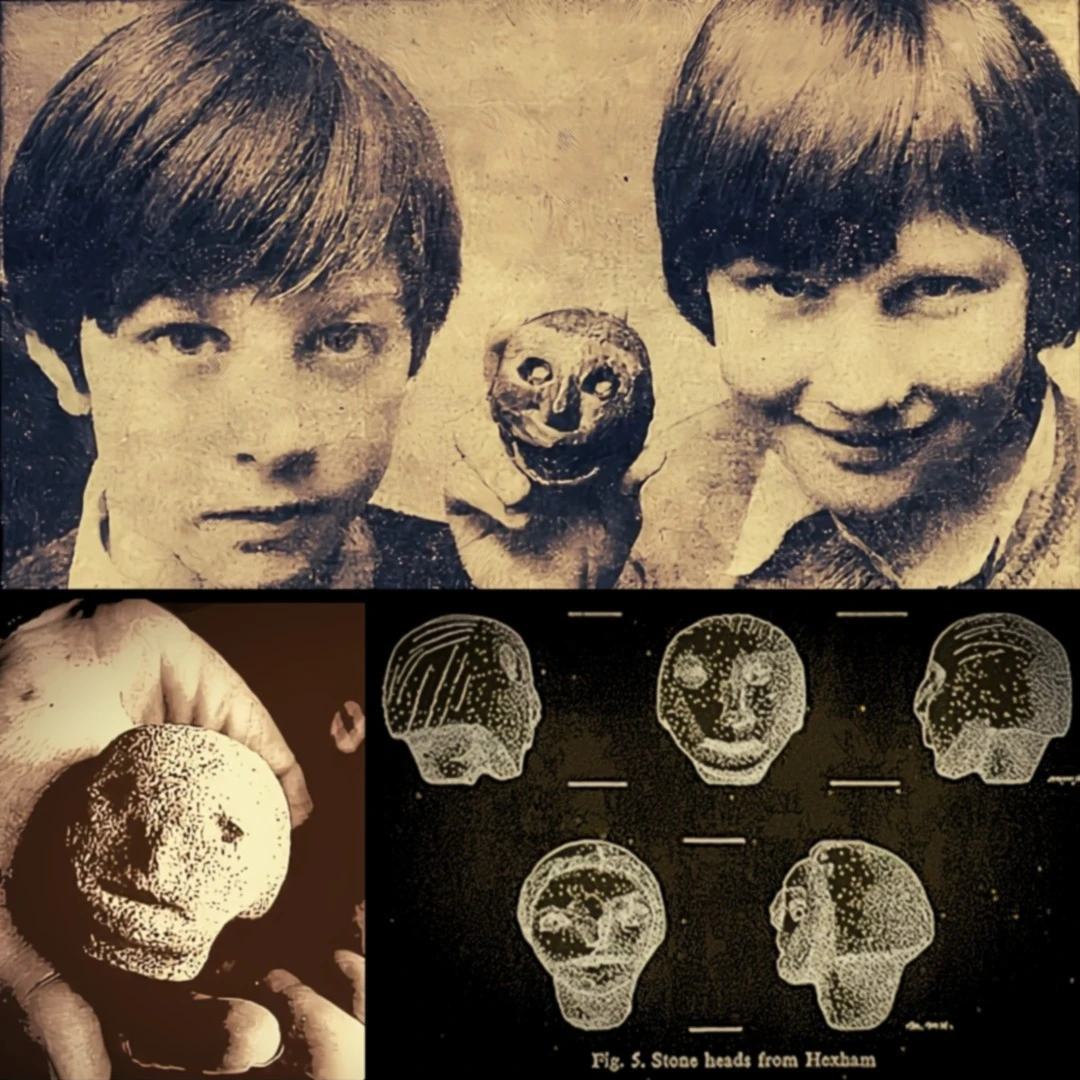
In the quiet northern English town of Hexham, a story emerged in 1971 that still gets mentioned whenever people talk about 'cursed objects.' Two children discovered two small heads buried in their garden, setting off a chain of strange events: objects moving on their own, sudden cold snaps, and sightings of a mysterious creature—half human, half animal. This isn't just a modern creepypasta; the story is rooted in a real historical incident. However, the 'curse' aspect remains highly debated. This investigation lays out the facts: What do we actually know? And what falls into the gray area between local legend and media sensationalism?
It all began with an innocent discovery in a family garden.
Most primary sources agree that brothers Colin and Leslie Robson were digging in their family’s garden in Hexham when they found two small heads, each about 6 centimeters in size. These artifacts later became known as the Hexham Heads. The town itself is no stranger to archaeological finds, being close to Hadrian’s Wall and other northern English ruins, so unearthing something buried was exciting but not unheard of—until the stories that followed.
When did talk of a curse begin?
After the heads were brought into the Robson home, the family reportedly experienced poltergeist activity: objects moving or being thrown (like bottles), and the heads themselves appearing to change position on their own. The most dramatic account came from their neighbors, the Dodd family. Mrs. Nelly Dodd claimed to have seen a creature—half human, half goat or ram—leaving the house at night shortly after the strange events began. This is when the story shifted from 'mysterious artifact' to 'ominous relic.' But remember: these are personal testimonies, not hard scientific or criminal evidence.
Expert involvement: Anne Ross steps in
The heads were later given to Anne Ross, an expert in Celtic antiquities. According to widely shared accounts, Ross and her daughter experienced a series of frightening incidents: sightings of a dark, half-wolf, half-human figure on the stairs or leaving a room, sudden chills, and doors slamming violently. The disturbances reportedly stopped once the heads were removed from the house.
This isn’t just hearsay—there’s academic documentation tied to the story. Most notably, Anne Ross published a 1973 article titled 'Some new thoughts on old heads' in the journal Archaeologia Aeliana (Series 5), which is frequently cited in discussions about the Hexham Heads.
Are the heads ancient relics or modern creations?
If the heads had been proven to be ancient Celtic or Roman artifacts, the public might have been even more convinced by the curse legend. But the opposite happened:
A man named Desmond Craigie came forward, claiming he had made the heads in 1956 for his daughter while living in the same house (or on the same property before the Robsons). He also said he made a third head, which was damaged and discarded. Additionally, an analysis attributed to Professor Dearman from Newcastle University concluded that the heads were factory-molded, not hand-carved.
This revelation doesn’t erase the haunting stories, but it does undermine the central pillar of the legend: the idea of an ancient pagan relic unleashing evil after being unearthed.
Television turns it into a national sensation
Had the story remained local, it might have faded into newspaper archives. But Hexham got what every legend needs to endure: a TV report.
A segment on the Hexham Heads aired on the program Nationwide in 1976. It became so well-known that for years, many believed the footage was lost—until it resurfaced in the BBC’s YouTube archive.
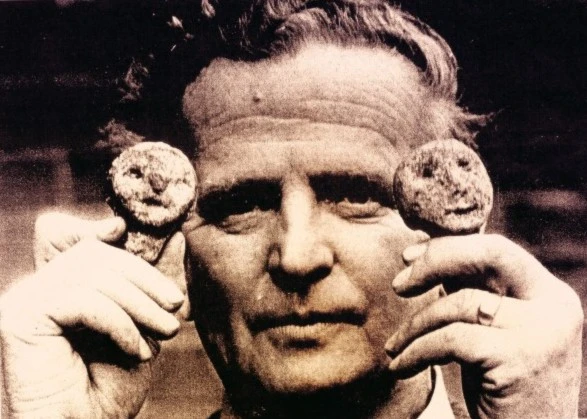
Decades later, the story made headlines again when the 'legend' of the missing TV segment was revived after it reappeared online around Halloween 2024, as covered by outlets interested in Britain’s 1970s horror history.
As a result, the story became more than just about two stone heads—it turned into a piece of collective memory shaped by the media.
The Skeptics’ Perspective
The cautious view—closer to strict journalistic standards—rests on three main points:
- The discovery itself is well-documented: two small heads appeared in 1971 and changed hands several times.
- The curse is based on unproven stories: scattered testimonies have grown over time, with some accounts only surfacing years later.
- The physical origin is highly questionable: claims from a possible maker (Craigie) and analyses suggesting they were manufactured or molded cast doubt on the idea that these are genuine ancient artifacts.
There's also a local prank story to explain the 'half-human, half-goat' sighting: perhaps it was just a drunken man carrying a stolen sheep carcass. This tale is often cited as an example of how a single unsettling event can spark an entire legend.
Why do some people believe it's 'more than just a story'?
On the other hand, those who support a paranormal explanation believe the case deserves attention because:
- Reports of strange phenomena came from multiple sources—not just one person, but the Robson family, neighbors, and later Anne Ross.
- Having a respected academic like Anne Ross involved (and a published article on the topic) lends the story credibility with the public, even if it doesn’t prove the curse is real.
- The power of television: many people remember the 'shock' more than the details, which is exactly how modern legends are born.
This is where the nocebo effect comes in: fear itself can create experiences—when people expect something bad, they start seeing ominous signs everywhere (creaks in an old house, a cold draft, random movements, etc.).
The facts are there... but there’s no solid evidence for a curse.
Yes, the incident happened: the 'Hexham Heads' were found in 1971, their journey is documented, and the story even made it to TV in the 1970s. The 'curse,' however, is a compelling and dramatic narrative—but it lacks scientific proof and thrives on a mix of personal testimonies, media hype, and the British fascination with the supernatural at the time.
Perhaps that’s why the story endures—not because it proves the existence of a hidden world, but because it shows how two small stone (or cement) heads, combined with a touch of fear, can become an immortal legend.
About the Author