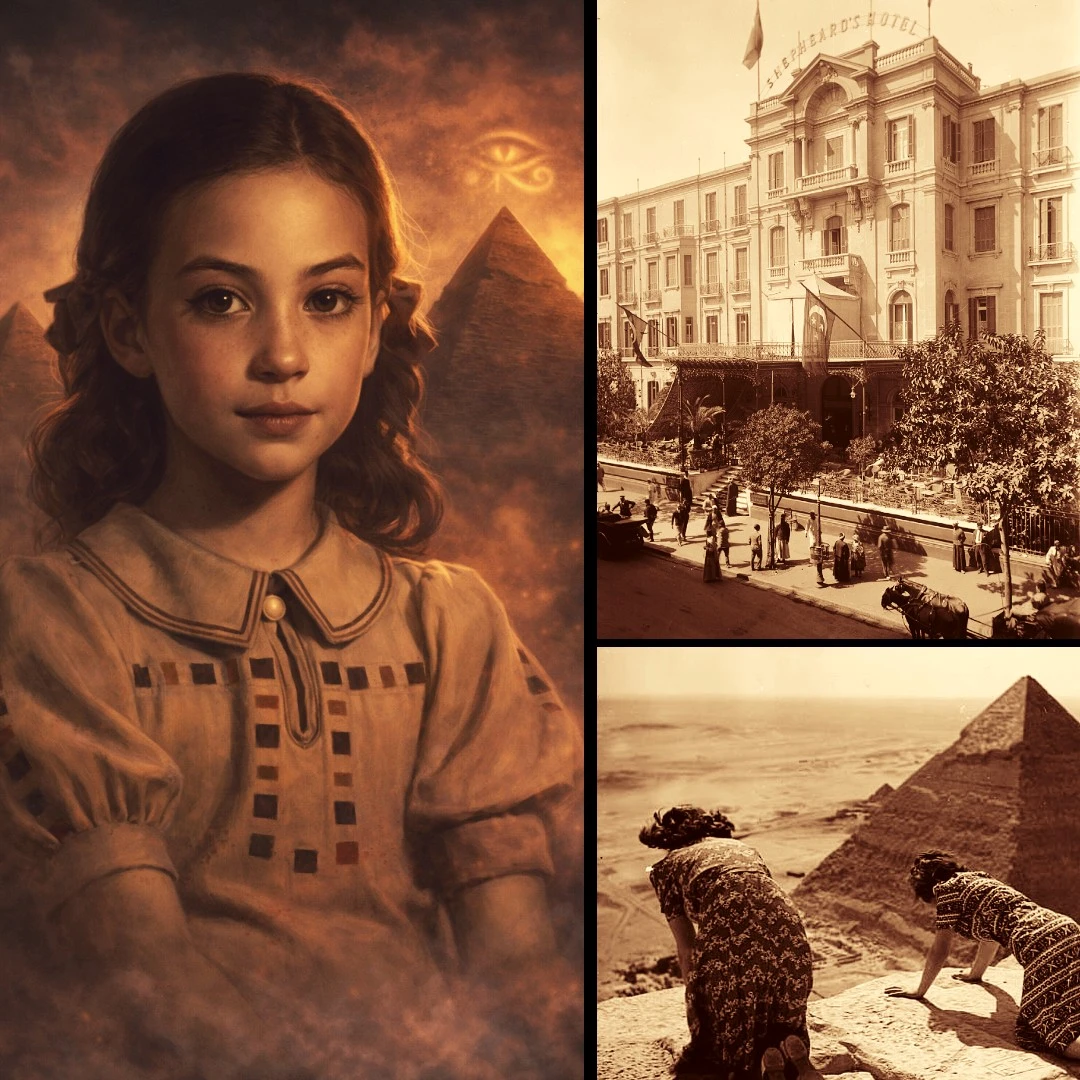
In the winter of 1938, a ten-year-old Italian girl named Rosanna Carmellini arrived in Cairo under highly unusual circumstances. This was no ordinary family visit or sightseeing trip; from the very beginning, her story seemed shrouded in mystery. According to some accounts, Rosanna displayed strange behaviors from a young age—speaking words in languages she had never learned, drawing unfamiliar symbols, and even showing knowledge of events before they happened. Those around her regarded her with a mix of suspicion and astonishment.
Rosanna wasn’t just an eccentric child, according to the story—she was said to possess abilities that baffled everyone who encountered her. Her relatives, especially her father Alfredo Carmellini, struggled to explain what happened on certain nights. The girl would speak in incomprehensible words, as if in languages she’d never been taught, then suddenly shift from crying to laughing in quick succession, before covering the walls with strange symbols unlike anything they’d seen before.
At school, the mystery only deepened. It wasn’t just that she excelled academically—there was something more. She was said to know the questions before they were asked and answered them with uncanny precision, as if reading from a prepared answer sheet. One of her teachers, Marco Balladini, described feeling as though Rosanna could see things invisible to others. He even recounted a bizarre incident where he found her exam papers already filled out in her handwriting before the test had even begun—a phenomenon impossible to explain by normal means.
As concern grew, an attempt was made to observe her under controlled conditions. She was placed in a locked, empty room. Yet after a short while, she was found standing in the center of the room, the walls around her covered in pyramid shapes, glowing eyes, and what appeared to be hieroglyphic-like writing—all drawn with a piece of charcoal that hadn’t been in the room to begin with.
Healing Rituals... and the Birth of a Legend
The story reached its peak when Rosanna was linked to a supposed healing ability. A relative, Father Federico Santini, was suffering from a malignant stomach tumor, and Rosanna requested to be alone with him. Inside the room, she began a strange ritual unlike any known medical practice: she fashioned a pyramid out of an Italian newspaper and placed it on his head, then circled the bed in a rhythmic motion, occasionally touching his body. She made a sound resembling a chant or sob, broke out in a heavy sweat, and her eyes widened dramatically.
This state lasted for several long minutes until, suddenly, silence fell. When the priest opened his eyes, he reportedly burst into tears, claiming he had been healed and that 'death had been lifted from him.' Whether true or not, this incident ignited controversy around Rosanna, casting her in some eyes as a supernatural phenomenon and in others as a potential threat that needed to be stopped.
As the commotion grew, the press began to give her striking nicknames, most notably 'the Pharaoh Girl,' alluding to her supposed connection to ancient Egyptian civilization. This label reflected how her case was framed as a mysterious blend of supernatural powers and the secrets of the pharaohs.
Exile from the Country
The story goes even further, claiming that under the rule of fascist leader Benito Mussolini, Italian authorities saw these phenomena as a threat or a deviation, accusing the family of practicing black magic. This led to their expulsion from the country. While it’s difficult to verify these details, they are a key part of the dramatic narrative that would soon lead the family to Egypt, where the most intriguing and mysterious chapter would unfold.
The Night Before the Mystery
The family settled at Shepheard's Hotel, a renowned establishment that, at the time, was a gathering place for European elites and travelers. That night, something in Rosanna’s behavior seemed to change. According to accounts, she became strangely insistent on visiting the pyramids, as if some unseen force was compelling her to go there.
Her request was far from ordinary—it was more like an inner calling that couldn’t be ignored. The family agreed, unaware that this would be the last time they would see their daughter.
The next morning, the family went to the Giza plateau, where the Great Pyramid stood as it had for thousands of years, a silent witness to a civilization steeped in secrets. There, Rosanna began to climb the pyramid with confident steps, showing no fear or hesitation, as if she knew exactly where she was going despite the difficult ascent.
As she climbed, her companions stopped at a certain point, but Rosanna continued alone. That was the pivotal moment. She kept climbing until she disappeared from view, vanishing suddenly without a sound or trace. There was no fall to follow, no cry for help—just a sudden absence that left everyone present in shock.
The Recurring Dream... and the Double Disappearance
The strangeness didn’t end there. That same night, the story adds another layer: both of Rosanna’s parents reportedly woke up in terror after having the exact same dream. In it, they saw their daughter falling from the pyramid before vanishing into a mysterious light.
When they went to her hotel room, they were surprised to find she wasn't there, as if she had never returned at all. This overlap between her disappearance at the pyramids and what supposedly happened at the hotel created what could be called a 'double disappearance', a powerful narrative device, but one that also raises a lot of doubts.
A story that spread... with no clear origin
Over time, this tale began appearing in various books and articles. One of the most notable references came from writer Anis Mansour, who mentioned a mysterious young woman who came to Egypt and vanished under unexplained circumstances. There were also claims about supposed Italian articles covering the story, but these references have never been clearly documented or traced to any reliable sources.
This is where the story shifts from legend to investigation. The real question becomes not what happened, but whether anything happened at all.
Investigation
The Story’s Absence from Archives
Attempts to trace the story in historical archives whether in major Italian newspapers or the Egyptian press active at the time, turn up no evidence of a foreign child disappearing under such circumstances. This absence isn’t limited to a single source, but spans all available records, casting serious doubt on whether the incident happened as described.
An incident of this magnitude, involving a European child in a foreign country, would have been expected to attract significant media attention, especially given the political and administrative context of the era. The complete silence in official documents raises serious questions about the credibility of the story.
Mussolini: More Drama Than History
The claim that Benito Mussolini intervened in the story is one of its most dramatic elements, but also one of the weakest in terms of evidence. Known records from that period make no mention of families being deported for mysterious practices or accusations of witchcraft. The lack of any official documentation suggests this detail was likely added later to heighten the drama.
A Disappearance Like This Would Have Shaken Cairo
Given the nature of Cairo’s society in the 1930s, with its foreign presence and organized administration, it’s hard to imagine a foreign child vanishing without an official investigation or media coverage. Such an event would naturally have become a major public issue. The total lack of any reference to it suggests the story wasn’t known at the time, but surfaced later in a different context.
An Illogical Account of the Disappearance
A closer look at the story’s details reveals clear contradictions that undermine its credibility. The child is said to have disappeared at the pyramids during the day, yet later it’s claimed she was missing from her hotel room at night as if she was in two places at once. This timeline doesn’t make sense and suggests the story was later reworked or embellished for dramatic effect, at the expense of logic.
When a Published Story Becomes a 'False Truth'
While the story of Rossana Carmellini didn’t appear out of nowhere, it was cited in sources that seem credible at first glance, a closer look reveals an important contradiction. Details of the story were published in Akhbar Al-Youm newspaper on September 30, 1973, referenced by writer Anis Mansour in his book 'Spirits and Ghosts,' and even attributed to a supposed Italian article titled “The Pharaonic Child” in La Gazzetta di Milano in 1938.
But the presence of the story in these sources doesn’t necessarily mean it actually happened. The main issue is that these accounts appeared much later or without any verifiable archival backing, making it likely they’re not documentation of a real event, but rather retellings of an older story, or even a later creation of a legend that was passed down orally before being written down.
In fact, the history of journalism and books especially those dealing with the strange and supernatural is full of stories published as fact, only to be revealed later as exaggerations or pure fiction. Publication alone isn’t proof of authenticity; it can simply be a way to share an intriguing or sensational story, regardless of its accuracy.
This is precisely where the danger of such stories lies: over time, and with repeated publication in various sources, they become accepted as 'truth,' even though they were never based on solid evidence. The story of Rossana, then, doesn’t appear to be a documented historical event, but rather an urban legend that gained credibility through repetition, not through factual accuracy.
Why Do We Believe Stories Like This?
The power of this story lies in its narrative structure, which draws on familiar elements from mysterious fiction especially the trope of a child with unexplained abilities, a theme that recurs in many tales blending mystery and the supernatural. The Egyptian setting also plays a key role, as the pyramids have long been associated in the Western imagination with ancient secrets and hidden powers, making any story set there more believable.
The open-ended conclusion, with the disappearance left unexplained, leaves plenty of room for speculation and interpretation, a hallmark of stories that endure over time. As the story was retold in later periods, especially with the rise of the internet, it became part of what’s known as urban legend: stories that gain credibility through repetition, not through evidence.
Between Legend and Reality
When we piece together the threads of the story and compare them to historical facts, it becomes clear that the tale of Rosanna Carmelini’s disappearance lacks any documentary evidence to support it. What we have is a much later account, rich in dramatic detail but missing any contemporary proof.
Still, this story is a prime example of how modern legends are born where imagination blends with real elements to create a narrative that feels plausible, even convincing at times, despite the fact that it may never have actually happened.
Even though the investigation leads us to doubt, the allure of the story remains. Some tales endure not because they are true, but because they speak to that part of us that wants to believe there is something out there… that can’t be explained.
About the Author