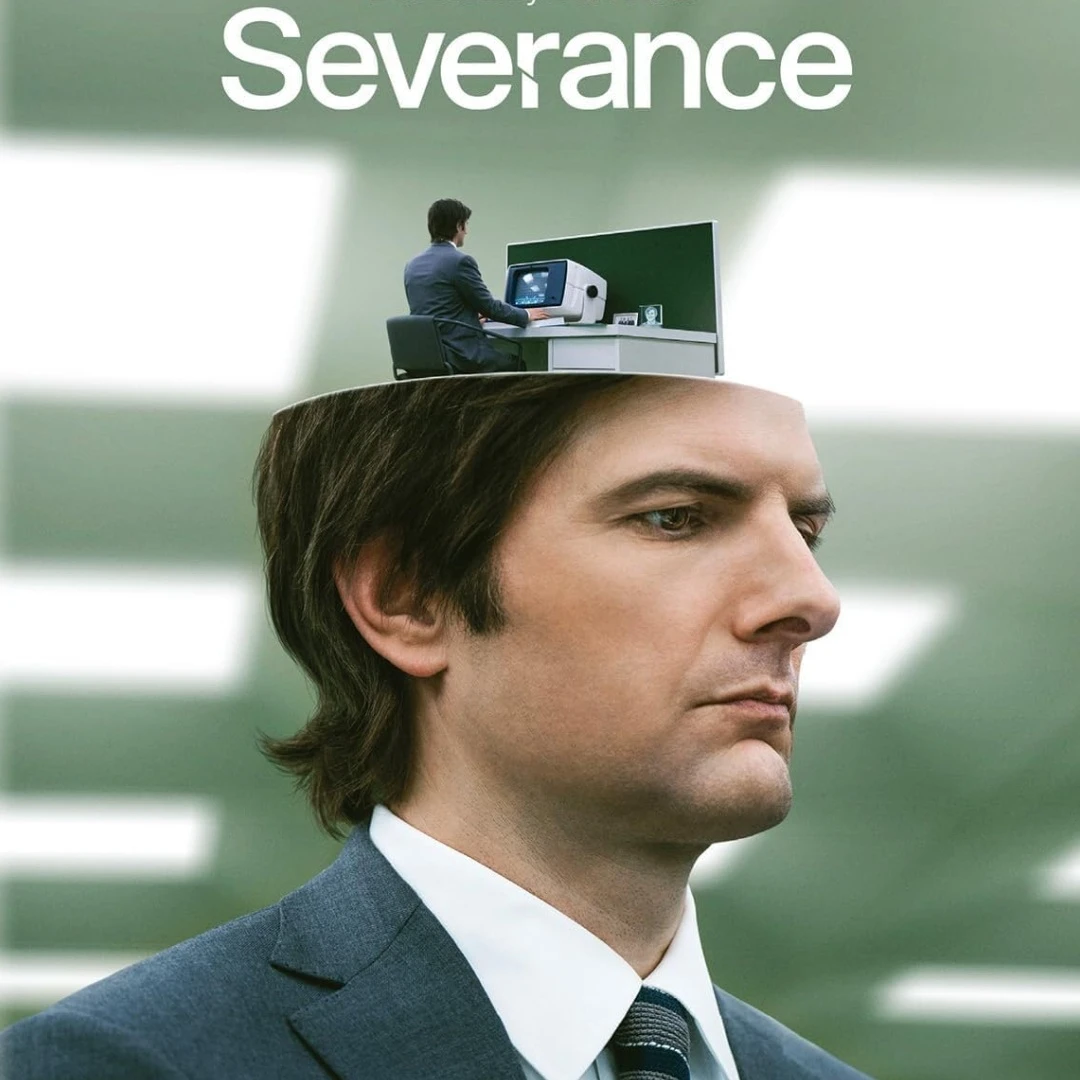
Imagine if science could split your consciousness into two separate identities, each completely unaware of the other. One lives your normal life, while the other knows only your workplace as if two different people inhabit the same body.
This bold concept is at the heart of the series Severance, an Apple TV+ original production with two seasons released so far and a third in the works for 2027. The story centers on a mysterious company called Lumon Industries, which develops a technology that implants a chip in the brain to separate memories into two distinct worlds. When an employee enters the company building, a new persona—known as the Innie, takes over, with no recollection of life outside work. Once the employee leaves, the Outie regains control, having no memory of what happened during work hours. The switch between these identities happens automatically at a specific point inside the building, transforming the employee from one person to another in an instant, while the body remains the same.
The company markets this technology as the perfect solution for work-life balance: employees leave their personal worries at home and don’t bring work stress back to their families. But the series quickly reveals that the implications go far beyond productivity, raising unsettling questions about control, freedom, and the very nature of identity.
Although Severance is rooted in science fiction, it draws on real issues explored in medicine and neuroscience. Dissociative Identity Disorder can cause a person to develop multiple identities that alternate control over behavior, though not as cleanly separated as in the show. Some split-brain patients—those who have undergone surgery to sever the corpus callosum connecting the brain’s hemispheres—have exhibited behaviors that led scientists to wonder if the brain can sometimes process information through two semi-independent systems. However, these cases don’t produce two fully separate personalities as depicted in the series; rather, they reveal just how complex human consciousness really is.
But the most intriguing questions are not medical, they’re philosophical.
If two identities share the same body, who is the real person? Do our memories define who we are, or is it our physical body? If the Innie commits a crime, falls in love, or endures years of suffering at work, does the Outie have the right to make decisions on their behalf, even though they know nothing about that life?
In this way, Severance becomes more than a show about the future, it’s a thought experiment that revisits an age-old question: what truly makes us who we are?
This idea takes on new relevance with the rise of artificial intelligence. Today’s smart systems often rely on independent 'agents,' each with its own memory, permissions, and tasks, all operating within a single framework. While these agents don’t possess human-like consciousness, they reflect a growing trend toward dividing knowledge and functions among separate entities, making Severance’s premise feel less far-fetched than it once did.
Science may not be able to split human consciousness into two distinct identities anytime soon, but the series succeeds in prompting us to ask something even more important than the technology itself. If one day we could separate, copy, or distribute memories among multiple identities, would we still be the same person, or would we be creating entirely new individuals within ourselves, without ever knowing them?
About the Author