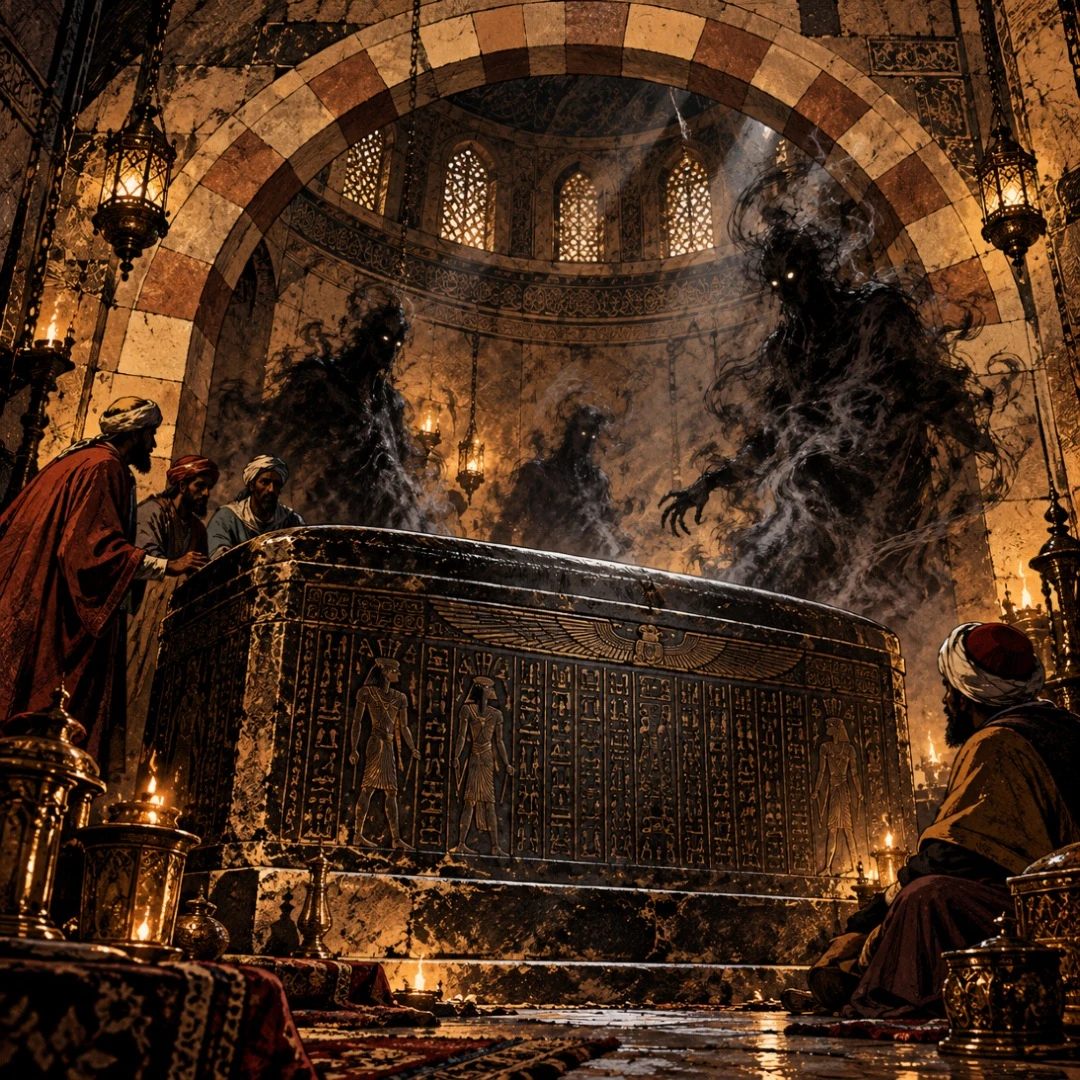
In one of Cairo’s old streets, there was a belief that a mysterious market would appear at midnight during the first ten days of Muharram in Islamic/Hijri Calendar, The vendors seemed ordinary, selling dates, fruit, bread, and pastries, but they were actually jinn disguised as humans. Anyone lucky enough to stumble upon the market and buy something would discover, after leaving, that their purchases had turned into pure gold.
This story isn’t just a modern urban legend. The British orientalist Edward William Lane recorded it in his famous 1836 book, "An Account of the Manners and Customs of the Modern Egyptians." Strangely enough, he even pinpointed the market’s location in front of an ancient Egyptian relic known as the "Hawd al-Marsud" (the Enchanted Basin), and linked its disappearance to the removal of this artifact from Egypt to Britain, where it remains today.
A Market Only the Fortunate Can See
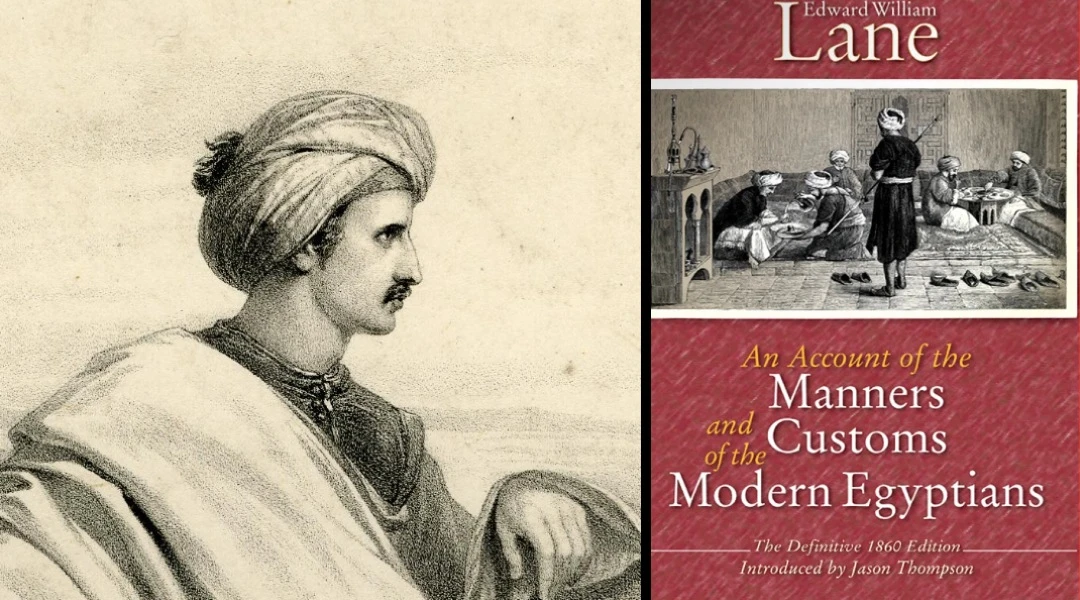
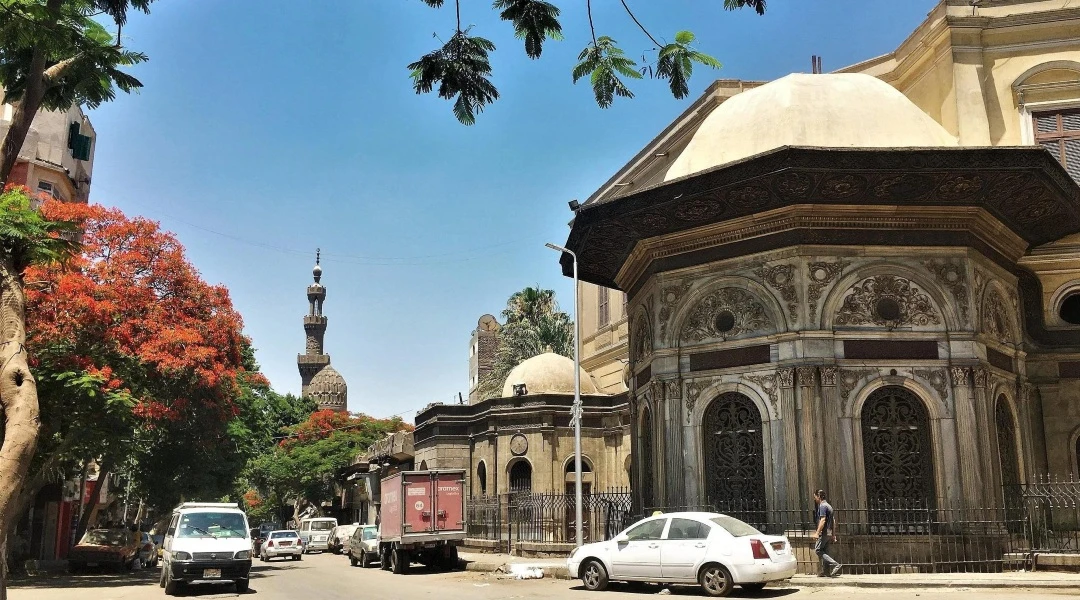
Edward William Lane lived in Egypt during the first half of the 19th century, studying the daily lives, beliefs, and customs of its people. In his chapter on annual celebrations, he recounts that some Cairenes believed in a jinn market that appeared on Saliba Street, south of the city, near a spot known as the Citadel of the Ram.
According to the tale, the jinn didn’t appear in frightening forms but disguised themselves as ordinary vendors, setting up their market in front of an ancient stone sarcophagus called the "Enchanted Basin." Anyone who bought food or fruit from them would find their purchase had turned to gold after leaving the area.
Lane noted an interesting detail: belief in this market wasn’t widespread. Some of his acquaintances told him that only a few people knew the story. He also mentioned that, according to local lore, the market stopped appearing after the Enchanted Basin was moved from its original location.
This story is part of a wider set of beliefs associated with the first ten days of Muharram, which Lane documented in the same chapter. Among them was the appearance of a jinn in the form of a water carrier who would knock on doors at night. If the homeowner asked where to empty his water skin and pointed him to a water jar, they would later find it filled with gold.
In another version, the jinn appeared as a mule carrying two saddlebags full of gold, with the head of a dead man on its back. The bells around its neck would ring as it approached a house. The homeowner was supposed to take the gold and refill the bags with straw or bran before letting the mule leave.
Popular imagination connected these visits to a kind of charity that the jinn bestowed on humans during the blessed days of Muharram. The market wasn’t the only source of mysterious wealth, it was part of a broader belief that hidden beings might choose to give money to certain people.
The Enchanted Basin: A Pharaoh’s Sarcophagus Shrouded in Legend
The Enchanted Basin wasn’t a figment of imagination, but a real Egyptian artifact dating back to around 600 BCE, during the 26th Dynasty. Made of dark granite, it was originally a funerary sarcophagus for an Egyptian official named Hapmen, decorated with hieroglyphs and funerary texts from the Book of the Dead.
Centuries later, the sarcophagus was repurposed as a water basin in Cairo, near the Mosque of Ahmad ibn Tulun and the Citadel of the Ram. Over time, it became the subject of stories attributing mysterious powers to it, the most famous being its supposed ability to cure those suffering from lovesickness.
This belief was known centuries before Lane’s visit. In the early 17th century, the Italian traveler Pietro della Valle visited Cairo and described a dark stone basin with strange carvings and an image of the Egyptian god Anubis, known as the "Lovers’ Fountain."
Locals told him that drinking its water would ease the pain of love. Amusingly, della Valle, who had recently suffered heartbreak, refused to drink from it, preferring to keep his feelings rather than lose them. He also noted that the water was murky and animals drank from it as well.

The healing legend wasn’t the only one linked to the basin. According to a story recorded by the Mamluk historian Ibn Iyas about the 10th century, there was a dark stone basin with bird-like carvings that was said to float miraculously on the Nile, ferrying people from one bank to the other. When the ruler Kafur al-Ikhshidi ordered it removed from the water for inspection, it lost its supposed magical ability.
Researchers and historians at the British Museum connect this story to the Enchanted Basin, though it’s impossible to say for sure that every tale about mysterious basins refers to the same artifact.
Stories also grew around the basin about hidden treasures beneath it, jinn guarding them, and a mysterious force preventing its removal. These beliefs were enough to turn an ancient funerary stone into a legendary source of healing, magic, and sudden wealth in popular memory.
How did the basin disappear ?

During the French campaign in Egypt from 1798 to 1801, the French seized a number of Egyptian antiquities, including the so-called 'Enchanted Basin.' After the French forces were defeated, many of these artifacts, such as the Rosetta Stone and the basin, ended up in British hands.
The basin eventually found its home at the British Museum in London, where it is registered as EA23. It measures approximately 274 centimeters in length and 140 centimeters in width.
This is where Lane’s story takes an even stranger turn: according to what he heard from Cairo locals, the Jinn Market stopped appearing after the basin was moved to Britain, as if its presence depended on the artifact remaining in its original place.
This connection offers insight into how legends form around certain places. When a landmark associated with mysterious powers disappears, people may explain the loss of those powers by the removal of the object itself. Over generations, such artifacts become focal points for collective memory, blurring the lines between history and belief.
Interestingly, the name 'Al-Hawd Al-Marsoud' has remained alive in Cairo, later becoming associated with a hospital in the Sayyida Zeinab district known for treating skin and venereal diseases. Meanwhile, the original sarcophagus stayed far from the city that spun so many tales around it.
Harnessing Jinn in Popular Belief
In Egyptian folklore, the relationship between humans and jinn isn't limited to strange encounters or sudden wealth. There are also widespread beliefs about people who can befriend, summon, or command jinn to fulfill their needs, ideas similar to what some today call 'raising jinn.'
In his chapter on magic, astrology, and alchemy, Edward Lane recounts stories about Sheikh Ismail Abu Ru'us from Desouk, who was rumored to possess supernatural powers. Some believed he had married a female jinn, while others thought he had jinn servants who obeyed his thoughts without the need for spells or incantations.
These stories about marrying or seeking help from jinn weren't just elements of folklore—they also appear in ethnographic accounts of folk magic practices.
In her 1927 book 'The Fellahin of Upper Egypt,' British researcher Winifred S. Blackman documented field observations of men and women who were believed to communicate with hidden beings.
One notable case involved a widow living with her two sons. She kept a room in her house off-limits to everyone else, where she always left food and a jug of water, believing she was in contact with five invisible beings who lived underground.

Blackman recorded the names of some of these beings as given by believers, including 'Zaidmal,' 'Maawad,', 'Al-Akhras' (the mute), and 'Al-Hagga.' The woman claimed she could call on them to reach other spirits and seek advice or explanations for mysterious illnesses.
This supposed relationship came with its own rules. For example, one of the beings, 'Al-Akhras,' would become angry if the woman wore unclean clothes, causing her to experience fits of trembling and paralysis. She also believed she was only allowed to wear black, green, or red.
Blackman herself witnessed a session where the woman claimed to speak with one of her invisible companions. The session was held for a woman said to be possessed by a mysterious spirit, which allegedly demanded gold earrings and a new dress in exchange for leaving her alone.
These accounts illustrate how the popular idea of harnessing jinn involves more than simply summoning a hidden being when needed. It's a relationship with mutual obligations ranging from food, cleanliness, and gifts to obedience or punishment.
Historical sources often use terms like 'harnessing jinn,' 'using them,' or 'befriending spirits.' What Blackman documented, however, are the behaviors, beliefs, and rituals of people, not proof of the existence of invisible beings themselves.
Between Popular Belief and Historical Interpretation
The story of the Jinn Market and Al-Hawd Al-Marsoud reveals the intersection of three layers of Egyptian heritage: the enduring presence of Pharaonic monuments, popular beliefs about jinn and magic, and tales of wealth and healing tied to places and objects with extraordinary reputations.
But connecting these layers requires caution. The presence of funerary inscriptions on an ancient sarcophagus doesn't mean it was actually used to summon jinn, and Lane's account of the market's link to the basin doesn't prove that magical rituals took place there. More likely, we're seeing a long accumulation of stories in which people reinterpreted ancient relics through their own beliefs about hidden powers.
It's also worth noting that historical sources don't portray all Egyptians as believers in these tales. Lane distinguished between the beliefs he heard and the skepticism he encountered, noting that some stories were only known among certain segments of the population.
The practices Blackman recorded nearly a century later reveal another side of the phenomenon. Belief in some people's ability to befriend or command jinn could grant them social status, leading others to seek their help for healing, protection, or solving problems. At the same time, this opened the door to exploitation, especially when supposed services came with financial demands or costly rituals.
While available accounts don't prove the existence of a hidden market or actual dealings with jinn, they clearly show how people treated the unseen world as a possible extension of everyday life, a realm that could bring wealth, cure illness, impose conditions, or punish those who broke the rules.
A legend that endured after the stone was gone
More than two centuries after the enchanted basin was removed from Cairo, the sarcophagus still stands in the British Museum, a tangible witness to a long history of transformation. Originally crafted to hold the body of an Egyptian official in the afterlife, it later served as a water basin in an Islamic city, became a source of healing and tales of jinn and hidden treasures in popular belief, and ultimately ended up as an artifact in London.
As for the so-called 'jinn market' that was said to take place in front of it, all that remains are a few lines recorded by Edward William Lane and a story of people buying bread and dates, only to find them turned to gold.
Perhaps the strangest part of this legend isn’t the market itself, but the belief that the disappearance of a single stone from an old street was enough to sever humanity’s connection to a hidden world they had always imagined was close by.
So the basin left Cairo, the market faded into legend, but the story endures—telling how, over the centuries, a pharaonic sarcophagus became a magnet for dreams of wealth, tales of forbidden love, and the mysteries of the jinn.
About the Author