On the way to Wadi Shab, nothing out of the ordinary happens. Silent rocky mountains stretch out, a ribbon of blue sea runs alongside, and simple tourist signs point you toward 'one of the most beautiful valleys in Oman.' But beauty, sometimes, has a darker side.
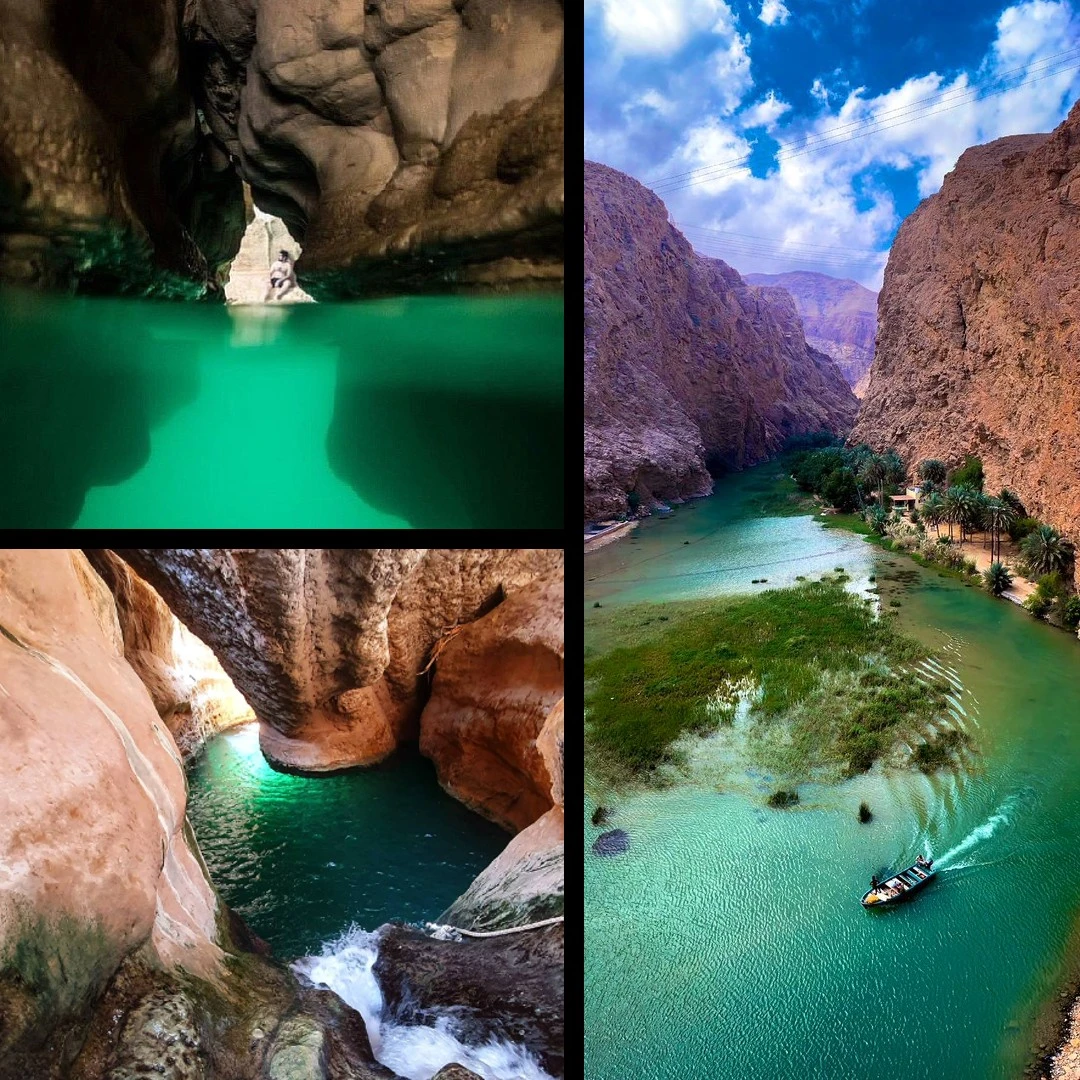
After crossing to the other side by a small boat, the walk begins between stone cliffs. The paths gradually narrow, the air grows cooler, and the sound of water draws closer than your own footsteps. There’s a moment, just before you reach the turquoise pools, when it feels like you’ve left the public world behind and entered a secluded pocket, cut off from everything else. Then comes the cave: a narrow passage through the rock, a brief swim in cold water, and suddenly the space opens up... A waterfall pours from an opening above, with light streaming down like a pillar from the sky.
This is where the stories begin: 'Don’t swim alone... the water doesn’t welcome strangers.'
In the nearby village of Tiwi, it’s said that the elders used to avoid some of the deeper pools at dusk. It wasn’t just fear of drowning. They believed the water had its own inhabitants. No names, no dates—just a phrase, whispered again and again: 'If one of them takes a liking to you... you won’t leave the way you came.'
The stories differ in detail, but follow a familiar pattern: a woman glimpsed for a moment at the water’s edge, a white shadow among the palm trees, a voice calling someone’s name from inside the cave—while their friends insist they never spoke a word. No one claims to have physical proof, but many talk about a sudden, inexplicable pull toward the depths of the pool, as if something is drawing you in—not physically, but from within.
This is where a well-known Gulf expression comes up: 'the enamored jinni, the lady of the water.' In some versions of the story, it’s not so much frightening as it is alluring. The female presence doesn’t attack or push; she attracts.
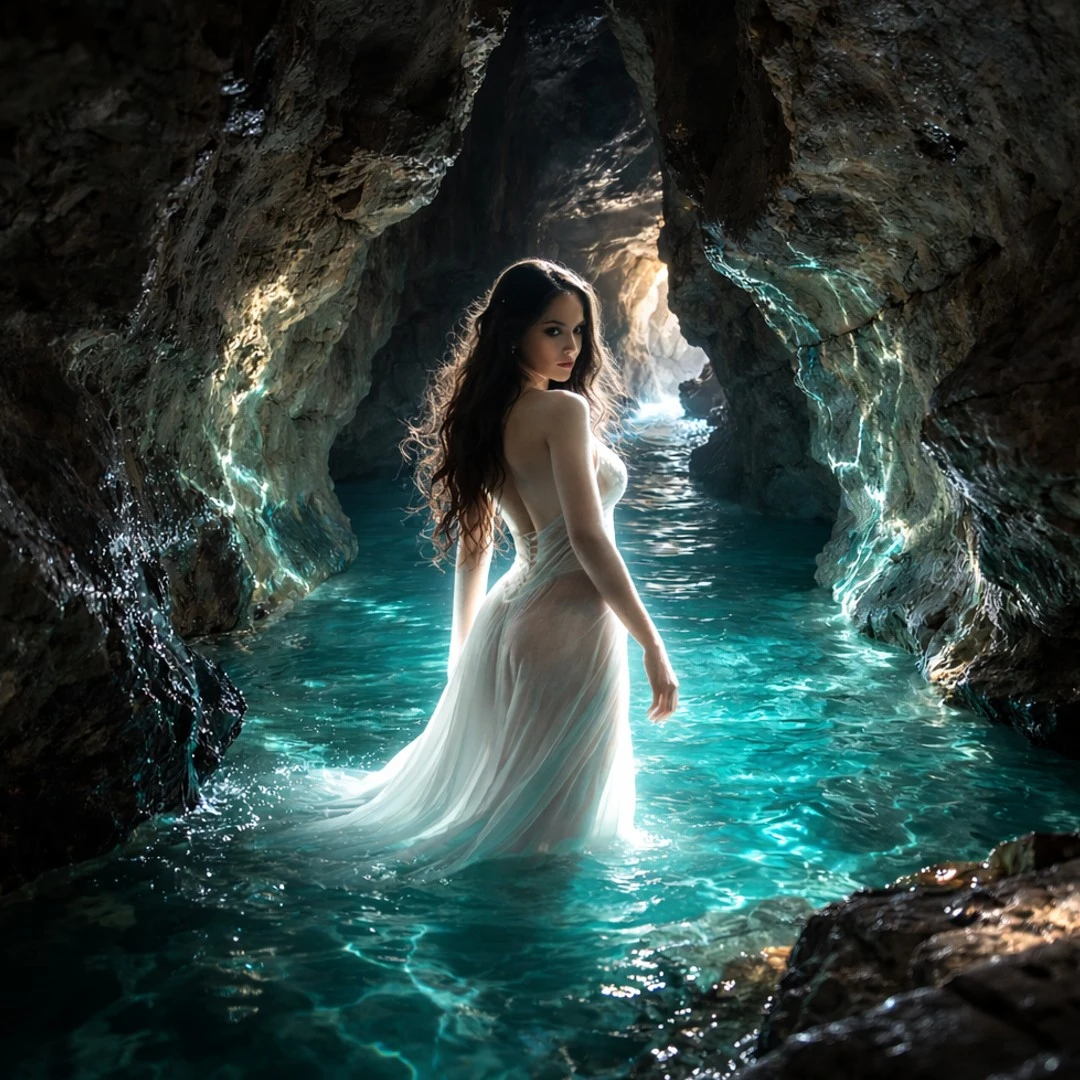
A pale girl with long hair stands at the cave entrance, smiling, then vanishes as someone approaches.
Did he really see her? Or was it just a trick of the light on the water, creating a fleeting human shape?
What’s striking is that most of these stories don’t just come from locals, but from visitors as well.
A tourist says he felt 'someone swimming behind him.' A young man insists he heard his name clearly inside the stone passage. A woman describes a recurring dream after visiting the valley, where the water opens a path downward for her.
Are we dealing with an ancient legend, or is the modern mind simply recreating it?
A place that shapes its own story
Let’s set the legends aside for a moment. Wadi Shab is no ordinary place. It’s a narrow valley surrounded by towering stone cliffs. Sound doesn’t travel in a straight line here—it echoes and shifts. The water is so clear it reflects shadows as if they were real bodies, and the cave with its waterfall creates a dramatic contrast between darkness and light.
In environments like this, the human brain works overtime to interpret signals. A drop falling from the ceiling might sound like a footstep. A passing shadow could take on a human form. And then there’s another factor: the gradual sense of isolation.
The journey starts in an open space, then the paths narrow, and finally you swim through a rocky opening. Each step takes you further from the noise of society and closer to a kind of primal contemplation.
A person in water is different from one on land. Balance shifts, breathing changes, the sense of the body transforms—and suggestion becomes much more powerful.
The enamored jinn... a social warning?
In Gulf popular culture, the idea of the 'possessive jinn' is nothing new. It's often linked to abandoned places, wells, or deep waters. Sometimes, its purpose isn't to prove the existence of a supernatural being, but to protect people from real dangers.
Water in valleys can rise suddenly, swimming in narrow caves can be risky, and hidden currents may pull in those who are overconfident. Have these natural hazards been transformed into a symbolic guardian of the place?
Instead of telling your child, 'Don't go into the cave, it's dangerous,' you might say, 'Someone lives in the water... and they might fall in love with you.'
Fear becomes more convincing when it takes on a personal form. But why specifically the idea of a 'lover'? That's an important question.
If the only goal was to warn, the legend would have taken the shape of a ferocious monster. Instead, it appears as an alluring woman.
This is where a deeper psychological factor comes in:
In collective imagination, water is tied to fertility, mystery, birth, and emotion. The pull of water is much like the pull of emotion itself.
Perhaps the 'possessive jinn' is just a symbolic projection of that mysterious feeling people experience when faced with overwhelming natural beauty.
When confronted with something beyond understanding, people look for a being to hold responsible.
Between legend and geology
There's no scientific evidence of any entity in Wadi Shab, but there's plenty of proof that the place is made for stories: echoes, shifting light, water reflections, the contrast between darkness and a glowing waterfall, and the physical exhaustion after hiking and swimming—all these elements combine to create an extraordinary sensory experience.
But that doesn't change another truth: the legend is part of the place's identity.
Even if there are no jinn in the water... the water itself knows how to make you believe it's alive.
So what remains?
Wadi Shab isn't a haunted site—it's one of Oman's most beautiful valleys. But sometimes, overwhelming beauty borders on awe. When you stand inside a cave, swim toward a shaft of light from above, and hear your voice echo as if it belongs to someone else...
For a moment, just a moment—you're ready to believe anything. Is there a 'possessive jinn' in Wadi Shab? There's no evidence.
But is there something about that place that makes you feel you're not alone?
Ask anyone who's swum there—they'll smile before they answer.
About the Author