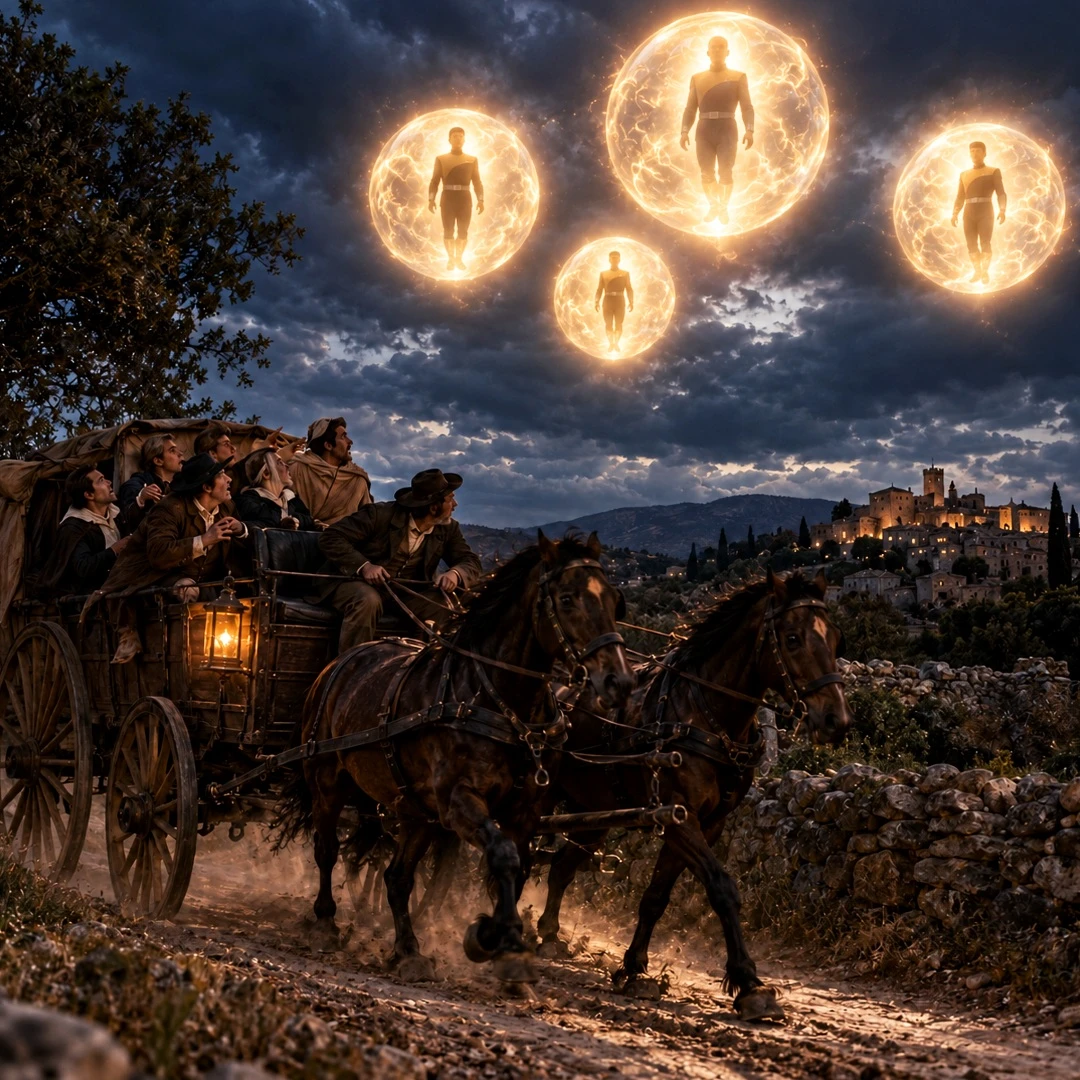
In the spring of 1812, seven travelers were making their way along a rural road in southern France in a horse-drawn carriage when they encountered something inexplicable: a glowing orb moving above the road. The orb then split into four fiery masses, which soon took on an even stranger appearance—four men, each seemingly surrounded by a lantern-like glow.
The sight terrified the travelers so much that they changed their plans and spent the night at a modest inn called "The Four Towers" instead of continuing on to the city of Manosque. At that time, there were no airplanes, no satellites, and not even the concept of "flying saucers," which would only emerge more than a century later. Yet, the details of this encounter bear a striking resemblance to accounts that researchers would later classify as unidentified flying objects.
What makes the incident even more intriguing is that it took place in an area experiencing a series of earthquakes, and the doctor who documented it wasn't writing about visitors from other worlds, but rather about natural phenomena that puzzled both him and the local residents.
The Manosque Incident of 1812
The geological story began on March 20, 1812, when an earthquake struck the Beaumont-de-Pertuis area in southeastern France. This was no minor event; aftershocks continued for weeks. Modern French seismic records confirm the earthquake, estimating its historical intensity at around VII to VIII on the European Macroseismic Scale, a measure of its effects, not its Richter magnitude.
In July of that year, physician and naturalist Louis-Joseph-Marie Robert published a study titled 'Notice historique sur le tremblement de terre du village de Beaumont,' in which he discussed the earthquakes and the atmospheric and terrestrial phenomena that accompanied them. Robert noted that some locals reported seeing what they described as tongues of electric fire emerging from the ground, and similar phenomena were observed in neighboring towns. He then described the May 4, 1812 incident on the road between Manosque and Villeneuve, where a glowing orb moved near the travelers' carriage before splitting into four lights.
Perhaps the strangest part of his account was his description of the travelers' vision becoming so disturbed that they believed they saw four men dancing around them, each inside a lantern.
In the towns of Sainte-Tulle and Manosque, there were also reports of a large light hanging in the sky for several minutes, likened to the aurora borealis. This highlights the importance of consulting the original document, rather than relying solely on later UFO literature.
The Historical Document: Page 10 from Robert's Book
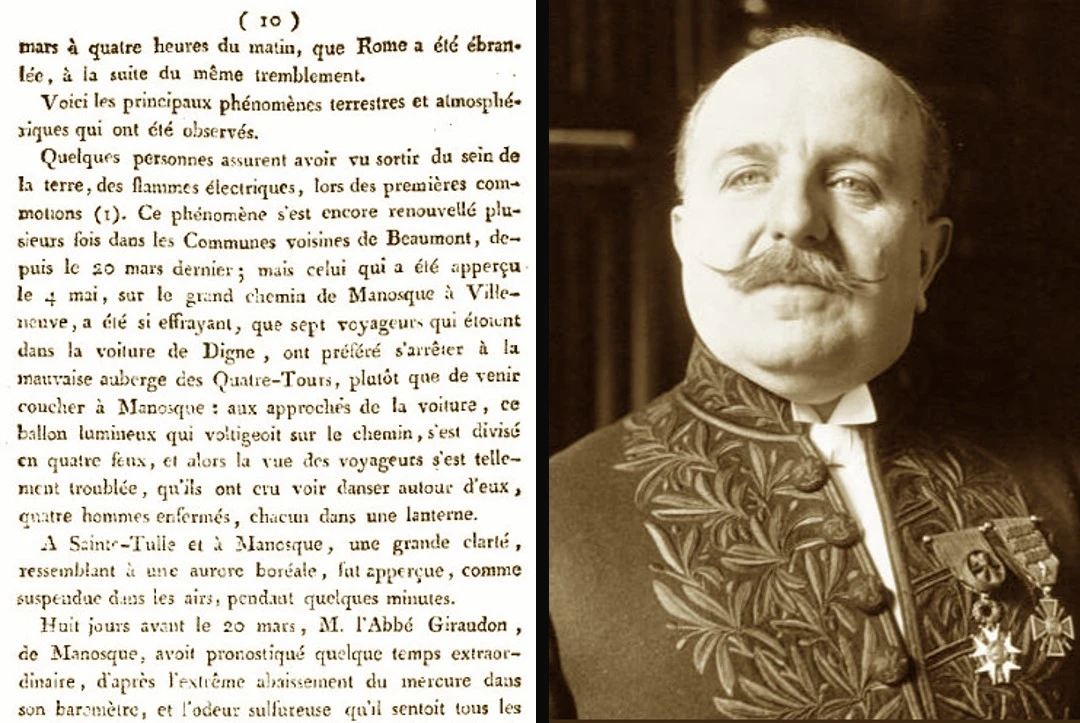
A reproduction of the original French page shows a description of the glowing orb splitting into four lights, along with the doctor's commentary on the nature of lights associated with earthquakes. So, did the doctor actually describe extraterrestrial beings?
The answer is no, his text does not support that conclusion. In fact, Robert added a footnote stating that the appearance of such lights was not unusual and linked them to phenomena accompanying major earthquakes. He also used language indicating that the travelers 'thought they saw' four men, rather than claiming they witnessed actual beings.
There are other limitations to the account: the travelers' names were not recorded, nor were their individual statements preserved, and it's unclear how the details of their experience reached the doctor. As a result, it's impossible to verify whether all seven saw exactly the same thing or simply shared a common description.
Over time, the incident has been subject to historical distortions. Some sources list the date as March 20, 1812, while another cites May 4, 1872. However, the original page clearly states May 4, 1812. This illustrates a common problem in studying historical phenomena: as accounts are passed from book to book and author to author, small changes can creep in and alter the original meaning.
Earthquake Lights: A Possible Scientific Explanation
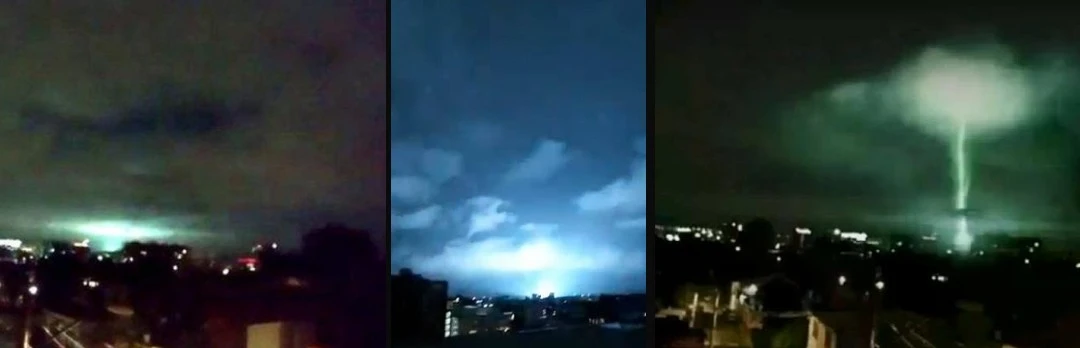
Researchers today use the term 'Earthquake Lights' to describe the phenomenon. This term refers to a range of luminous phenomena reported before, during, or shortly after earthquakes. These lights may appear as glowing orbs, flashes, luminous tongues, or a diffuse glow near the horizon.
Some physical theories have been proposed to explain these phenomena, including the generation of electrical charges caused by stress on rocks. However, the exact mechanisms remain under debate. The US Geological Survey (USGS) notes that scientists disagree on how reliable the reported cases are, and that some recent accounts have been traced to sparks from vibrating power lines.
In the specific case of Manosque, there are three main possibilities: the lights could be a natural phenomenon linked to seismic activity, an unrelated atmospheric event, or the witnesses’ descriptions may have been influenced by fear and the stressful circumstances they were experiencing.
However, the connection between the lights and the 1812 earthquake remains speculative. The travelers’ sightings occurred weeks after the main quake, and there are no physical measurements or independent testimonies to confirm the cause.
Chile 1868: The Giant Metallic Bird
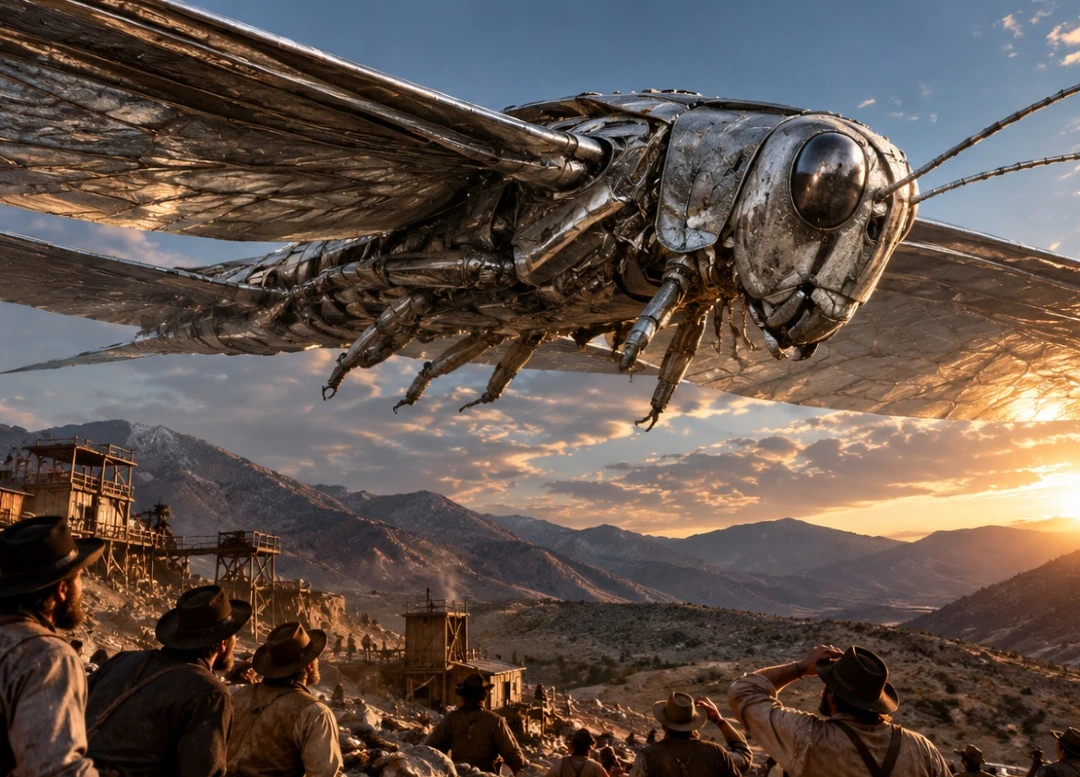
In March 1868, the Chilean newspaper El Constituyente in Copiapó published a story even stranger than the French light sightings. According to the article, miners were preparing to eat when they saw a massive object flying overhead. At first, they thought it was a cloud, but as it drew closer, they described a winged creature with gray feathers, a locust-like head, glowing eyes, and a long body covered in shiny scales that made metallic sounds.
The story was picked up by international sources, including the British natural history magazine The Zoologist in July 1868, and later resurfaced in the 20th century in books about mysterious phenomena and UFOs.
A closer look at the story’s origins reveals an important detail: Chilean sources note that the newspaper included the phrase "ESTE ES UN CUENTO" above the article, meaning "this is a tale." While this doesn’t prove it was entirely fictional, it does suggest caution in treating it as a factual news report.
Interestingly, the story blends elements of mythical creatures and technology: a giant bird, metallic scales, and machine-like sounds. These details may reflect the popular imagination of the time as much as they hint at something unexplained in the sky.
The Arabian Gulf, 1879
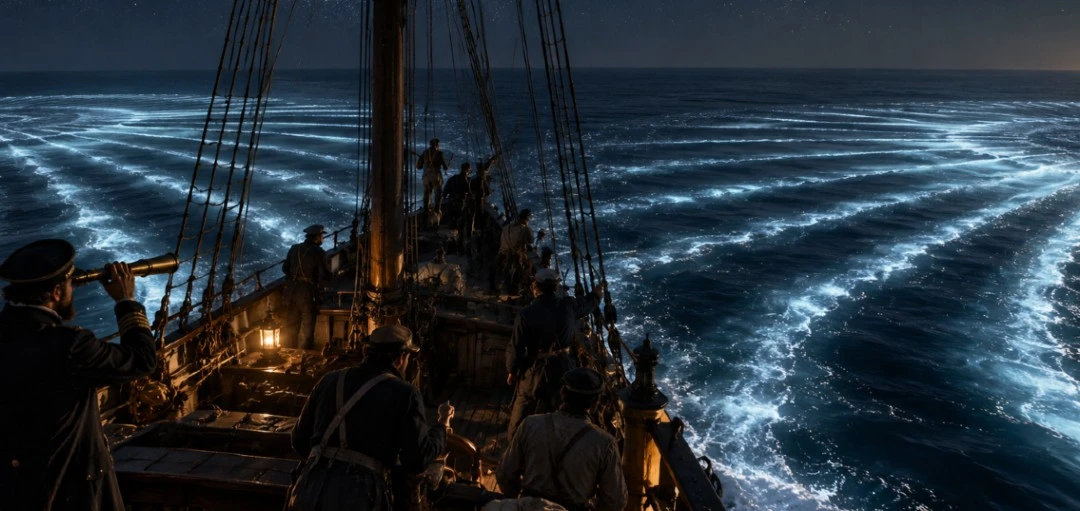
Unusual phenomena weren't limited to the skies. On May 15, 1879, British warship commander Elliot Pringle of HMS Vulture witnessed a strange event in the waters of the Arabian Gulf near Bahrain. The sky was clear and the sea calm when he noticed bright waves moving rapidly across the water's surface. From the ship, they appeared as two giant wheels spinning in opposite directions.
The phenomenon lasted about 35 minutes and was included in an official report to the British Admiralty, later published in the scientific journal Nature on July 24. However, after moving to a higher vantage point on the ship, Pringle observed that the waves were actually moving in parallel, suggesting that the appearance of spinning wheels was likely an optical illusion caused by perspective.
Researchers believe such marine lights are linked to the bioluminescence of microscopic organisms, though debate continues about how these complex geometric patterns form. While this incident doesn't fit the classic definition of a UFO sighting, it serves as a rare example of how a seemingly engineered, moving structure can have a natural explanation.
Mexico, 1883
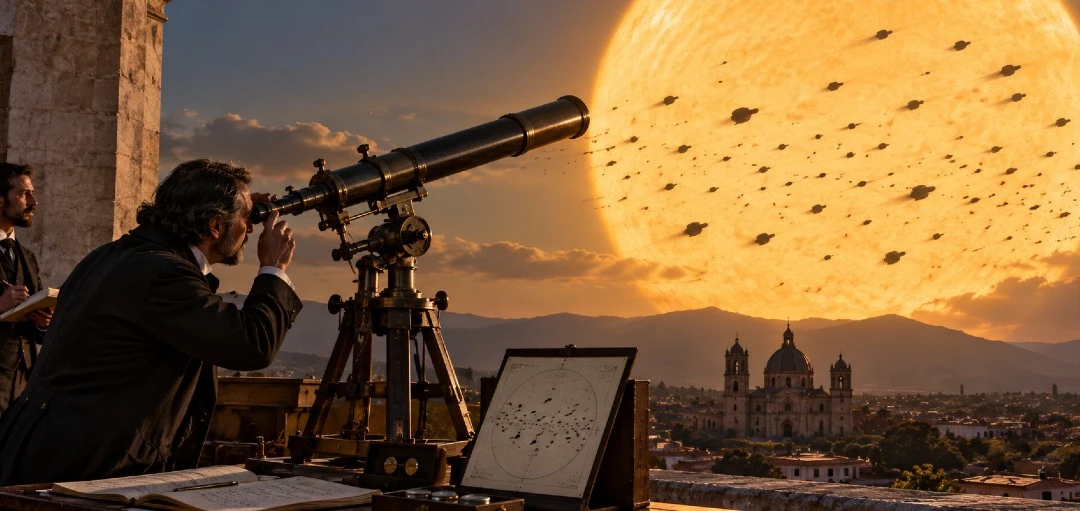
On August 12 and 13, 1883, Mexican astronomer José Árbol y Bonilla was working at the Zacatecas Observatory when he noticed dark objects passing in front of the sun.
Bonilla recorded about 447 objects during his observation period and managed to photograph several of them. He described some as having a hazy appearance. Before his findings were published in the French journal L'Astronomie in 1886, the editor, astronomer Camille Flammarion, suggested the objects might have been birds, insects, or particles close to the telescope.
The case resurfaced in 2011 when three Mexican researchers published a study proposing that Bonilla may have witnessed fragments of a disintegrating comet passing near Earth. While intriguing, the theory faced a major scientific challenge: if hundreds of large objects had passed that close to Earth, why weren't they observed by other observatories? As a result, the comet fragment hypothesis remains unproven, and the historical photos do not provide evidence of spacecraft.
America, 1896–1897
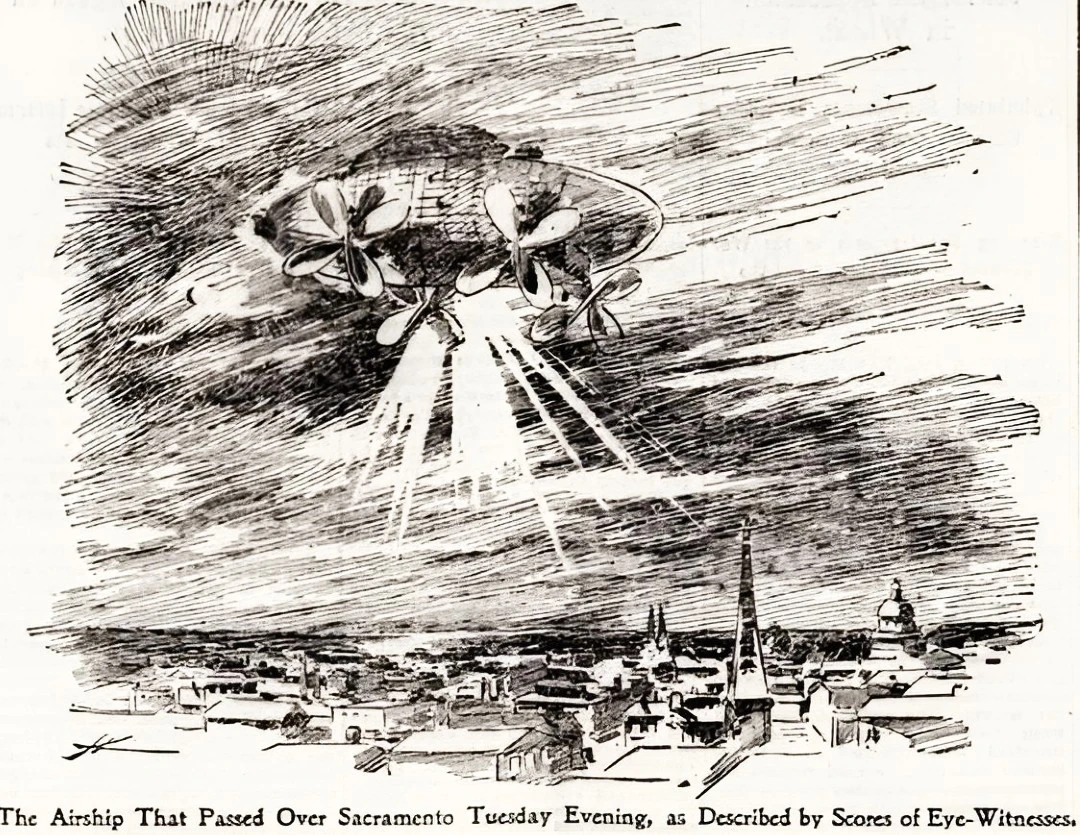
A drawing published by The San Francisco Call on November 19, 1896, depicted the alleged airship over Sacramento. This was an imaginative illustration based on witness descriptions, not an actual photograph. In November 1896, American newspapers began reporting sightings of mysterious lights and flying objects over Sacramento, California. Some witnesses described a bright light moving slowly and changing altitude, while others reported a long, blimp-like craft equipped with propellers and lights. Some even claimed to hear voices coming from the craft. The stories quickly spread to other cities and eventually reached the Midwest in 1897.
This period saw advances in aviation and airship experiments, but the available technology couldn't fully explain all the capabilities attributed to these alleged craft. Notably, some newspapers that reported the sightings soon began to question their own stories.
On November 20, 1896, the Sacramento Daily Record-Union published an article titled 'Air Fancies,' acknowledging that a strange light had indeed been seen, but suggesting that tales of the craft and its occupants were likely the result of exaggeration, rumors, and pranks.
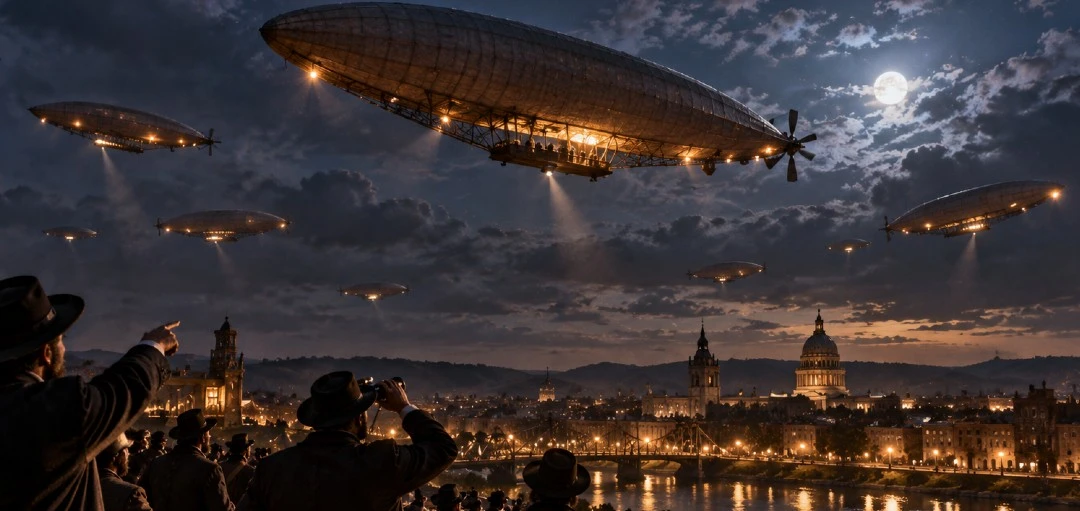
The Nebraska Historical Society notes that some newspaper editors fabricated sighting reports to boost their towns' reputations, and that people used kites to trick onlookers.
This is how one of the most famous waves of mysterious sightings began—nearly half a century before the term 'flying saucer' became popular in 1947.
Did unexplained phenomena exist before we gave them modern names?
Comparing these accounts reveals an intriguing historical pattern. In France in 1812, the phenomenon involved lights, fire, and men surrounded by lanterns. In Chile in 1868, the mystery took the form of a mythical bird with a metallic body. By the end of the century in America, reports described craft with propellers and lights, reflecting the ambitions of engineers and inventors of the era.
This variation suggests that cultural expectations and the technology of each era shape how witnesses interpret and describe what they see. Some cases may be misinterpretations of real natural phenomena, others the result of folklore or journalistic exaggeration, while some remain unresolved due to lack of evidence.
But there's an important distinction between three levels of historical truth: whether the account was actually published, whether a witness honestly described what they saw, and whether their interpretation was accurate. Confirming the first doesn't automatically prove the other two.
That's why not every old report of a strange light or object should be treated as evidence of a spacecraft.
What does the Manusque incident, in particular, tell us?
The Manusque account is especially intriguing because it appears in the context of a study about a real earthquake. It wasn't originally written to argue for the existence of extraterrestrials—the book itself is authentic, the earthquake is well-documented, and the original text describes an unusual event. However, we can no longer verify the identities of the witnesses, the exact circumstances, or the physical nature of the lights. When we read about the four men inside the lanterns, it's important to remember the phrase that came just before their appearance: the travelers' vision was disturbed. Did they truly see human figures inside the lights, or were their minds simply trying to make sense of a strange visual phenomenon by giving it a familiar shape?
Was the light itself a phenomenon related to seismic activity, or was it an unrelated atmospheric event?
We don't have enough evidence to support any definitive explanation.
The skies of the past were no less mysterious.
Records from the nineteenth century show that people witnessed and described mysterious objects long before modern airplanes, radar, or satellites. At the same time, these records reveal how media, collective memory, and the rise of science fiction could reshape those stories.
Whether it's the French doctor who documented earthquake lights, the Mexican astronomer who photographed objects crossing the sun, or the American journalist who wrote about an airship with an unknown origin, the common thread is humanity's attempt to interpret experiences that fall outside everyday understanding.
Perhaps the more important question isn't whether spacecraft visited us in the nineteenth century.
Instead, we might ask: how many of today's UFO sightings are, at their core, similar to those old stories—shaped by the language, technology, and expectations of our own time?
About the Author