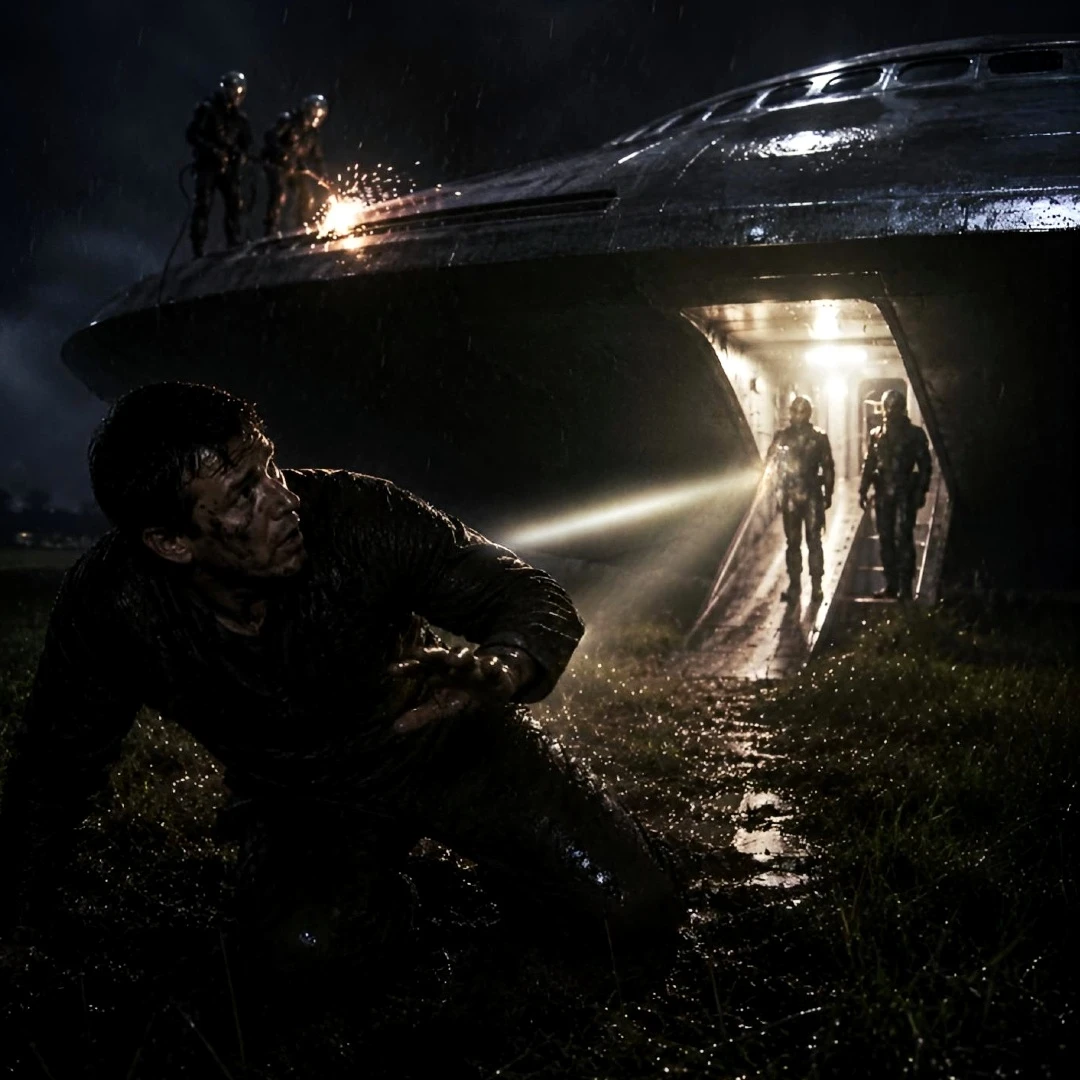
In most UFO sightings, the strange object appears briefly in the sky before vanishing, leaving witnesses with little chance to get close. But what Italian worker Bruno Facchini claimed to experience in the spring of 1950 was something else entirely: a massive craft sitting in a dark field, figures in heavy suits working to repair it, and a mysterious beam that knocked him down when he tried to escape.
The Flash After the Storm
On the evening of April 24, 1950, a powerful thunderstorm had just passed over Varese province in Lombardy, northern Italy. Bruno Facchini, a mechanic in his forties, lived on the outskirts of the small town of Abbiate Guazzone, near Tradate.
Around 10 p.m., after the rain had stopped, he stepped outside and noticed intermittent flashes near a high-voltage power line. Thinking the storm had damaged one of the poles, he cautiously walked toward the source of the light, expecting to find broken wires or an electrical arc.
But according to his account, he reached a field and saw a huge black mass resembling a flattened sphere or a low dome. Its metallic surface was divided by regular horizontal and vertical lines, and in the center was a lit rectangular opening with an external ladder attached by metal supports. He estimated the object to be about ten meters tall, and he was only four or five meters away.
Inside the opening, he saw another ladder, pipes and cylinders connected together, and pressure gauges gleaming in the light. The scene, as he later described it, looked less like the sleek flying saucers from science fiction movies and more like a complex industrial machine packed with pipes and dials.
Men in 'Diving Suits'
Two figures stood near the ladder, while a third was on a mechanical platform that could be raised, working on a set of external pipes with a tool that gave off sparks like a welding torch. Facchini realized that these flashes were what had caught his attention in the first place.
He described the figures as being about 170 centimeters tall , roughly human-sized, wearing heavy, dark gray suits similar to diving gear. They moved slowly, as if their clothing restricted them. Their faces were covered by transparent masks at eye level, and he thought he saw some kind of liquid moving inside. Behind the masks, their faces looked extremely pale. A tube extended from the mouth area, ending in a nozzle, possibly for breathing or connecting to another device.
At first, Facchini didn’t think of aliens. With the Malpensa airport and airfields at Vergiate and Venegono nearby, he assumed he was looking at pilots who had made an emergency landing with an experimental craft and had stopped to fix it.
He approached and offered to help.
But the response wasn’t in Italian or any language he recognized. Instead, they made strange gestures and guttural sounds. Then he heard a deep buzzing noise, like a giant beehive or a huge generator. That’s when he realized the machine was unlike any aircraft he knew, and fear set in.
The Beam That Knocked Him Down
Facchini turned and started to run, but when he looked back, he saw one of the figures lift a device hanging around its neck that looked like a small camera. The device was pointed at him, and a beam or flash shot out, hitting him in the back.
He didn’t describe the sensation as an electric shock, but more like a powerful blow or a strong blast of compressed air. He fell to the ground and hit one of the stones marking the edge of the field.
From where he lay, he watched the crew finish their work. The figure on the platform climbed down, the pipes or telescopic parts were retracted, and the platform was folded up and brought inside the craft. The ladder contracted, the door closed, and the light disappeared, leaving only the buzzing sound. The noise grew sharper and more intense, then the object shot up into the sky and vanished into the darkness. Facchini returned home in shock and, according to his account, spent a sleepless night.
Traces in the Field
The next morning, he returned to the site—reportedly searching for his cigarette case, which he had lost during his fall. There, he found four circular marks, each about a meter in diameter, arranged in a square pattern with roughly six meters between each mark. He also noticed patches of scorched grass and collected small metal fragments, believing they had fallen off during welding work.
He reported the incident to the Varese police and later claimed they asked him not to discuss it publicly to avoid causing panic. However, no original police report or dated field documentation is available in the publicly released materials, making it impossible to verify the condition of the traces when first discovered, who examined them, or whether they were photographed and measured using forensic methods.
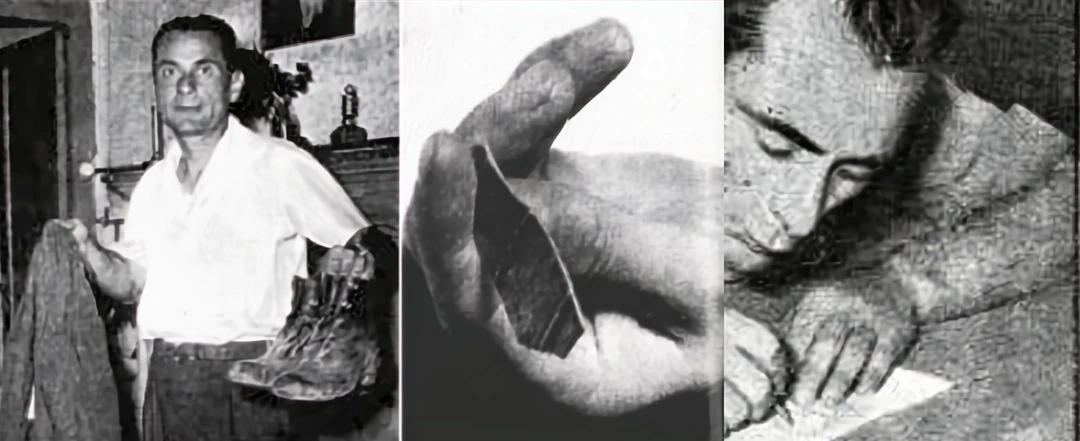
Some of the metal fragments were later analyzed and described in the press as 'anti-friction metal.' However, this term might sound more mysterious than it actually is; the analysis indicated the fragments were a bronze alloy primarily composed of copper and tin, with some lead and traces of other common elements. No rare elements or unusual compositions outside of standard industrial materials were found.
The report suggested the fragments likely came from a bearing lining or a component designed to withstand significant friction and pressure. The samples were later lost and are no longer available for independent testing with modern equipment.
As such, the fragments don't provide evidence of an extraterrestrial origin, but they do at least fit his account of a metallic machine and mechanical repairs.
The body that changed color
Facchini said his health was never the same after that night. He experienced sudden hot flashes in his face without having a fever, and a dark patch appeared on his back that later turned yellow. He suffered from pain for nearly a month. In a family investigation conducted in 2008, his sister recalled seeing him a few days after the incident looking pale and yellowish, withdrawn, and behaving differently than usual.
However, as far as records show, these symptoms were never documented in a contemporary medical report that would confirm radiation burns or any unusual injury. In fact, the change in color from dark to yellow matches the normal healing process of bruises. Facchini himself mentioned that he fell onto a stone edge after feeling a push, which could easily explain a painful, color-changing bruise on his back.
The 'hot flashes' and his withdrawn behavior could also be explained by fear, shock, or social pressure, without necessarily implying that the experience was imagined.
The Story Emerges Two Years Later
One of the main weaknesses in the case is the lack of any known article published immediately after April 1950. The earliest known media coverage appeared in La Domenica del Corriere on August 24, 1952—over two years later.
References to the incident resurfaced in Specchio magazine in 1958, and a more detailed investigation by Pino Carminati Ghidelli was published in the first issue of Dischi Volanti magazine in 1960.
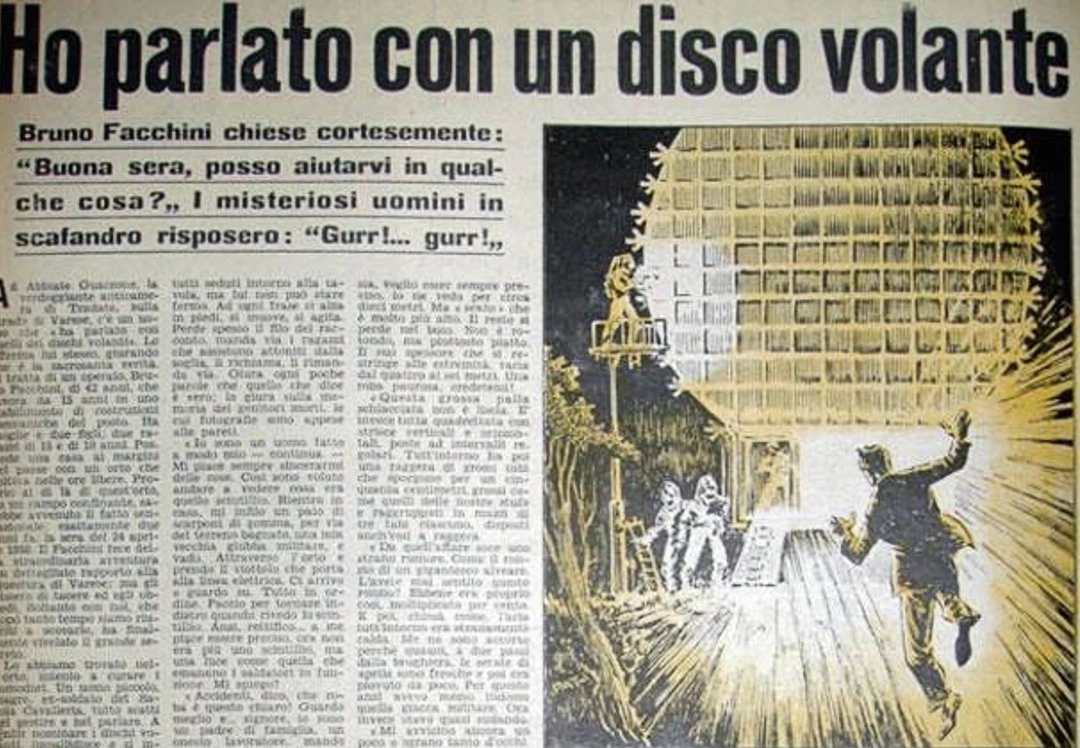
While this delay doesn't prove the story was fabricated, it does raise the possibility that some details may have evolved with repeated retellings or were reshaped by journalists and researchers. There are indeed minor discrepancies between sources regarding the witness's age, the number of crew members, the location of his injury, and the circumstances under which he left his house.
A 1962 newspaper article claimed that some neighbors witnessed the incident but refused to come forward. However, their names and independent testimonies were never published, and the later family investigation did not confirm several secondary details added by that article.
The Experimental Aircraft Hypothesis
Aviation researcher and writer Renato Vesco suggested that Facchini may have witnessed a secret experimental aircraft making an emergency landing. Several elements support this idea:
The people present appeared to be of average human height and wore heavy breathing suits. The craft contained pipes, cylinders, and gauges, and one of them was clearly welding. The metal fragments were made of an earthly industrial alloy, and the area was relatively close to airports and aviation facilities. Even Facchini initially assumed they were pilots in need of help.
However, this theory faces major challenges. No known aircraft matches the disc shape, dimensions, rapid vertical takeoff, and lack of visible wings described. Documented vertical takeoff aircraft projects only began to flourish in the mid-to-late 1950s; the first successful jet VTOL tests were in 1953, and US contracts for vertical fighters were awarded in 1951—a year after Facchini's incident.
While it's theoretically possible that a secret project existed before the publicized ones, this possibility alone isn't sufficient evidence. It's also hard to explain why an ultra-secret prototype would land in a field near homes, be repaired in the open, then have a weapon or device aimed at a civilian—leaving him alive and able to describe everything.
Did the Storm Create the Scene?
The conditions that night allow for another hypothesis: flashes of lightning or an electrical arc near a high-voltage line, combined with darkness, wet ground, and mounting fear, could have caused the witness to misjudge the size of real objects or people. There's also the rare phenomenon of 'ball lightning,' a glowing sphere that can move near the ground for a few seconds during storms.
However, weather phenomena don't easily explain a scene that lasted long enough to observe three people, two ladders, gauges, welding, equipment being packed up, and a takeoff. So the storm is only a plausible explanation if we assume that most of the details were later shaped by memory distortion or storytelling.
Did Facchini Make It Up?
There's no definitive evidence ruling out fabrication, especially given the lack of immediate documentation, lost samples, and delayed publication. However, there's also no clear motive for deception: the story didn't bring him wealth or fame, but instead made him the subject of ridicule in his hometown. According to relatives and researchers who met him, he regretted ever speaking about it.
When he was interviewed again in 1981, it was noted that the core elements of his story remained unchanged: a stalled machine, people in heavy clothing, an attempt at communication, a blow to the back, and then a takeoff. However, he added that after seeing astronauts on television, the suits worn by the figures reminded him of those worn by lunar astronauts. This comparison could suggest a persistent, unusual memory, but it might also show how old memories are reinterpreted through images that later become part of popular culture.
So what really happened?
The most cautious conclusion isn’t that Facchini encountered extraterrestrials, nor that he necessarily lied, but rather that he likely experienced something extremely strange from his perspective. The story then reached us through a series of later sources, making it impossible to separate what he actually saw from what was added by memory, the media, and researchers.
The theory of a terrestrial machine or secret aerial activity could explain the industrial look of the scene, the people in suits, and the bronze alloy. However, there’s no documented vehicle that matches the reported performance.
Lightning and misperception could account for the flash, the beginning of the event, and perhaps the fall, but they don’t explain the entire complex narrative. The extraterrestrial hypothesis covers the unexplained elements, but it doesn’t provide independent evidence that the craft came from beyond Earth.
The Bruno Facchini case remains one of the most intriguing Italian encounter stories, not just because of the strength of the evidence, but because of its unusual nature: visitors who didn’t land to explore or abduct humans, but rather a mysterious crew whose machine broke down in a field after a storm, busy with repairs… until a man approached who was never meant to see them.
About the Author