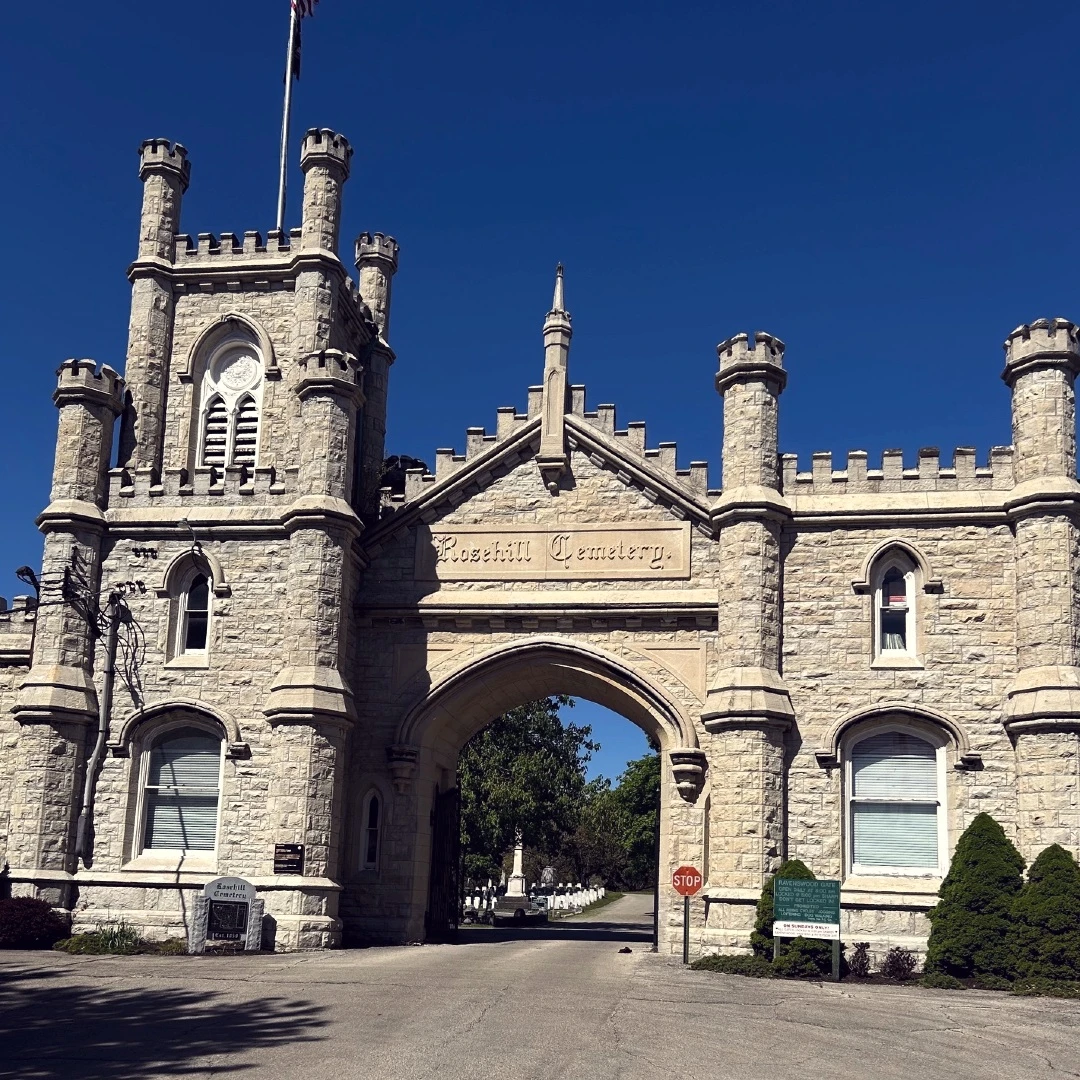
One autumn evening in 1995, a worker at Rosehill Cemetery in Chicago was preparing to close up for the night when he noticed a woman standing by a tree near the cemetery wall. While it wasn’t unusual to find a late visitor, he approached her to let her know it was time to leave. But as he got closer, she seemed less and less like an ordinary guest. She was dressed in old-fashioned clothes, and when he looked at her feet, he realized they weren’t touching the ground. Then came what he later described as the most terrifying part of the experience: he tried to back away, but couldn’t move, as if his feet were suddenly weighed down and rooted to the spot. Before his eyes, the woman’s features began to fade until she dissolved into a cloud of white mist and vanished into the darkness.
It might have been dismissed as a fleeting illusion or a trick of the light fueled by fear, if not for the strange phone call the cemetery received the next day. That’s where one of Rosehill’s most famous legends begins.
A City of the Dead in the Heart of Chicago
Founded in 1859 on a vast tract of land north of Chicago, Rosehill Cemetery grew to become the city’s largest and most renowned burial ground. Winding paths weave through trees, past marble and bronze monuments, funerary statues, stained glass windows, and the graves of people who played key roles in the city’s and America’s commercial history. But the site also holds an even older layer of the dead. As Chicago expanded in the 19th century, parts of older cemeteries including City Cemetery, which once stood where Lincoln Park is now were removed, and many remains were relocated to new cemeteries like Rosehill. From the start, Rosehill became a resting place for people who, in a sense, were buried twice.
That alone might not mean much, but it set the stage for stories to flourish: relocated graves, wealthy families, unusual mausoleums, legal disputes, family tragedies, and Gothic architecture that seems tailor-made for ghost stories. It didn’t take long for the legends to appear.
A Rivalry That Outlived Its Owners
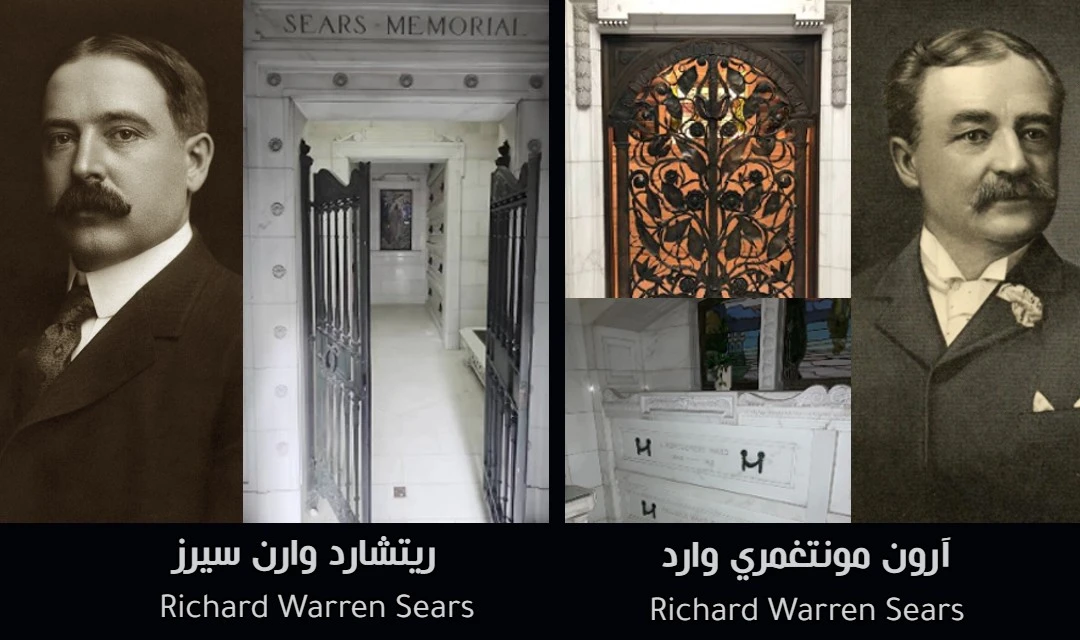
Among those buried at Rosehill are two famous names in American business history: Aaron Montgomery Ward and Richard Warren Sears. Each built a retail empire based on mail-order catalogs, becoming fierce competitors in a rapidly changing marketplace. Local folklore claims their rivalry continued even after death.
According to the story, the figure of a man in old-fashioned formal attire has been seen more than once heading toward Ward’s grave. Some believe it’s the ghost of Richard Sears himself, as if he’s still searching for his old rival. Ironically, both men are buried in the same cemetery, in a mausoleum complex that houses the tombs of Chicago’s wealthiest families.
Of course, business competition is one thing, and the legend that casts them as eternal adversaries is another. There’s no evidence their personal relationship was as dramatic as the stories suggest. But at Rosehill, it doesn’t take much fact to spark a ghost story.
The Tomb of Charles Hopkinson
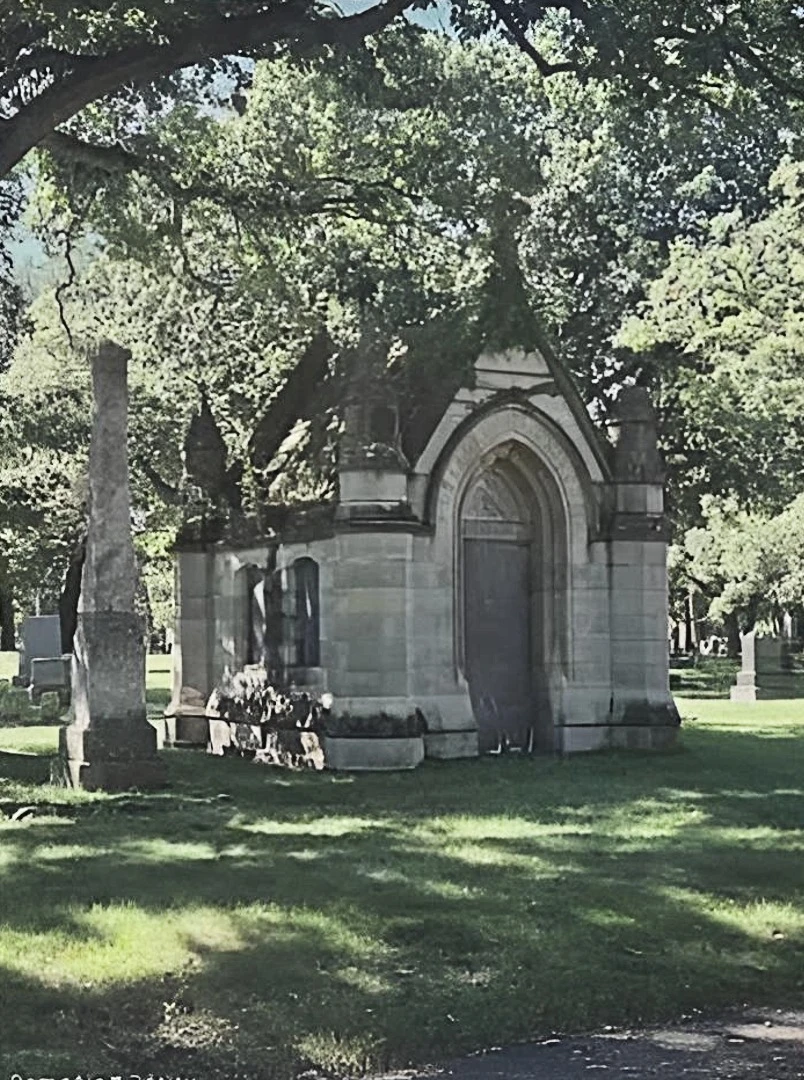
Perhaps the cemetery’s most intriguing tale centers on Charles Hopkinson, a real estate businessman who, in the 19th century, purchased plots at Rosehill for his family. After his death, his wife wanted to build a grand Gothic-style mausoleum resembling a small church, but the cemetery management objected to the plan.
The dispute escalated into a full-blown legal battle, eventually reaching the Illinois Supreme Court, which ruled in favor of the Hopkinson family in 1885. That’s where the official record ends and the folklore begins.
According to legend, Hopkinson never forgave those who tried to delay the construction of his tomb. On the anniversary of his death, strange sounds are said to be heard near the mausoleum: a low moan, followed by the rattling of chains from within. Storytellers claim that the man whose grave became the subject of a legal fight could never truly rest, even after the case was resolved. There are no independent records of moans or chains, but the legal dispute itself is well documented. This is a recurring pattern at Rosehill: a real historical event becomes the seed of a legend decades later.
The Mother and Child Behind Glass
One of Rosehill’s most famous graves belongs to Frances Pearce and her young daughter. Frances died in 1854 while still a young woman, and about two months later, her infant daughter, who shared her name passed away as well. They were first buried elsewhere, then later moved to Rosehill. Horatio, the husband and father, having lost both wife and child in a short span, commissioned a memorial depicting them together: a woman lying peacefully with her child in her arms. American sculptor Chauncey Bradley Ives created the piece in Rome, and it became one of the cemetery’s most celebrated funerary statues. To protect the marble from Chicago’s weather, the statue was enclosed in glass, and that’s where the legend began.
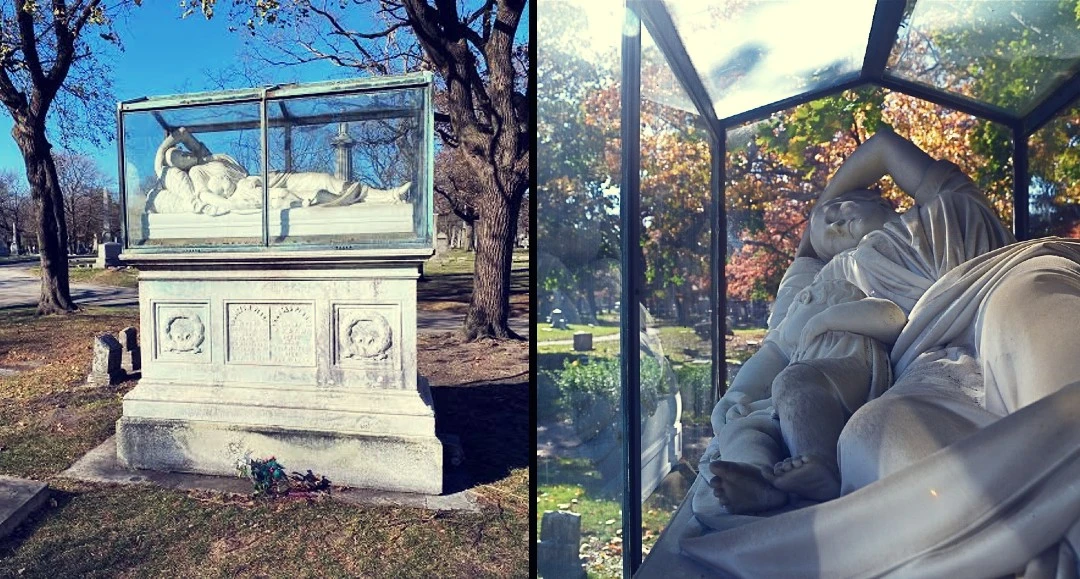
Visitors say that on certain days, the glass case fills with thick white mist. In some versions, this happens on the anniversary of their deaths and disappears at midnight. More dramatic accounts claim the mist sometimes seems to swirl around the mother and child.
But there’s a clear problem with the story: mother and daughter didn’t die on the same day, so the idea of a shared 'death anniversary' doesn’t match historical records. As for the mist inside a glass case housing a cold marble statue in Chicago’s unpredictable climate, there’s a much simpler explanation: condensation.
Still, the image of a mother and her child lying lifeless in a fogged-up glass coffin was enough to keep the legend alive for generations.
The Scent of Flowers at Lulu's Grave
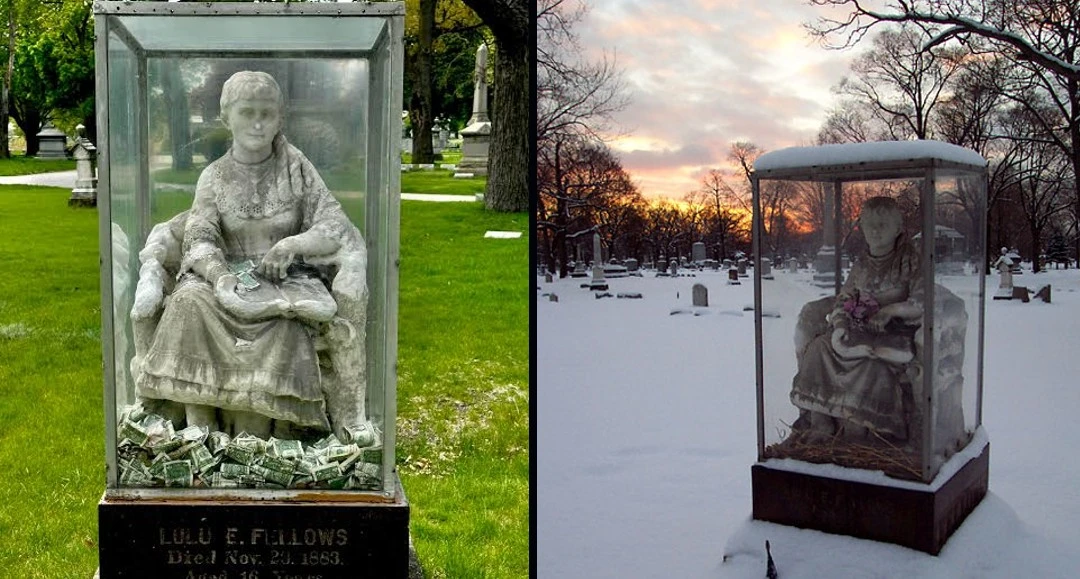
There’s another grave that’s less eerie but far more poetic. Lulu Fellows was a young girl who died of typhoid fever before her seventeenth birthday. A statue of her sits atop her grave, depicting her seated with a book in her lap. The inscription speaks of the hopes that were buried with her.
It’s said that Lulu loved flowers during her life, and visitors and staff sometimes notice a sweet floral scent near her grave even when there are no flowers around.
There are no apparitions, voices, or ghostly figures here, just a scent. But according to legend, this fragrance lingers regardless of the season or weather.
There’s no verifiable evidence for this phenomenon, just scattered personal accounts. Still, it’s become part of the collection of stories that have given Rose Hill its mysterious reputation.
The Mist That Walks Among the Graves
One particularly striking account comes from a woman who worked at Rosehill in the 1990s. She recalled seeing, in broad daylight, a swirling mass of mist that seemed to take on a vaguely human shape as it moved among the graves. On another occasion, this mist was spotted near a grave that had been damaged when a tree branch fell on it during a lightning storm.
This wasn't the only strange occurrence reported by staff. There were also stories of whispers and the sounds of men arguing inside the administration building, even when the rooms were empty. One sales employee recounted working alone one evening when he heard someone call his name three times. At first, he assumed a coworker was playing a prank, but after searching the building and finding no one, he checked the parking lot and saw his car was the only one there. He left before finishing his shift.
These kinds of experiences are familiar in the lore of haunted places: unexplained voices, a sense of being watched, and mist moving in unnatural ways.
But the story from 1995 is more complicated.
The woman who wanted a headstone for her grave
The night after a woman appeared to the night guard in the fall of 1995, Rosehill’s management received a call from a woman living outside Chicago. She began by assuring them she was fully lucid, then explained that her late aunt, Carrie Kalbas, had appeared to her in a dream the previous night. Although they hadn’t been especially close in life, the woman in the dream introduced herself and said she’d been buried at Rosehill since 1933. She had a specific complaint: she’d been laid to rest without a proper headstone. According to the story, Carrie expressed her fear that, over time, nothing would remain to mark her existence.
Moved by the dream, her niece promised to set things right. The next morning, she called the cemetery and requested a small marker with Carrie’s name to be placed next to the headstone of her husband, Wenzel, who had died years earlier.
At that point, cemetery staff connected the phone call with the guard’s account from the previous night. Was the woman seen near the fence actually Carrie herself? According to the story, some believed she was.
After the new marker was installed, there were no further reports of the woman’s apparition. And so the legend was complete: a spirit appears to a stranger, then visits her relative in a dream on the same night, asks for something specific, and disappears once her request is fulfilled.
It’s almost a textbook example of "the dead who want to be remembered."
But did it really happen this way?
When the researchers entered the cemetery
About a year before the Carrie incident, in August 1994, a team from the Ghost Research Society visited Rosehill to conduct what they described as a field investigation into the reported phenomena.
The team used cameras, audio recorders, electromagnetic field meters, and other devices commonly used in ghost investigations. They visited several sites linked to the stories, including the Francis Pierce monument. Their published findings were noteworthy:
The team saw and recorded nothing out of the ordinary during their investigation.
This result doesn’t prove that all the stories are false, but it does serve as a reminder that tales passed down for decades don’t automatically become observable phenomena.
Even the Carrie Kalbas incident, which is one of the most coherent accounts, ultimately relies on a chain of testimonies reported by a group already interested in ghost research. Based on available records, there’s no independent document from the cemetery management or a contemporary news report confirming in detail that the guard’s sighting and the phone call happened exactly as the story is told today.
Between the cemetery and the legend
The secret of Rosehill may not lie in a single ghost. The place brings together nearly every ingredient for a rich funerary folklore: a 19th-century cemetery, remains relocated from even older graves, gothic mausoleums, wealthy businessmen, rivalries, children who died young, statues encased in glass, legal disputes, and generations of visitors and staff who have retold the stories each time adding a new detail.
A business rivalry turns into enmity after death, condensation inside a glass case becomes a mysterious mist, a legal battle over a mausoleum transforms into the sound of chains, and a missing headstone is said to bring a woman back from the dead.
Some sightings might be explained by light, fog, and reflections, and some sounds by the nature of old buildings and wide open spaces. Expectation, fear, and knowledge of the site's history can strongly influence how people interpret what they see and hear.
But that doesn't erase the question that has kept Rosehill's stories alive all these years.
If cemeteries were created to help us remember the dead, is it possible that, in our stories, what ghosts fear most is being forgotten?
Perhaps that's why Rosehill's most famous story isn't about a vengeful spirit or one that haunts the living.
Instead, it's about a woman who, according to legend, returned for a much simpler reason:
She just didn't want to be forgotten.
About the Author