In the story of the Queen of Sheba in Surah An-Naml, a mysterious figure briefly appears and then disappears from the narrative despite performing the story’s most astonishing act: bringing the queen’s throne to Solomon in the blink of an eye.
A powerful jinn claims he can bring the throne before Solomon rises from his seat, but another figure described in the Quran only as 'the one who had knowledge of the Book' says, 'I will bring it to you before your glance returns to you.' Instantly, the throne appears before Solomon.
What’s striking is that the Quran never mentions this man’s name, position, or the nature of his knowledge. Yet today, many people know him asAsif bin Barkhiya, Solomon’s vizier and the possessor of the 'Great Name.'
So where did this name come from? Was Asif really the one who transported the throne? How did a figure unnamed in the Quran become one of the most famous occult and mystical personalities in tradition, even being credited with a mysterious book called 'Al-Ajnas'?
The man who outpaced the jinn
Based solely on the Quranic text, the details are extremely limited: a jinn offers to fetch the throne first, then 'the one with knowledge of the Book' makes a faster offer, and Solomon finds the throne before him.
Everything else—the man’s name, his role as vizier, and his knowledge of the Great Name—comes from later interpretations and stories, not from the verse itself.
Crucially, commentators never agreed on his identity.
Al-Tabari, who died in 923, collected several accounts: some say he was a man from among humans named Balikha, others say he was an Israelite who knew one of God’s names, or an unknown worshipper living on an island. Another account identifies him as Asif bin Barkhiya. In this version, cited by Al-Tabari from Ibn Ishaq, Asif is described as a righteous man who knew the 'Great Name.'
Later commentaries expanded the possibilities even further; some suggested he was Al-Khidr, or Gabriel, or another angel. Some even proposed that it was Solomon himself. In other words, the now-common claim 'Asif bin Barkhiya was the one who brought the throne'—is not a stated fact, but one of many interpretations that, over time, became the most popular.
Where did the name 'Asif bin Barkhiya' come from?

Here we see an intriguing connection to Jewish tradition. The name itself isn't entirely an Islamic invention; in the Book of Chronicles in the Bible, there's a figure named Asaph son of Berechiah. However, he's not portrayed there as a sorcerer or as someone who transported the throne of the Queen of Sheba. Instead, he's described as a Levite and a musician during the reign of King David, responsible for singing and playing music during religious ceremonies.
This is an important point: just because the name appears in Hebrew tradition doesn't mean that ancient Jewish sources claimed this person possessed 'knowledge of the Book.'
It's more likely that the name entered Islamic culture through a network of stories that later became known asthe Isra'iliyyat: stories, names, and details about the prophets of the Israelites that circulated among Muslims and the People of the Book, eventually finding their way into Islamic storytelling and exegesis, often changing along the way.
The influence of this channel is clear in the works of al-Tabari himself. Some details of the story are narrated by Ibn Ishaq, who cites Wahb ibn Munabbih , a well-known figure associated with transmitting stories of earlier nations and prophets into Islamic literature.
So it's not accurate to say that Muslims found a specific Jewish text stating 'Asaph transported the throne' and copied it directly; there's no evidence of such a direct source. What can be established is that the ancient Hebrew name existed, and later appeared in Islamic storytelling linked to Solomon, before the character grew in significance and acquired traits not found in the biblical text.
A recent study by historian Michal Biran highlights how the image of Asaph son of Berechiah evolved throughout Islamic history. He shifted roles from minister to sage to possessor of magical knowledgeand his importance grew significantly in medieval literature.
How did he become the bearer of the 'Great Name'?
Perhaps the ambiguity left by the Quranic verse contributed to the character's expansion. The Quran states that the man possessed 'knowledge of the Book' without specifying what that knowledge was, leaving room for later stories to fill in the gaps. Some claimed he knew 'the name of God that, when invoked, is always answered,' which eventually became associated with the concept of the 'Great Name.'
In this way, Asaph became an ideal figure for esoteric literature, not a prophet or a jinn, but a human who, according to the story, possessed knowledge that allowed him to accomplish what even the powerful demon could not, and to do so with remarkable speed.
This marked the shift from a mysterious, interpretive figure to one surrounded by legends—credited with secrets, names, rings, and books on spiritual matters.
The name Asif has appeared in books of interpretation and stories for centuries, long before modern editions of 'al-Ajnas' emerged. For example, al-Tabari mentioned him in the 10th century, and his name recurs in later commentaries, prophetic tales, and literature. However, searching for ancient magical texts actually written by Asif leads to a different conclusion.
Online, you'll find files and images with titles like 'The Invocation of Asif bin Barkhiya' or 'Asif's Spells,' some presented as ancient manuscripts. But the digital versions available rarely provide reliable manuscript records: there's usually no trustworthy date, no documented chain of ownership, and no catalog number from a recognized manuscript library that would allow them to be traced to a specific era.
For instance, the version titled 'The Invocation of Asif bin Barkhiya and the Invocation of Mars' on Internet Archive doesn't include any information about the manuscript's date or historical origin—only the date the file was uploaded in 2023.
A thorough search of accessible manuscript catalogs and sources turned up no dated, authenticated copy of 'al-Ajnas' that could confirm its existence under this title and text before modern times.
This doesn't prove that all its content is recent; some material may have been drawn from older traditions and manuscripts. But it does mean that attributing the book itself to a supposed figure from Solomon's era lacks historical support.
Al-Ajnas: Attributed to Asif
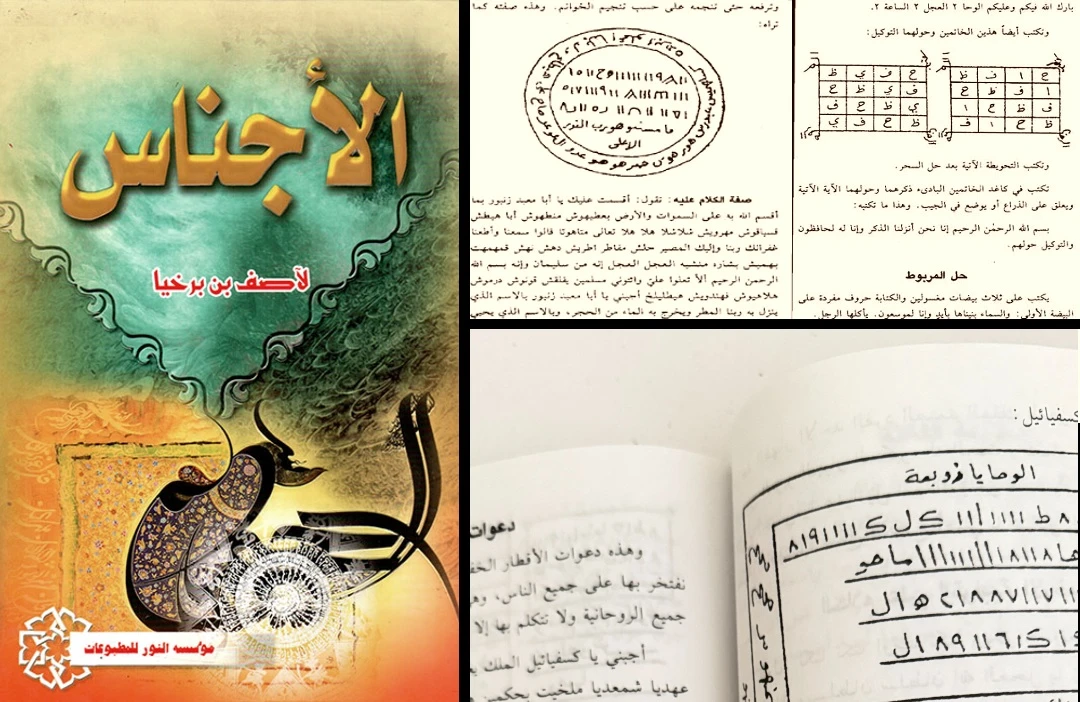
The version of the book circulating today presents Asif bin Barkhiya as its author. There's an indexed Arabic edition published in 2005, about 200 pages long, and its content clearly belongs to the genre of magic and spiritual literature: it discusses the heavens, planets, angels, kings of the jinn, names, rings, talismans, and tried-and-tested rituals. Names of Hebrew origin appear, such as Adonai, El Shaddai, and Sabaoth, alongside the figure of Metatron well-known in Jewish esoteric tradition, while the same sections also include Quranic verses, prayers, and Islamic concepts.
This blend is historically intriguing, but it doesn't prove Asif was the author; in fact, examining the text itself reveals a major issue with this attribution.
Is 'al-Ajnas' really Asif's book?
One of the first things that stands out is that the book openly references the Prophet Muhammad and the Quran. It includes prayers citing the surah 'Alam Nashrah,' repeatedly mentions 'our Prophet Muhammad,' and uses unmistakably Islamic concepts. Clearly, these sections couldn't have been written by someone from Solomon's era.
It's possible, of course, that Muslim scribes added these parts to an older original. But the book offers even stronger evidence that editing continued into much later times.
In one section, the text literally describes obtaining a silver coin 'minted by the Egyptian government,' then mentions gold 'struck in the English dinar style.'
At this point, any claim that the text before us dates back to Solomon's era completely falls apart.
The supposed Asif could not have referred to the 'Egyptian government' or English currency. This isn't just a religious phrase added by a Muslim scribe, it's a historical marker showing that parts of the text were compiled or modified in relatively modern times.
So, 'al-Ajnas' appears to be more of a cumulative work: a collection of older and newer material from various spiritual traditions, gradually assembled over time and eventually attributed to Asif bin Barkhiya to lend it the authority of ancient Solomonic lore.
The idea that there was once an 'original version' written by Asif that was later altered can't be completely ruled out from a logical standpoint, but so far, there's no known manuscript evidence to support it.
Who transported the throne of the Queen of Sheba?
If we approach this as a religious question based on the Quranic text, the answer is both simple and mysterious:
The throne was moved by someone 'who possessed knowledge from the Book,' but the Quran does not mention this person's name.
Asif bin Barkhiya is the name given to this figure in one interpretive tradition, and over time, this version became so widespread that his name is now almost inseparable from the story.
This seems to be a rare example of how a legendary figure is born over centuries: it began with an unnamed man in a verse, who was later given a well-known name from Jewish tradition, then became Solomon’s scribe, minister, and possessor of the Greatest Name; in esoteric literature, he was transformed into a master of secrets, and eventually, books of magic appeared bearing his name.
That’s why perhaps the most intriguing question isn’t just:
How was the Queen of Sheba’s throne transported?
But also:
How did a man whose name isn’t even mentioned in the Quran end up, over the centuries, with a full biography, a legendary secret, and entire books of magic attributed to him?
Somewhere between scripture, interpretation, and myth, Asif bin Barkhiya stands as one of the most enigmatic figures in tradition.
About the Author