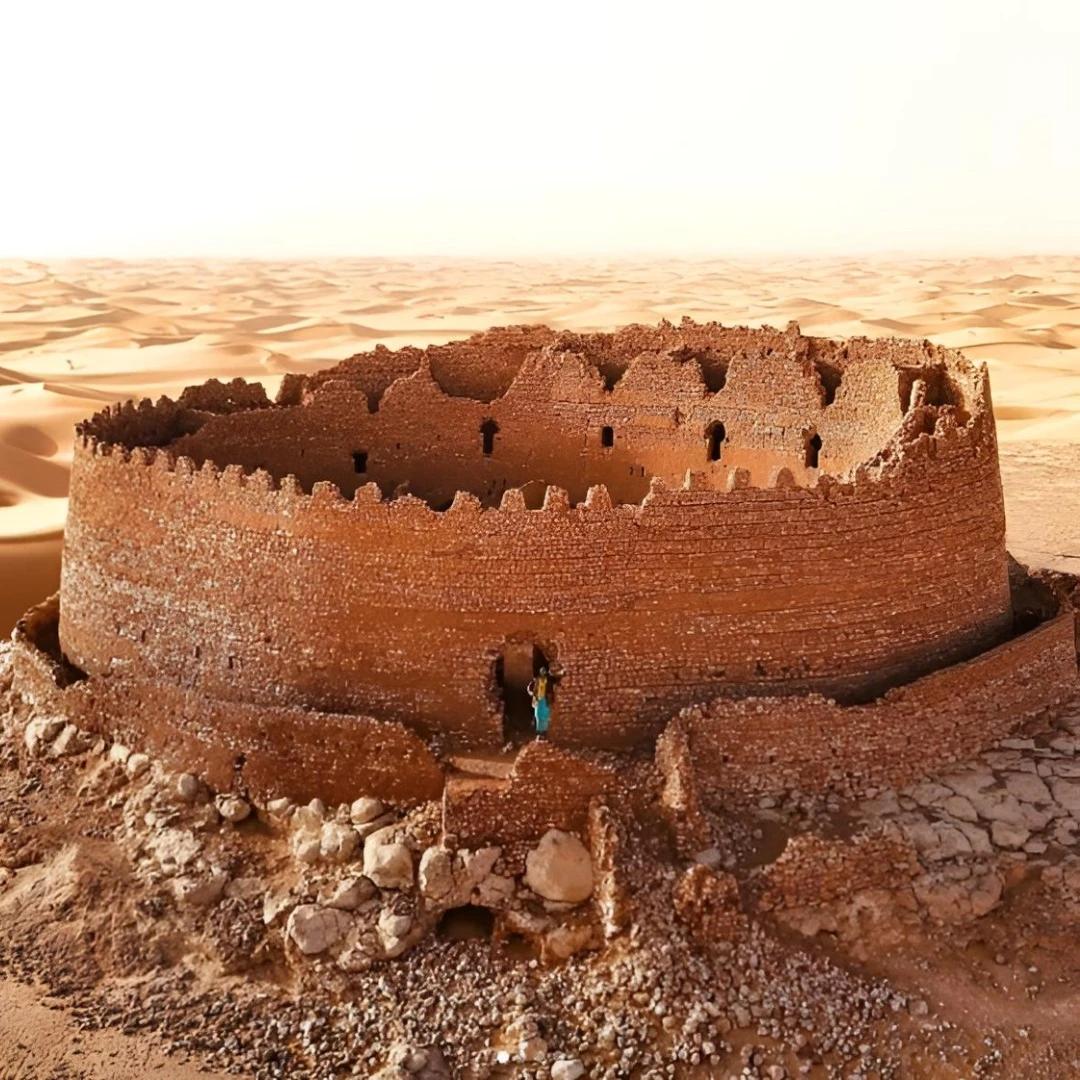
Imagine crossing the vast red dunes of Algeria’s Timimoun Desert, where endless sands stretch to the horizon. Suddenly, a massive circular fortress appears, standing alone in this silent sea. What would be the first question on your mind? Did its builders choose this harsh location willingly? Or was the desert once different, with the sands slowly swallowing roads and oases over centuries, leaving this fortress as the lone witness to a forgotten era?
This isn’t a work of fiction, it’s the real-life mystery surrounding Ksar Draa (also known as Ksar Dheraa), one of the most enigmatic sites in the Algerian Sahara, where archaeological facts blend with legends of treasures guarded by supernatural beings.
Even the name of the site raises questions. In Arabic sources, it’s often called "Ksar Dheraa," while foreign references use "Ksar Draa." In local Saharan dialects, words like "Draa," "Dheraa," and "Derraa" can mean an expanse, a cliff, or a slope. To this day, there’s no agreed-upon historical explanation for the name’s origin. It might be an Arabized version of an older local name or a geographic term whose meaning has faded over time. Like many of the fortress’s mysteries, the name itself remains unexplained.
Who built this fortress?
Ksar Draa is located near the Ouled Said oasis, about thirty kilometers from the city of Timimoun in southwestern Algeria, on the edge of the Grand Erg Occidental—one of the world’s largest sand seas. While photos often show the fortress in complete isolation, as if it was deliberately built in the heart of the desert, the reality is more complex.
The entire area is part of the Gourara region, famous for its oases and palm groves for centuries. Locals relied on an ingenious network of underground channels called foggaras to transport water over long distances for irrigating orchards and fields. Some researchers believe that the landscape we see today may be very different from what the original builders knew.
It’s possible that when the fortress was first constructed, it stood near a caravan route, a water source, or a small oasis, before the dunes gradually advanced, burying roads and smaller structures and leaving the fortress alone above the sands.
However, there have been no archaeological excavations confirming the existence of an oasis right next to the fortress, so this idea remains a logical hypothesis rather than a proven fact.
A structure without a history
Strangely, no one can pinpoint when it was built. There’s no foundation inscription, no carvings naming its builder, and no historical documents describing its construction. Estimates range from the medieval period to the 17th or 18th centuries, while some local legends claim it’s over a thousand years old. In reality, none of these dates have been confirmed by published archaeological studies or scientific analysis of the building materials. This makes the fortress one of the rare structures where three fundamental facts remain unknown at the same time:
Who built it? When was it constructed? And for what purpose? Why does it look so different from other buildings?
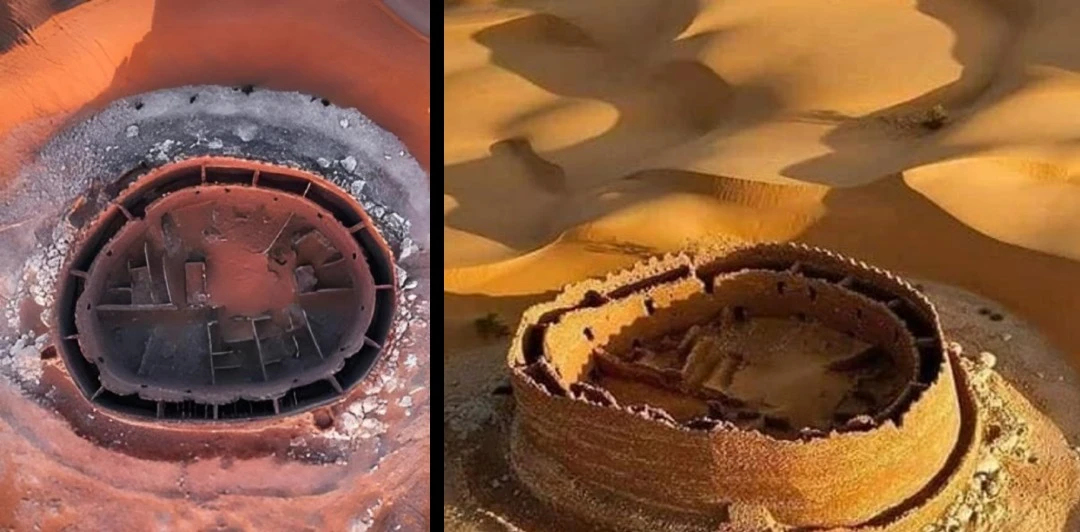
Unlike most traditional desert palaces, the Deraa Palace stands out for its circular or semi-circular design, surrounded by thick double walls and accessible through a single entrance. Inside, the rooms and corridors are arranged in a way that clearly suggests a defensive purpose. Some researchers believe this architecture points to its use as a fortress protecting trade caravans crossing the desert with gold, salt, ivory, and other valuable goods. Others think it may have served as a fortified granary or storehouse for provisions. There are also those who suggest it was a refuge for a group seeking shelter during a period of unrest. However, none of these theories have been definitively proven.
Was it built by Jewish communities?
One of the most widely circulated stories links the palace to Jewish groups who either lived in the Touat region or sought refuge there after events in the late 15th century. However, this theory is based on local historical accounts, and no archaeological evidence has been found inside the palace to confirm the identity or religion of its inhabitants. As a result, it remains just one possibility among several.
When folklore takes over
Whenever documentation is lacking, legend steps in to fill the gaps—and that's exactly what happened with Deraa Palace. In local folklore, it's said that the fortress hides a treasure buried by its owners before they vanished, and that this treasure is not left unguarded but is protected by supernatural forces or desert spirits, making it impossible for anyone to reach it, no matter how hard they try.
These stories align with one of North Africa's most famous folk beliefs: the idea of the 'guarded treasure.' According to this belief, some ancient treasures are protected by spirits and can only be retrieved through special rituals or with permission from these supernatural guardians. Still, it's important to separate folklore from historical fact, so far, there is no archaeological study or credible testimony confirming that Deraa Palace has witnessed paranormal phenomena, mysterious entities, or unexplained events.
Why was it abandoned?
If the palace was indeed an important stop for caravans or a defensive fortress, why was it left behind? No one knows for sure. Trade routes may have shifted, water sources could have dried up, or its residents might have left due to changing political or economic conditions. Over the centuries, the wind has pushed sand dunes up against the site, making it seem as though it emerged from the heart of the desert itself. Today, it stands silent as the landscape of sand changes around it year after year.
Between history and the supernatural
Deraa Palace might simply be a desert fortress whose name faded with time, or it could be the last witness to a forgotten chapter in the history of trans-Saharan trade. The legends of spirits and hidden treasures are likely just human attempts to fill the void left by missing records, much like what has happened with dozens of mysterious archaeological sites around the world. Yet, this doesn't diminish the awe the place inspires.
Sometimes, what unsettles us most isn't the idea of ghosts, but standing before a massive structure built with tremendous effort, only to realize that we still don't know who built it, when it was constructed, or why this particular location was chosen. Perhaps that's why Deraa Palace continues to capture the imagination more than many legends do: its mystery isn't the product of stories, but of history itself.
About the Author