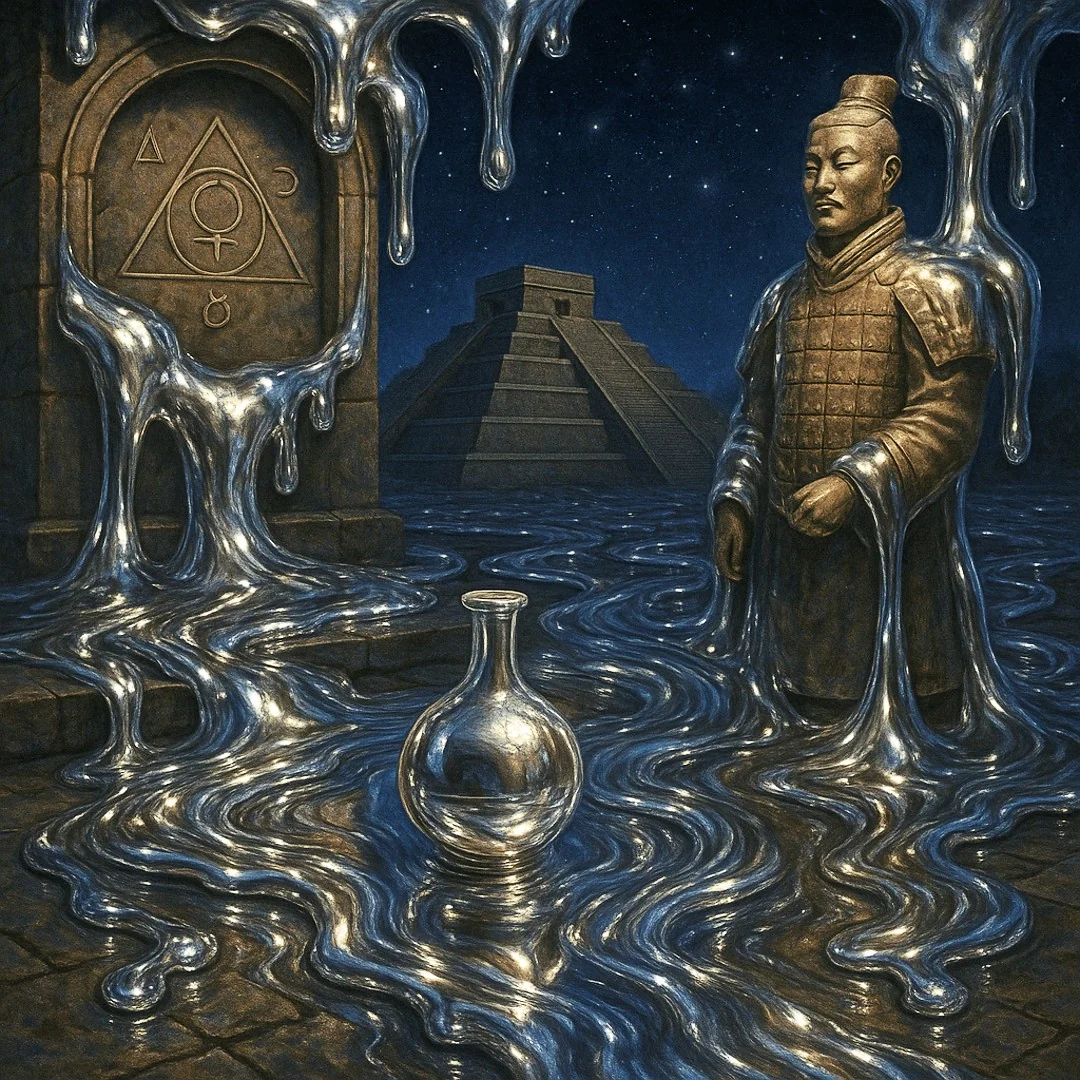
Its mesmerizing silver sheen and fluid movement gave it an almost sacred aura in the eyes of ancient peoples. Mercury was used in magical rituals and alchemy, and became associated with immortality, hidden treasures, and even the underworld. This article explores both the mystical and scientific roles of mercury, along with the latest archaeological discoveries that highlight its significance in ancient civilizations.
The Alchemist’s Dream: Turning Mercury into Gold
Jabir ibn Hayyan considered mercury a fundamental component in the formation of metals, symbolizing the spirit in his 'mercury and sulfur' theory. It was believed that the perfect blend of mercury (the spiritual aspect) and sulfur (the material aspect) could produce precious metals like gold.
In Latin America
In Latin America, mercury is still used today in rituals to cleanse homes of evil spirits and attract prosperity. It’s sprinkled in the corners of houses or added to candle oils in spiritual shops known as Botanicas, symbolizing energy and protection.Among the Maya and Aztec civilizations, mercury held religious and spiritual significance. The Maya used cinnabar to decorate royal tombs, and archaeologists have found vessels containing liquid mercury at six different sites possibly as symbols of magical mirrors or sacred water. Mercury was poured into shallow clay dishes to create 'magic mirrors' believed to reflect hidden worlds. Priests would gaze into the mercury’s surface to divine the future or communicate with spirits. The discovery of mercury-filled vessels in elite Maya tombs suggests it played a role in sacred rituals. Recent studies have also revealed high levels of mercury contamination in Maya archaeological sites, likely a result of these ancient practices.
In 2015, archaeologists discovered a pool of liquid mercury beneath the Temple of the Feathered Serpent (Pyramid of Teotihuacan) in Mexico. This liquid is thought to have symbolized the underworld or a river separating the living from the dead, underscoring mercury’s importance in the religious ceremonies of ancient Mesoamerican peoples.
In Ancient Europe
The ancient Greeks believed mercury possessed magical powers that could bring inanimate objects to life. They would place mercury inside wooden or bronze statues, and its heavy, fluid movement would make the statues appear alive or inhabited by a divine spirit. Priests used this trick in temples to inspire awe among worshippers, while inventors like Hero of Alexandria incorporated mercury into theatrical devices and astonishing machines. For the Greeks, mercury symbolized the animating spirit that breathed life into the lifeless, making it a key element in alchemy and magical rituals.
In Ancient China
From China to India, mercury was believed to have the power to extend life or even grant immortality.
In Hinduism, mercury known as Parad was used in complex spiritual rituals. But it was in ancient China that humanity’s fascination with mercury as an elixir of immortality reached its peak.
Emperor Qin Shi Huang (221–210 BCE), who unified China, was obsessed with achieving eternal life. He ordered alchemists to create mercury-based elixirs, believing they would grant him immortality. Ironically, his consumption of these potions led to his death by mercury poisoning. According to historian Sima Qian, Qin’s mausoleum was designed as a map of China, with rivers of mercury flowing beneath the floor and a star-studded dome above. Modern studies have confirmed extremely high mercury levels in the soil around the tomb, supporting these ancient accounts. The obsession with mercury continued for centuries, with more than a dozen Chinese emperors dying from similar poisoning—an enduring testament to the tragic side of humanity’s quest for immortality.
In Ancient Egypt
Despite the widespread modern myths surrounding what is known as Pharaonic Red Mercury, scientific evidence shows that the ancient Egyptians used cinnabar (mercury sulfide) as a pigment to decorate tombs and murals. There is no evidence that liquid mercury was ever used in the mummification process. Dr. Zahi Hawass has also confirmed that so-called "red mercury" is nothing more than a myth exploited by charlatans to deceive treasure hunters.
Treasure and Gold Hunting
Because mercury can bind to gold, a legend emerged claiming it could attract buried gold underground. In the Arab world, this idea evolved into the story of red mercury, which is said to be used in rituals to summon spirits and reveal the locations of hidden treasures, even though scientists insist it doesn't exist. There are stories about sorcerers mixing mercury with herbs and incense for this purpose, but these practices have no scientific basis and are often just tricks used by fraudsters to exploit those seeking wealth.
Is it scientifically possible to turn mercury into gold?
Both gold (Au) and mercury (Hg) belong to Group 11 of the periodic table, which also includes copper and silver—precious metals that have fascinated alchemists for centuries. The dream of turning mercury into gold was only partially realized with the advent of modern nuclear science. Gold and mercury are neighboring elements in the periodic table, differing by just one proton (gold has atomic number 79, mercury 80). Transforming mercury into gold requires changing its number of protons through nuclear reactions, which is possible in particle accelerators or nuclear reactors by bombarding mercury isotopes with high-energy particles.
However, this process consumes enormous amounts of energy and produces only tiny traces of gold, making it economically unfeasible. In nature, both gold and mercury are formed in the hearts of massive stars through nuclear fusion and stellar explosions, such as supernovae.
This shows that the ancient alchemists' dream wasn't pure fantasy, but achieving it is millions of times beyond the capabilities of early technology.
In the end, mercury remains a metal that embodies humanity's struggle with the unknown. To the ancients, it was a magical liquid promising immortality and hidden treasures; in modern science, it symbolizes advances in nuclear physics and our understanding of the universe. Between legend and science, the story of mercury stands as a testament to our desire to push the boundaries of nature—even if the price is a deadly poison or a curse buried deep within the earth.Mercury's Rarity and Production
Mercury is relatively rare in the Earth's crust, though not as scarce as gold or platinum. Its concentration is about 0.08 parts per million—roughly 80 grams per million tons of rock. Mercury is most often found as mercury sulfide (HgS), known as cinnabar, which is the main ore used for extraction. The largest historical deposits were in Almadén, Spain, which produced about a third of the world's mercury over more than 2,000 years.
Today, mercury is produced in limited quantities, with global annual production ranging from 2,000 to 3,000 tons. Demand has dropped due to environmental and health concerns, and mercury has been replaced in many applications such as thermometers and older types of lamps.
Despite its relative rarity, mercury is not considered a precious metal like gold because it is relatively inexpensive and was more widely available in the past. Its fame comes not from abundance, but from its unique properties, being the only naturally liquid metal and its historical roles in magic, alchemy, and ancient medicine.
About the Author