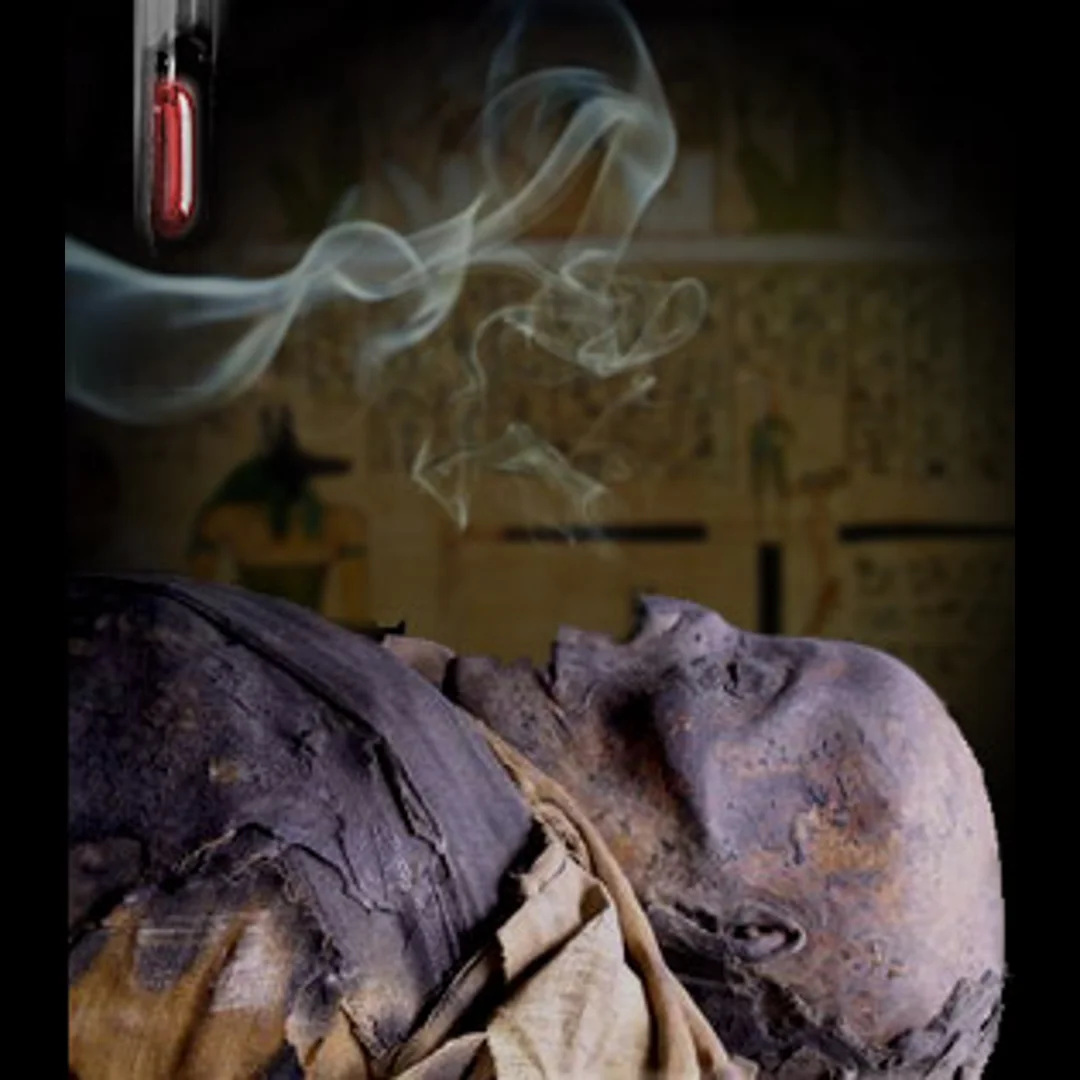
The renowned chemist Jaber ibn Hayyan (often referred to as the "Father of Chemistry") explained that mercury exists in two forms.
The first is metallic mercury, which naturally occurs in the environment. The second form, according to him, is a type of mercury extracted from all existing materials, meaning it is composed from all elements found in nature. In more recent times, this second form has become popularly known - especially among less-educated individuals, and surprisingly even among some educated circles - as "Pharaonic Mercury." However, rather than classifying it as a scientific chemical compound, many treat it as a magical substance endowed with extraordinary and supernatural properties.
Scientifically, it is impossible for such a compound to exist, as no known material is composed of all the elements listed in Mendeleev’s Periodic Table. Before delving further into the corridors of the Pharaonic Mercury legend, it is worth recalling a brief episode from the life of Jaber ibn Hayyan. He acquired much of his early knowledge from his father, Jaber ibn Abdullah, a practicing Attar (an Arabic term for a herbalist and pharmacist), who taught him the secrets of metals and stones. However, his father warned him sternly against pursuing the fabled Elixir (better known as the Philosopher’s Stone - see more below), a substance that scientists and seekers had madly pursued throughout the ancient and medieval worlds.
The obsession with the Philosopher’s Stone stemmed from the belief that it could transmute base metals into gold - a dream that fueled the development of alchemy. It was also imagined to be the elixir of life, capable of granting immortality to its discoverer. Interestingly, the modern myth of Pharaonic Mercury, which has captivated many minds across the Middle East, bears striking similarities to these ancient obsessions. Even today, countless individuals desperately chase after this elusive material - fighting, struggling, and sacrificing - despite the fact that, ultimately, they will never find it. The following sections will explore the true origins of this alleged "mercury."
The Pharaonic mercury as a "Magical Material"
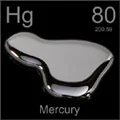
Those who search for Pharaonic mercury claim it to be a magical substance, resembling in appearance, but not in properties, the common white medical mercury (which actually has a silver color) found in pressure gauges and thermometers. However, unlike standard mercury, Pharaonic mercury is said to appear in various other colors, including red, yellow-green, and black.
According to their claims, this mercury is contained within a stone vessel, often referred to as an ampoule ,a term they use to describe the cartridge that allegedly houses the substance. This stone ampoule is peculiar in that it has no visible opening or vent, yet it is hollow inside. When the ampoule is shaken, it supposedly produces a sensation of internal movement without making any sound.
When skeptics or more knowledgeable individuals question how the mercury could have been placed inside the sealed stone ampoule without an opening, the believers respond that this is one of the many magical feats attributed to the ancient Pharaohs, one of several extraordinary properties linked to this mysterious material.
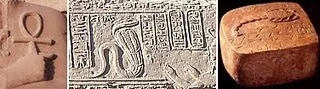
The ampoule itself is described as being adorned with ancient Egyptian symbols: a scorpion on one side, a cobra (another important Pharaonic symbol) on the other, and most importantly, the ankh or key of life, symbolizing the Pharaohs' concept of immortality. It is further claimed that such an ampoule would be hidden within the mummified remains of a royal figure, placed either in the throat of a king to prevent bodily decay, disintegration, and rot, or, in the case of queens, inserted into the vaginal cavity for the same purpose.
Comment
According to this belief, these magical Pharaonic mercury ampoules are said to exist only within royal tombs. However, despite extensive archaeological exploration of such tombs, no stone ampoules resembling these descriptions have ever been found — neither in the tombs themselves nor within the mummified remains of kings or queens. In reality, no such artifacts matching these claims have been discovered.
The Trade
It is claimed that each Pharaonic mercury ampoule contains three and one-third grams of mercury — meaning three full grams plus an additional third. Some ampoules are said to contain seven and one-third grams, with these being slightly larger in size. Curiously, the significance of that precise "one-third gram" is unclear, especially considering that mercury grains are microscopically small and difficult to measure by the naked eye. What purpose that extra fraction serves remains unexplained.
The Pharaonic mercury allegedly appears in three color varieties:
Red Mercury: The cheapest type, valued at around $15 million per gram. A full ampoule containing three and one-third grams would sell for $45 million, though the one-third gram is supposedly given "as a bonus."
Yellow-Green Mercury: Priced at $20 million per gram.
Black Mercury: The rarest and most expensive, costing $30 million per gram.
Physical Characteristics Allegations
Supporters of the legend claim that if a Pharaonic mercury ampoule were to be broken, the spilled mercury would gather into a single large droplet without being absorbed into the earth or contaminated by dust. Additionally, they assert that if the one-third gram is separated from the main three grams and the remaining mercury is resealed inside the ampoule, shaking the ampoule would no longer produce the same internal sensation of movement , a sensation that only returns once the missing one-third gram is replaced.
Comment
It is important to note that ordinary medical mercury, a naturally occurring metallic element in liquid form, behaves in the same way, forming cohesive droplets and resisting absorption into dust. Therefore, there is nothing miraculous or unique about the alleged physical behavior of so-called Pharaonic mercury.
Health Benefit Allegations
Some proponents go even further, claiming that Pharaonic mercury in any of its three-color variants — possesses astonishing healing powers. Traders allegedly purchase it for millions, aiming to resell it to princes, kings, and wealthy individuals suffering from aging or impotence. According to these claims, injecting just one gram into the final vertebra at the base of the spine can miraculously restore youth, vitality, and sexual prowess, even to men over a hundred years old. The substance is also alleged to cure diseases such as blindness, leprosy, arthritis, and other chronic conditions.
Alleged Use: Harnessing Jinn
Charlatans (or "sheikhs," as some refer to them) are said to use Pharaonic mercury to feed their servant jinn. According to the myth, doing so rejuvenates the jinn — restoring their vitality and youth, much like the legendary Fountain of Youth. For example, a jinn said to be five thousand years old could, after consuming this mercury, revert to the strength and energy of a thirty-year-old.
These rejuvenated jinn are then allegedly tasked with extracting vast treasures ,including billions of dollars, from banks, without being detected by guards, employees, or surveillance systems. Supposedly, the jinn can penetrate bank vaults and steel safes invisibly, stealing their contents without leaving a trace.
Comment
Such claims, of course, defy all logic and reality. In any banking system ,whether Swiss or elsewhere , funds are meticulously tracked and audited daily. The unexplained disappearance of even a few hundred dollars would trigger serious alarms, leading to immediate investigations and potentially widespread media coverage. The notion that billions could vanish undetected, without any breach or physical tampering, is utterly implausible.
Methods of Swindle and Fraud
The fraudulent trade of Pharaonic mercury typically involves multiple intermediaries acting between the ampoule’s supposed owner and a potential buyer. Once a willing buyer is found, the seller begins to set conditions indirectly through these intermediaries. A key demand is that the full payment must be made before the ampoule is broken open to verify its contents.
If the potential buyer, often a sheikh or wealthy individual from outside Egypt, he may insist on verifying the authenticity first. In response, the intermediaries arrange a series of so-called "tests" to prove the ampoule’s legitimacy:
First Test: The owner must place the ampoule behind his back. If an involuntary physical reaction (such as an erection) occurs, it is considered a sign of authenticity.
Second Test: The ampoule is placed in front of an electric lamp. If the lamp explodes, the test is deemed successful.
Third Test: The ampoule is positioned near a television screen. If the TV device explodes or malfunctions, the test passes.
Fourth Test: The ampoule is placed before a mirror. If no reflection of the ampoule appears, it signifies authenticity.
Fifth and Final Test: The ampoule is broken, and its mercury contents are placed into a metal dish. If the mercury beads gather into a single droplet, garlic cloves are added; if the mercury then scatters and separates, this is taken as final confirmation of its magical nature.
After the ampoule owner informs the intermediaries representing the merchant or sheikh that he has successfully completed all the required tests, these intermediaries who have neither seen the ampoule nor personally witnessed the so-called tests, report back to the merchant or sheikh. In response, the merchant or sheikh demands a final verification test before traveling to Egypt and paying the full price for the ampoule.
This final test requires the ampoule owner to hold the ampoule in his left hand and then call the sheikh on his mobile phone. During the call, the sheikh would allegedly harness his jinn through the phone, reciting spells to confirm whether the ampoule truly contains Pharaonic mercury. However, upon hearing this request, the ampoule owner typically refuses. He claims that the sheikh might use the jinn to steal the contents, siphoning the mercury grains invisibly, leaving the ampoule empty and worthless, or worse, use the mercury to command jinn to loot banks. Thus, the ampoule would lose its magical powers, becoming completely valueless and unsellable.
This entire superstitious process often drags on for many months, during which the intermediaries desperately seek another sheikh. When they eventually find one willing to inspect the ampoule in person, they propose that he travel to Egypt. They agree that if the ampoule is verified as genuine, he must pay the full price, including a commission for the intermediaries. However, if the tests fail, they agree in advance that the intermediaries must pay a substantial penalty fee.
What usually happens is that the sheikh or merchant wins the penalty because he is already certain that Pharaonic mercury does not exist. It becomes a profitable trap, exploiting the foolishness of intermediaries who spend lavishly on international communication, travel, and negotiations, chasing a myth. They only see the ampoule for the first time when the sheikh arrives, a stone tube engraved with a scorpion, a cobra, and a key of life, but when broken, it merely contains tiny droplets of ordinary medical mercury, worth less than a fraction of a penny.
Sometimes, the scam succeeds for the ampoule owner; other times, the fraudulent sheikh or merchant profits instead. The cycle repeats endlessly. Among these gullible circles, rumors have even spread about another substance called "white spiritual mercury" allegedly natural mercury imbued with "light enchantments." However, this "spiritual mercury" is useless, has no real value, and no one in the mercury trade market wants it.
Red Mercury Scam
Another variant of the scam involves what they call "German Mercury Ampoules." Fraudsters claim that this red mercury is extracted from old German-made equipment such as high-voltage transformers from Egypt's High Dam, vintage German televisions, or even Singer sewing machines.
They describe the ampoule as a piece of glass similar to those used in fire-sensor systems in hotels, claiming it contains red mercury grains. They use this to trick wealthy buyers into believing it is Pharaonic mercury.
When experienced swindlers or veteran sheikhs inspect the ampoule, they often pretend it still has value, claiming it can be sold for one million Egyptian pounds if the ampoule passes certain tests. They then buy it cheaply and resell it to naïve wealthy individuals as "genuine" Pharaonic mercury.
The German mercury undergoes two tests:
Paper Test: After breaking the ampoule and emptying its contents into a metal or glass dish, the mercury is placed on a paper tissue. If the tissue absorbs the red color, it proves the mercury was merely artificially dyed white mercury. If the tissue does not absorb the color and the red hue remains, the mercury "passes" the test.
Lemon Test: Lemon juice is squeezed over the mercury grains. If the color changes from red to white, the test fails. If the color remains unchanged, the mercury "passes."
The reality is that most so-called "red mercury" is nothing more than white mercury dyed red , a delicate process requiring an expert chemist. Moreover, the coloring fades within a few days, meaning the fraudsters must sell it quickly before the deception is exposed. Even if the scam is uncovered later, the buyers are usually unable to find the swindlers again. Some scammers even use red nail polish inside glass or stone ampoules, selling them as "German red mercury," further deceiving foolish intermediaries or greedy buyers.
Priest Oil Scam
Another lesser-known but related scam involves the so-called "Priest Oil." This substance, supposedly found in small glass bottles placed under the heads of Pharaonic mummies, is claimed to be a magical oil created by ancient Egyptian priests.
Although less expensive than Pharaonic mercury, it is still sold at a high price. Charlatans claim it cures leprosy, rheumatoid arthritis, joint pain, and even hair loss, simply by rubbing a small amount on the affected area.
Comment
Curiously, ancient Egyptian priests were entirely bald, as part of their religious practices, contrary to priests of other civilizations who often grew their hair long. In fact, most ancient Egyptian men were bald.
Thus, if "priest oil" were truly a remedy for hair loss or skin diseases, it would logically be a natural mixture of herbs, similar to the compounds used in mummification, rather than some magical jinn-infused potion. Linking it to sorcery and jinn serves only one purpose: to exploit people's ignorance and hunger for quick riches.
A True Story: The Deception of Mr. Shaker
One of the most striking real-life examples involves a wealthy and well-known Egyptian businessman, Mr. Shaker (aged 50). Blinded by greed, he fell victim to a con artist who claimed to possess knowledge of extracting billions of dollars from Swiss and European banks using red mercury and jinn.
The charlatan convinced Mr. Shaker to buy a red mercury ampoule allegedly extracted from a Pharaonic tomb, urging him to seize the opportunity, as such mercury was exceedingly rare. Shaker, driven by ambition, paid a staggering $15 million for the ampoule.
After purchasing it, Shaker and the fraudster returned to Shaker’s villa. The charlatan instructed Shaker to provide a young girl, supposedly for a ritual to summon and feed the jinn. Over the next month, the conman lived lavishly at Shaker’s expense, enjoying luxury food, wine, and women.
Eventually, he told Shaker that the jinn had already retrieved billions, now hidden in the desert. Excited, Shaker mobilized vehicles, workers, and bodyguards to dig at the indicated site. Sure enough, cartons filled with cash appeared but before Shaker could verify them, fake police officers (the charlatan's accomplices) stormed the area, forcing everyone to flee.
Trick Revealed
In reality, the entire scheme was staged. The red mercury was fake. The cartons contained just a few real bills atop stacks of blank paper. No Pharaonic mercury has ever been found in any royal tomb, including the famous tomb of Tutankhamun, nor is it mentioned in any ancient papyri or funerary texts.
The idea that a precious magical substance could be left behind while all other treasures were looted is absurd. What Shaker encountered was nothing more than cleverly orchestrated fraud.
The charlatan, having tricked Shaker and spent a month enjoying luxury, orchestrated the staged police raid to create plausible deniability and escape.
Arrest and Aftermath
A year later, the con artist was arrested during a similar fraud attempt, this time by real police. His name and photo appeared in official newspapers, finally revealing the truth to Shaker who remained silent but deeply ashamed at having been so thoroughly deceived, despite being a highly educated and prominent businessman.
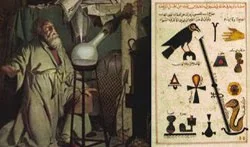
The Philosopher’s Stone: The Ultimate Goal of Alchemy
The Philosopher’s Stone is a legendary substance believed to have the ability to transform base metals, such as lead, into gold, and to be a key ingredient in creating the fabled Elixir of Life. The concept of the Philosopher’s Stone is rooted in the ancient science of alchemy, which has its origins in ancient Egypt.
However, the idea of transmuting inferior metals into precious ones, such as gold or silver, can be traced more precisely to the works of the Arab alchemist Jabir ibn Hayyan. Drawing on Aristotle’s philosophy, Jabir classified natural properties into four fundamental qualities: heat, cold, dryness, and moisture. According to this view, fire is hot and dry, earth (dust) is cold and dry, water is cold and moist, and air is hot and moist. Jabir proposed that minerals were composed of combinations of these four elements, two intrinsic and two external. Thus, he theorized that by rearranging these elemental properties, it would be possible to transform one metal into another.
This transformation, according to alchemical belief, would be facilitated by a mystical substance known as the Elixir, sometimes described as a red powder derived from the legendary Philosopher’s Stone.
Some scholars suggest that Jabir ibn Hayyan conceived the idea of the Philosopher’s Stone based on his knowledge of alloys where precious metals like gold or silver could be concealed within mixtures and later extracted through chemical treatment. Jabir is also credited with inventing aqua regia, a potent mixture of nitric acid and hydrochloric acid, notable for being one of the few substances capable of dissolving gold, a method still used today by jewelers and gold refiners.
In ancient times, gold was regarded as an incorruptible metal, immune to decay, tarnishing, or corrosion. Since the Philosopher’s Stone was thought to transform corruptible metals into incorruptible ones, many people concluded that it could also grant immortality to humans. This belief reached its peak during the Middle Ages, when the quest for the Philosopher’s Stone and the Elixir of Life captivated countless alchemists and adventurers.
The fascination with the Philosopher’s Stone persisted for centuries, until the modern scientific definition of chemical elements was firmly established by scientists such as Antoine Lavoisier, debunking the myths of transmutation.
In the end, every era has its myths whether it be the Philosopher’s Stone and the Elixir of Life during Europe’s Dark Ages, dominated by superstition and magic, or modern myths like the Pharaonic Mercury, which continue to captivate some even amid today’s incredible advances in science and technology.
About the Book
This article is adapted from the book "Charlatans & the Search for Pharaohs' Treasures," which exposes the deceptive practices employed by fraudsters and magicians to smuggle ancient Egyptian artifacts or extort money from unsuspecting victims. The book categorizes and defines different types of charlatans and magical practices throughout history, recounts numerous real-life stories including the myths surrounding red mercury, the harnessing of jinn to uncover hidden treasures, and the supposed urban miracles of the Pharaohs and explores methods of archaeological excavations.
The book was completed in 2008.
Sources
- "Charlatans & Searching for Pharaohs Treasures ", written by "Hisham Abdel-Hamid"About The Author