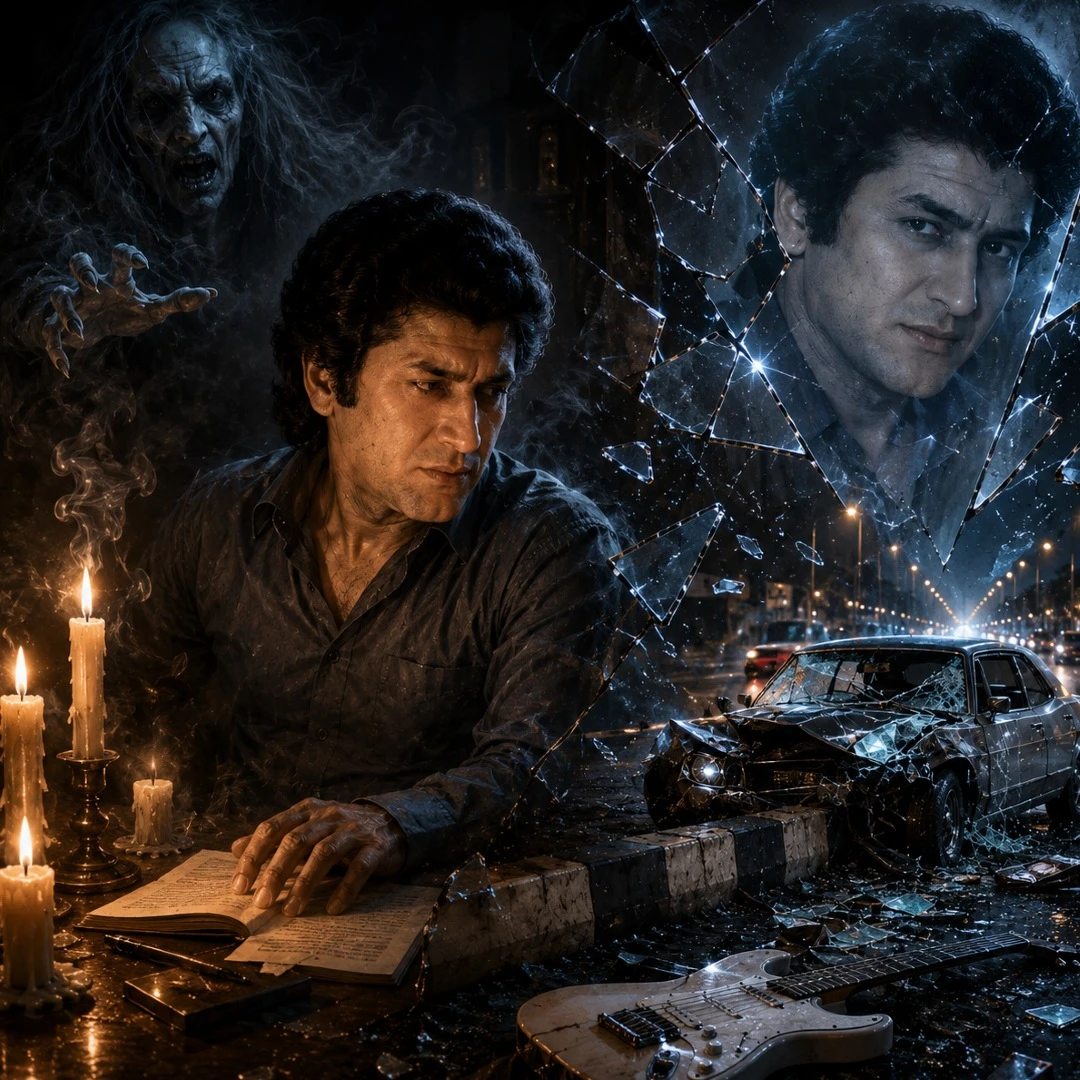
In the early hours of Friday, May 29, 1981, Cairo’s Al-Haram Street was quiet, lit only by the occasional passing car. No one could have predicted that this night would mark the end of one of the Arab world’s most famous musicians.
Suddenly, the car driven by musician Omar Khorshid swerved violently and crashed into the median. The vehicle was destroyed, glass scattered across the road. Khorshid died at just 36 years old, while his wife, who was with him, survived. Actress Madiha Kamel, driving in a car behind them, witnessed the accident.
The incident was officially recorded as a traffic accident, but controversy has surrounded it ever since. Some witnesses claimed another car was chasing Khorshid before the crash, and theories of political assassination or a deliberate killing soon emerged. However, investigations were never able to confirm any of these suspicions.
Amid all these stories, one account stood out as stranger than the rest: a tale that claims Omar Khorshid experienced a mysterious event in his office just days before his death—an event that ended with a phrase that, after his passing, seemed almost prophetic.
Who was Omar Khorshid ?
Born in 1945, Omar Khorshid was one of the most influential guitarists in the history of Arabic music. Known for blending Eastern melodies with Western arrangements, he recorded with legends like Umm Kulthum, Abdel Halim Hafez, Warda, and Nagat El-Saghira. He also acted in several films during the 1970s.
Despite his artistic fame, his personal life was often the subject of controversy, whether due to his multiple marriages or his fascination with mysterious books and spiritual topics. This reputation would later tie his name to a story that has intrigued the public for decades.
A Sudden Change in His Final Days
According to a widely circulated account attributed to journalist Hassan El-Hefnawi, those close to Omar Khorshid noticed a marked change in him during his last days.
He became noticeably calmer, more devoted to prayer, and less interested in the lively nightlife he was once known for.
This transformation led some who knew him to wonder: Did he sense that his end was near? Or had something happened to him that he couldn’t quite explain?
The Night the Candles Went Out
Hassan El-Hefnawi recounts that Omar Khorshid personally told him about a strange incident he experienced alone in his office.
One night, Khorshid was quietly reading a book when the power suddenly went out. He opened his desk drawer, took out several candles, placed them around the room, and lit them.
He returned to his seat, but just as he was about to reopen his book, something happened that made him freeze in place.
All the candles went out at the exact same moment. There was no draft—the doors and windows were closed. At first, he thought it was just a coincidence and tried lighting them again.
But strangely, the candles refused to stay lit. He tried several more times, but it was no use.
Trying to ease his nerves, he burst out laughing and joked:
""What, do I have a ghost with me in the office or something?""
A voice came out of nowhere.
In the next moment, the joking gave way to fear. In the silence, Omar heard a strange voice with no clear source. He couldn't see anyone, nor could he describe any figure or shape, but he felt as if someone was standing close by, speaking to him. The original account doesn't specify what was said that night, but it was enough to make Omar leave the office immediately, abandoning everything behind.
The surprise the next morning
Omar returned to his office the following morning.
He opened the door and stood in shock. All the candles he couldn't light the night before were now burning—and, even stranger, they hadn't melted as you would expect if they'd been burning all night. He tried blowing one out, but it wouldn't go out. He tried several times, but nothing happened.
At that moment, he realized that what was happening defied any logical explanation.
When he began to recite the Quran
He opened his desk drawer again and took out the Holy Quran. As soon as he started reciting, all the candles went out at once. Stunned, he paused for a moment, but then continued reading. Suddenly, he felt an invisible hand grip his arm tightly. Despite his fear, he kept reciting. Moments later, the sensation vanished completely, as if nothing had happened.
A confession shrouded in mystery
Some time later, Hassan El-Hefnawy visited Omar Khorshid in his office. During their conversation, Omar told him about what he had experienced that night, adding that he sometimes heard strange noises in the office.
Hefnawy asked him, "So, what did it say to you?"
Omar fell silent for a moment, then replied with the phrase that would become the most famous part of the story:
"It told me: 'Your face is reflected in the shards of glass... and I have no idea what that means.'"
Hefnawy smiled and said, "Neither do I."
The voice never said Omar would die, never mentioned a time, a car, or an accident. It was just a cryptic phrase that no one understood at the time.
A few days later... the accident happened
Just a few days later, on the night of May 29, 1981, according to reports at the time, Omar Khorshid was driving his car at night on Al-Haram Street with his wife beside him. Actress Madiha Kamel was driving behind them.
Omar's wife and Madiha Kamel both said another car was following Omar and harassing him. It turned into a brief chase before Omar lost control and crashed into the median. He died from his injuries, while his wife survived.
Later, police identified and questioned the driver of the other car. He denied deliberately chasing Omar or causing his death, and the investigation could not prove there had been a planned assassination.
But for many, the sight of shattered glass around the car brought back memories of that mysterious phrase:
"Your face is reflected in the shards of glass."
Was it a prophecy?
This is where the most controversial part begins.
The story never claimed that the entity identified itself as a jinn, or that Omar saw it with his own eyes, or that it told him exactly when he would die. All of these interpretations came after the accident. The phrase could be seen as a personal experience Omar had that no one could explain, or as a story that was reinterpreted after his death—turning it into a prophecy or a tale that evolved over time, with new details added that weren't in the original account.
Adding to the mystery is the fact that, to this day, the original issue of "Al Kawakeb" magazine attributed to Hassan El-Hefnawy's article has never been found, even though dozens of websites retell the story. For this reason, it's important to treat it as a widely circulated journalistic account rather than a verified historical document.
Between the supernatural and assassination
More than forty years later, the death of Omar Khorshid still follows three parallel narratives:
The first is the official version, which holds that it was a nighttime car accident, possibly caused by speeding or a chase mentioned by witnesses, but with no forensic evidence to support the theory of assassination.
The second centers on assassination theories—whether for political or personal reasons—which have remained in the media spotlight, though never supported by definitive proof.
The third is the paranormal angle, based on Hassan El-Hefnawy's story, which interprets the cryptic reference to "glass shards" as a warning that preceded the tragedy.
In the end, this incident remains shrouded in controversy, with a personal account that's difficult to verify and a mysterious phrase that continues to spark the imagination far more than it provides any final answers.
Perhaps that's why, more than four decades after his passing, Omar Khorshid's name is still linked not only to his music but also to one of the most intriguing paranormal stories in the history of Arab art.
About the Author