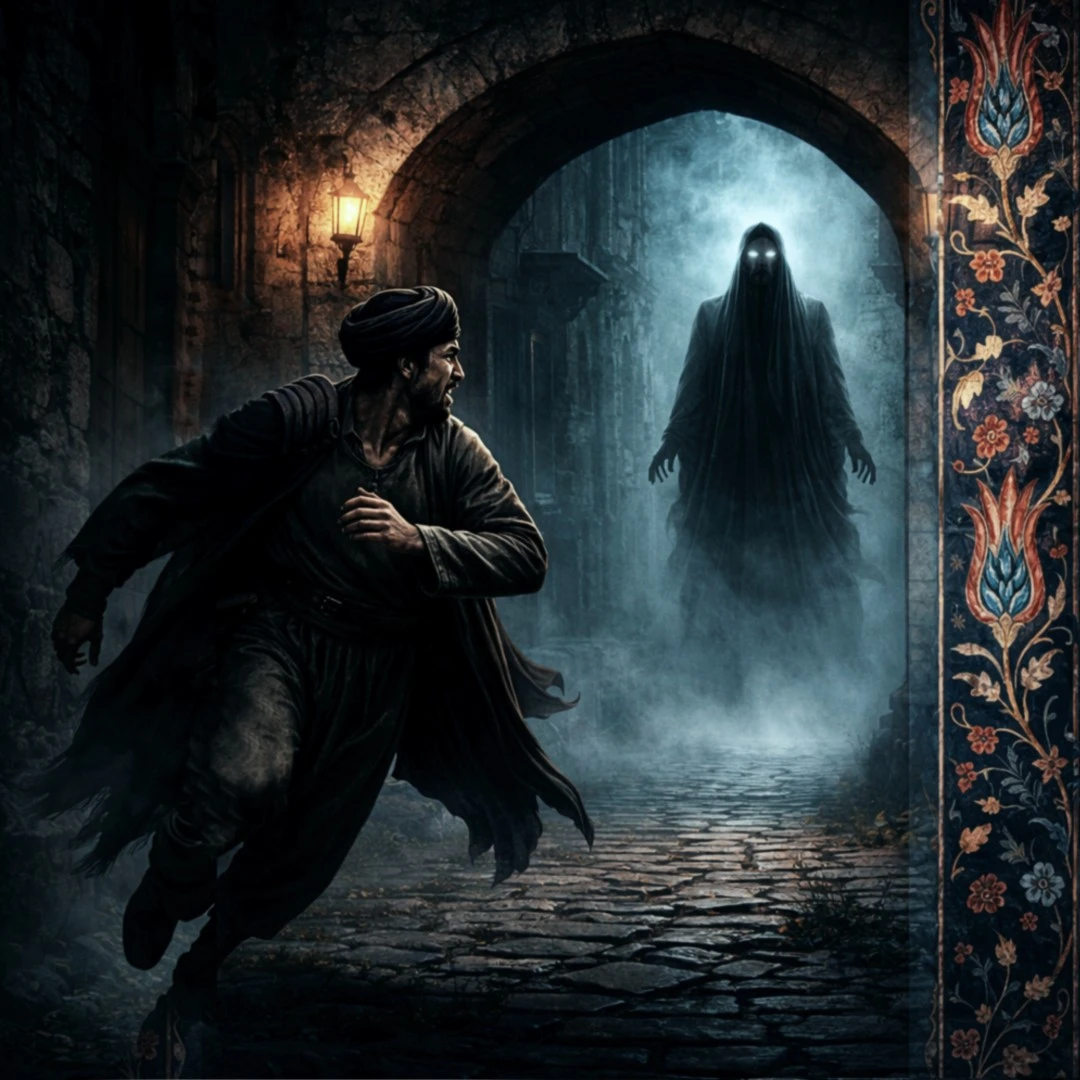
Not all jinn stories from Ottoman folklore were simply told for entertainment. Some are what folklorists call 'memorates'- accounts presented as real-life experiences, either lived by the storyteller or heard directly from witnesses. These tales aren’t told with the classic 'once upon a time' introduction, but rather as reports of mysterious events that happened in a mosque, on a road, or in an abandoned house.
A prime example of this style is found in the stories of the Ottoman writer Cinânî. In his works, jinn aren’t just imaginary beings, they blend into everyday life, appearing as people, voices, or passersby, only to later reveal their otherworldly nature.
The power of these stories lies not just in what they describe, but in how they’re told as if they really happened, not just as products of imagination.
Who was Cinânî?
Cinânî was a 16th-century Ottoman poet and writer, not just an anonymous collector of folk tales. His real name was Mustafa, known in Ottoman sources as Mustafa Çelebi. Born in Bursa - Türkiye or Anatolia region, he died around 1595. He was a court poet, a teacher, and a writer, and became known for his love of stories, anecdotes, and tales , not just for his poetry.
Here are seven Ottoman stories, attributed to various narrators and witnesses, that reveal what people experienced when they encountered the jinn:
1) The Man Who Followed the Shadow
One story tells of a man walking at night on the edge of his village when he noticed a shadow moving ahead of him, with no clear source. At first, he thought it was just a natural reflection, but the shadow moved with a will of its own , stopping when he stopped, then drifting ahead as if inviting him to follow. Driven by curiosity, he trailed the shadow to an abandoned area, where it suddenly vanished.
When the man returned to his village, he was changed. He became withdrawn and distracted, as if he’d left a part of himself behind in that place.
2) Unexpected Congregation
One tale from the Ottoman era tells of a man who worked at a mosque and often entered late at night or before dawn. One night, he noticed people already inside, lined up or sitting quietly. At first, nothing seemed out of the ordinary; it looked like a typical gathering for worship. But something about the atmosphere was unsettling: a heavy silence, an unnatural stillness, and movements that seemed just a bit off.
As he approached, he realized some faces looked unfamiliar, smooth, expressionless, lacking normal human features. In stories like this, the shock doesn’t come all at once, but from a small detail that ruins the scene: eyes that never blink, rigid postures, or limbs that don’t move as they should.
Terrified, the man left the mosque and never dared to enter at that hour again. Soon, neighbors began whispering that certain mosques or old prayer halls might be visited by 'other beings' at times when people shouldn’t be there.
3) The Woman Who Moved Into a House That Wasn’t Empty
An Ottoman-era story tells of a woman who moved with her husband into an old house in the city. At first, everything seemed normal. But after a few days, she began noticing faint movements at the edges of the house, then strange sounds, and finally a clear sense that 'someone else' was living there. One night, she woke to find another woman sitting silently in the corner of her room, just watching her. The figure vanished after a few moments, but the experience repeated itself. When a local religious leader was called, he said the house was inhabited by a jinn who had taken the form of a woman and had lived there for years.
4) The Guard Who Learned the Truth Too Late
In another story, a man worked as a night guard at an abandoned facility. He often saw people passing by at night, greeting him and exchanging a few words. He assumed they were workers or locals. But one night, he noticed something strange: as one of them walked away, he saw that the man’s feet were reversed. Terrified, he pretended not to notice.
The next day, locals were asked about those people, and the answer was chilling: 'No one passes through there at night... not for years.'
5) The Tree That Wasn't a Tree
One story from rural Anatolia tells of a road people avoided after sunset. The reason was a large tree standing at a crossroads. Some travelers claimed that, at night, the tree would slowly move... then transform into a tall, mysterious figure watching them.
In one account, a man swore he saw the tree instantly return to its normal shape as soon as daylight reached it. Since then, the spot became known as a haunt of shape-shifting spirits.
6) The Invitation That Should Never Have Been Accepted
An Ottoman storyteller recounts the tale of a young man walking at night who heard his name called from afar. The voice sounded familiar, like that of a friend or relative, so he followed it.
The closer he got, the further the voice seemed to move, leading him out of the village. Suddenly, he realized he couldn't see anyone... but the voice was still close by. Then a whisper came from right behind him: 'You shouldn't have come...'
Terrified, the young man ran for his life. It's said he suffered from bouts of fear afterward, as if something continued to follow him even after he returned home.
7) The Man Who Thought He Was at a Human Feast
This story is a classic of old Ottoman folklore: a person finds himself among non-humans before realizing the truth. One night, a man was passing by an isolated spot or house that seemed to be hosting a lively gathering. He heard voices, saw lights, and maybe even smelled food or incense, so he assumed it was a local celebration or private feast.
As he approached, the people inside greeted him with an unsettling calm. There was no hostility or threat-just a cold acceptance, as if they'd been expecting him.
He sat among them, still believing he was with ordinary people. But gradually, he noticed the faces weren't quite right, the conversation had a strange rhythm, and some guests didn't seem to touch the ground—or their bodies were unnaturally still.
Then comes the pivotal moment: the man spots a single detail that shatters the illusion. It might be an inhuman foot, a sudden movement, or a face that changes for just a second. That's when he realizes he's not at a human feast, but in the company of spirits.
In some versions of this tale, the man escapes by running or invoking God's name. In others, he returns to his people confused, ill, or changed, as if simply entering that space was a boundary no human should cross.
In Ottoman stories, spirits don't always appear as obvious monsters. Sometimes, they're just a subtle disturbance in reality: a shadow that doesn't match its owner, a sound with no source, a person who seems normal until you notice the one wrong detail.
That's where the power of these stories lies: not in what they show, but in what they suggest.
About the Author