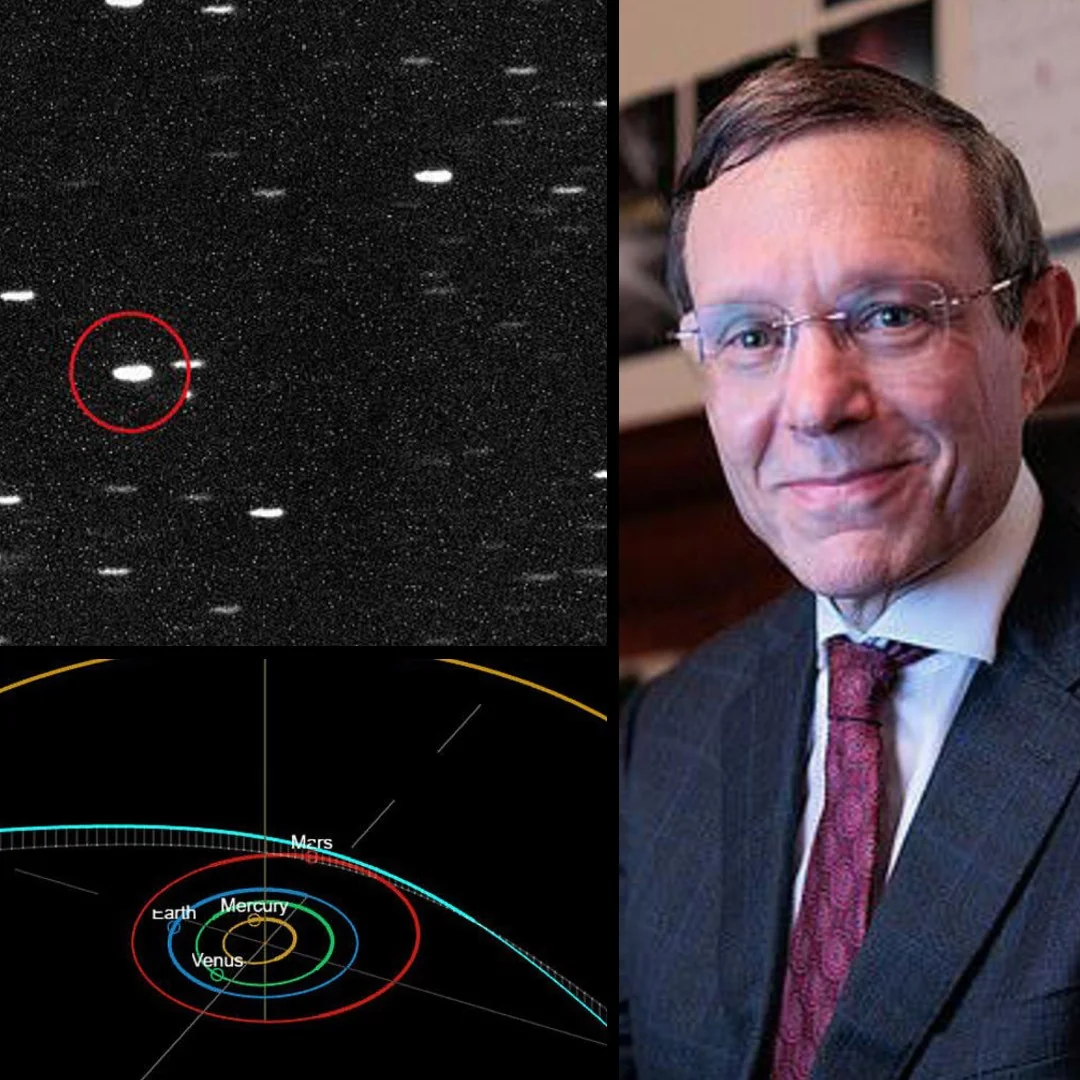
Professor Avi Loeb, an astrophysicist at Harvard University and director of the Galileo Project, which searches for signs of extraterrestrial intelligence, has sparked widespread debate after suggesting that a mysterious object passing through our solar system may not be just a comet, as NASA describes it, but could actually be a nuclear-powered spacecraft.
The object, known as 3I/ATLAS, was photographed by the Hubble Telescope on July 21. The images revealed an unusual brightness concentrated on the side facing the sun. According to Loeb, this glow doesn’t resemble the typical comet tail caused by dust trailing behind, but instead looks like a forward-facing illumination powered by an internal energy source.
Loeb explained that the object's size doesn’t fit the theory that it’s simply reflecting sunlight. To shine this brightly, it would need to be over 20 kilometers long, which is highly unlikely for a free-floating object in interstellar space. He also pointed out that its path through the solar system appears unusually precise, as it’s set to pass close to three major planets—Venus, Mars, and Jupiter. Loeb estimates the odds of this happening by chance are just one in 20,000.
However, many scientists have dismissed these ideas. Among them is Oxford astronomer Chris Lintott, who called the suggestion that the object is artificial "nonsense" and said it undermines serious research into understanding this celestial body.
3I/ATLAS is expected to make its closest approach to Earth on December 17, 2025, before leaving the solar system in early 2026. Until then, Loeb insists on continuing to monitor the data, maintaining that what we’re witnessing is "not just an ordinary natural event."
Loeb also revealed that he has been in contact with U.S. Representative Anna Paulina Luna, who is involved with the congressional committee overseeing disclosures related to unusual aerial and space phenomena (UAPs). He mentioned the possibility of redirecting NASA’s Juno probe, currently orbiting Jupiter, to intercept the object and investigate it up close.
About the Author