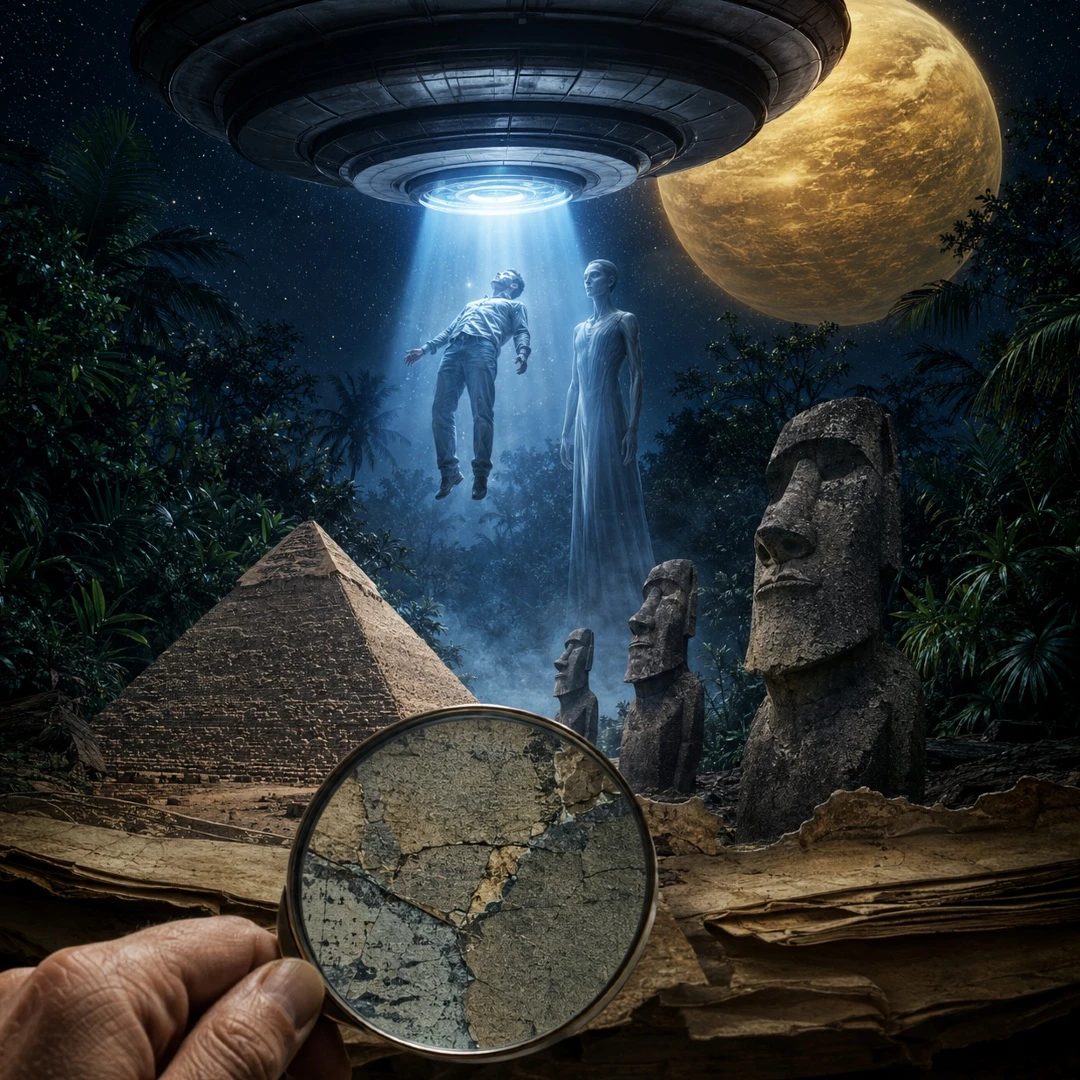
On a June night in 1987, Frenchman Michel Desmarquet suddenly woke up in his home in northeastern Australia. He didn’t know why he got up or why he got dressed, but he found himself writing a brief note to his wife, telling her he’d be gone for about ten days. Then he stepped out into the garden.
There, as he tells it, an eerie silence settled over the area and a blue light distorted the shapes of trees and walls. Suddenly, he felt his body lift off the ground. In front of him stood a tall, human-like being named 'Thao,' who would take him on a journey across the galaxy to a golden planet called 'Thiaoouba.'
Nine days later, Desmarquet returned to his garden, claiming to carry the most important message humanity had received in two thousand years. But did he really travel to another planet, or is this a spiritual tale borrowing from New Age literature and ancient astronaut theories?
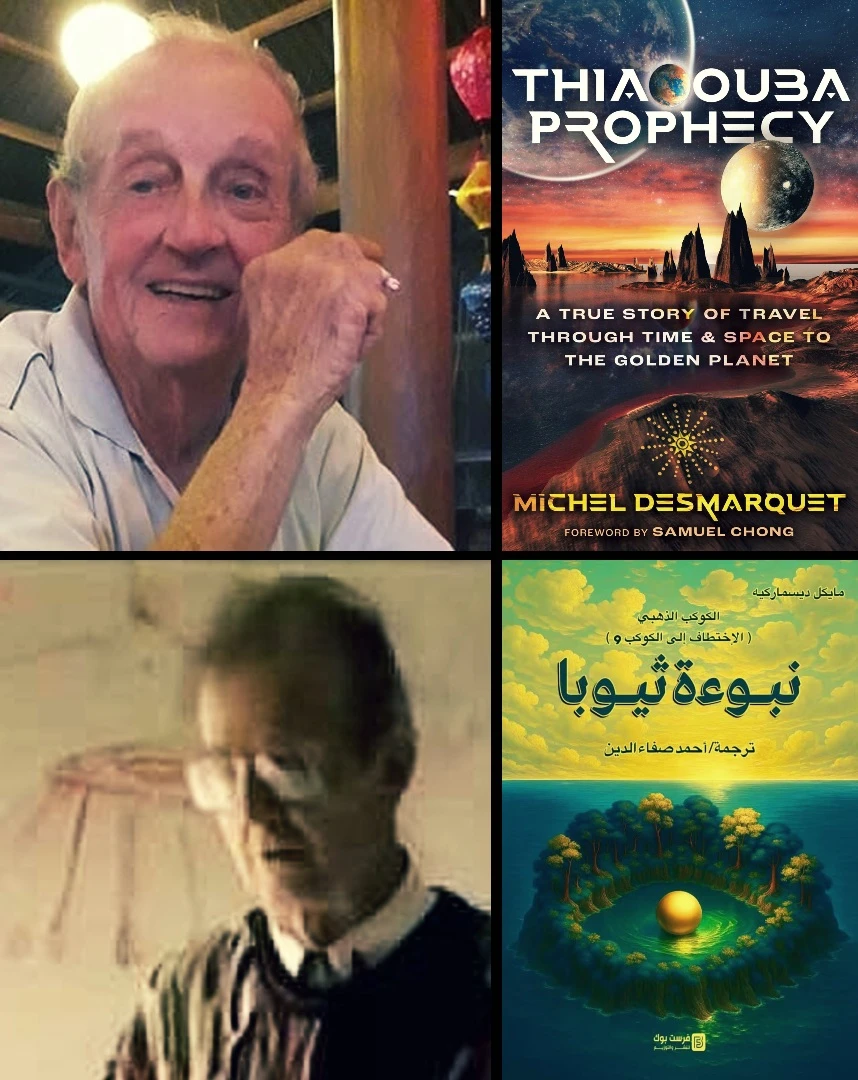
Who is Michel Desmarquet?
Desmarquet was born in Normandy, France, in 1931. He spent time in Africa and New Caledonia before settling near Cairns, Australia, where he worked in agriculture and landscaping. He wasn’t an astronomer, physicist, or archaeologist, and according to his biography, he had no prior experience as an author.
He says he finished the French manuscript of his story in January 1989, after receiving telepathic guidance from Thao. However, it took several years to find a publisher. The first English edition appeared in 1993 under the title 'Abduction to the 9th Planet,' later changed to 'Thiaoouba Prophecy.'
According to the 2004 edition, the original French manuscript was lost, and the English translation was later revised and corrected with the author’s approval. While this doesn’t automatically discredit the story, it means the widely available English text is a revised version, not the original manuscript Desmarquet wrote immediately after his experience. A recent Arabic translation was published under the title:Thiaoouba Prophecy: The Golden Planet by First Book Publishing and Distribution.
What did he see on the Golden Planet?
According to the book, 'the ninth planet' doesn’t refer to Thiaoouba’s position in a solar system, but to its classification as the highest level—ninth—in a spiritual hierarchy of planets. Earth, by contrast, is in the first and lowest category.
Desmarquet describes the inhabitants of Thiaoouba as tall, beautiful, and androgynous beings with abilities such as telepathy, levitation, material manipulation, and bodily regeneration. They can live for millions of years. Their society has no money, schools, or books, as knowledge is transferred directly from mind to mind.
During the journey, Thao presents him with an alternative history of Earth: the first humans were migrants from other planets; the continents of Mu and Atlantis were advanced civilizations; the Great Pyramid was a communication device, not a royal tomb; and the statues on Easter Island depict beings who visited Earth in ancient times. Disappearances in the Bermuda Triangle are explained by the overlap of our universe with a parallel one.
The book weaves all of this together with reincarnation and astral projection as well as colored auras and messages warning against materialism, greed, drugs, pollution, and the misuse of technology.
Where’s the evidence for the journey?
The main issue is that Dismarque’s account stands alone, without any independent proof. There are no photos, samples, recordings, or physical traces brought back from Thiaoouba, nor is there any published testimony from someone who witnessed his departure or return.
The website dedicated to the book claims that his family noticed his absence but didn’t contact the police because he left a note saying he’d be back. However, the site doesn’t show the original note or provide any verified statement from his wife or children confirming how long he was gone or the circumstances.
When asked about physical evidence, the book’s promoters respond that the inhabitants of Thiaoouba deliberately withheld any technology because humanity isn’t ready for it. The planet’s location is also unknown, and suggestions that it’s in the Pleiades cluster are just later guesses, not information from the journey itself.
This makes the story impossible to verify: there’s no evidence because the beings supposedly didn’t want to leave any, no coordinates because the location must remain secret, and any information not yet confirmed by science is said to be proven in the future. This structure protects the belief, but it doesn’t prove it.
When Fiction Clashes with Archaeology
The book claims that the statues of Easter Island, or Rapa Nui, are remnants of the lost continent of Mu, supposedly destroyed by a catastrophe around 14,500 years ago, and that some of the statues reach heights of up to 50 meters.
However, archaeological and genetic evidence links the people of Rapa Nui to Polynesian navigators who arrived around the year 1200 CE. These settlers are credited with carving the statues in the centuries that followed. A study of ancient genomes confirmed that the islanders' ancestry matches Polynesian origins, not a sunken continental civilization from thousands of years ago.
The tallest statue actually erected stands at about 10 meters, while the largest unfinished statue in the quarry measures around 21 meters—not 50. The presence of unfinished statues in the Rano Raraku quarry, along with tools and transport paths, shows that statue production was a local activity by the island’s inhabitants.
A similar conflict appears in the story of the Great Pyramid. The book attributes its construction to 'Thoth' from Atlantis, claiming it was built in nine years using anti-gravity and 'ultrasonic electric waves,' and denies that it was built during Khufu’s reign.
In contrast, inscriptions, tombs, workers’ villages, and discovered documents all connect the pyramid to Khufu’s era in the 26th century BCE. One of the strongest pieces of evidence is the diary of Inspector Merer, which records the transport of limestone blocks from Tura quarries to Giza during Khufu’s rule. The Wadi al-Jarf papyri provide direct evidence of the labor and supply network behind the pyramid project.
Humans from Outer Space ?
The book presents human races as descendants of black, yellow, and white groups that arrived from different planets, using outdated racial descriptions once common in older writings but incompatible with modern genetics.
Fossil and genetic evidence shows that Homo sapiens evolved in Africa about 300,000 years ago, then spread across the globe, sometimes interbreeding with earlier human groups like Neanderthals. There is no indication in the human genome of any extraterrestrial origin or that current races are separate species from different planets.
And What About the Bermuda Triangle ?
The book explains the disappearance of ships and planes in the Bermuda Triangle by suggesting a 'natural warp' connects our world to a parallel universe, potentially swallowing people and vehicles and leaving them trapped outside of time.
But this idea assumes the area has an unusually high number of disappearances, which is not supported by records. The National Oceanic and Atmospheric Administration states there is no evidence of mysterious disappearances in the Bermuda Triangle at rates higher than other busy ocean regions. Most known incidents involve weather, hurricanes, strong currents, human error, or media exaggeration.
Rewriting Religion
The book doesn’t stop at space and archaeology, it radically reinterprets religious stories as well. It links the name Theoba to the sacred Hebrew letters יהוה, known as the Tetragrammaton YHWH, and claims that the inhabitants of this planet appeared to Abraham, helped Moses, and gave him the commandments.
However, there is no known linguistic basis for turning YHWH into 'Theoba.' Scholars of Semitic languages connect the Hebrew name to the verb for 'to be' or 'to exist,' and suggest a pronunciation close to 'Yahweh,' though some details of the ancient pronunciation remain debated.
The book offers an even stranger account of Christ, claiming that Mary’s pregnancy was the result of alien intervention, that Jesus born in Bethlehem, later traveled to Asia and died in the Japanese village of Shingo, while the crucified figure was another being from Theoba who took on a human form. Miracles and the resurrection are explained as alien technology.
These are not historical discoveries based on manuscripts or archaeological evidence. Instead, they are reinterpretations of religious beliefs within the book’s fictional world, and in key ways, they contradict both Islamic and Christian doctrines.
Does the book contain a prophecy?
Despite its title, the book does not offer a clear prophecy that specifies an event and a date that could be tested. Instead, it presents general warnings about materialism, pollution, weapons, technology, the media, politicians, and the possibility of a civilizational disaster.
Its message promoting love, reducing consumption, and using technology responsibly—is certainly worth considering. However, these were also major issues during the 1980s, amid the Cold War, fears of nuclear destruction, and the rise of environmental movements. The presence of a positive moral message does not prove it comes from an extraterrestrial civilization.
In fact, the promotional environment around the book later moved beyond the story itself to conspiracy claims. Its website alleges that about a dozen secret families control the global financial system, without providing verifiable names or evidence.
Between Experience and Reality
We have no way of knowing for certain whether Michel Desmarquet was deliberately lying. He may have truly believed what he described, experienced a visionary episode or an altered state of consciousness, or created a work of fiction that eventually became his personal creed. It’s impossible to diagnose a decades-old psychological experience based solely on a book.
However, a person’s sincerity in describing what they believe they experienced is different from the accuracy of their interpretation. When the author presents his account as the true history of humanity, religions, and ancient sites, his claims must be compared with available evidence. Here, clear errors and contradictions emerge, and the core event lacks any independent witness or physical trace.
For this reason, the book Thiaoouba Prophecy can be read as an engaging work of imaginative fiction and a spiritual text reflecting New Age culture and late twentieth-century anxieties. However, presenting it as an 'extraordinary truth' or a documented revelation of human origins is not supported by available evidence.
Thiaoouba, for now, exists only within the pages of a book.
About the Author