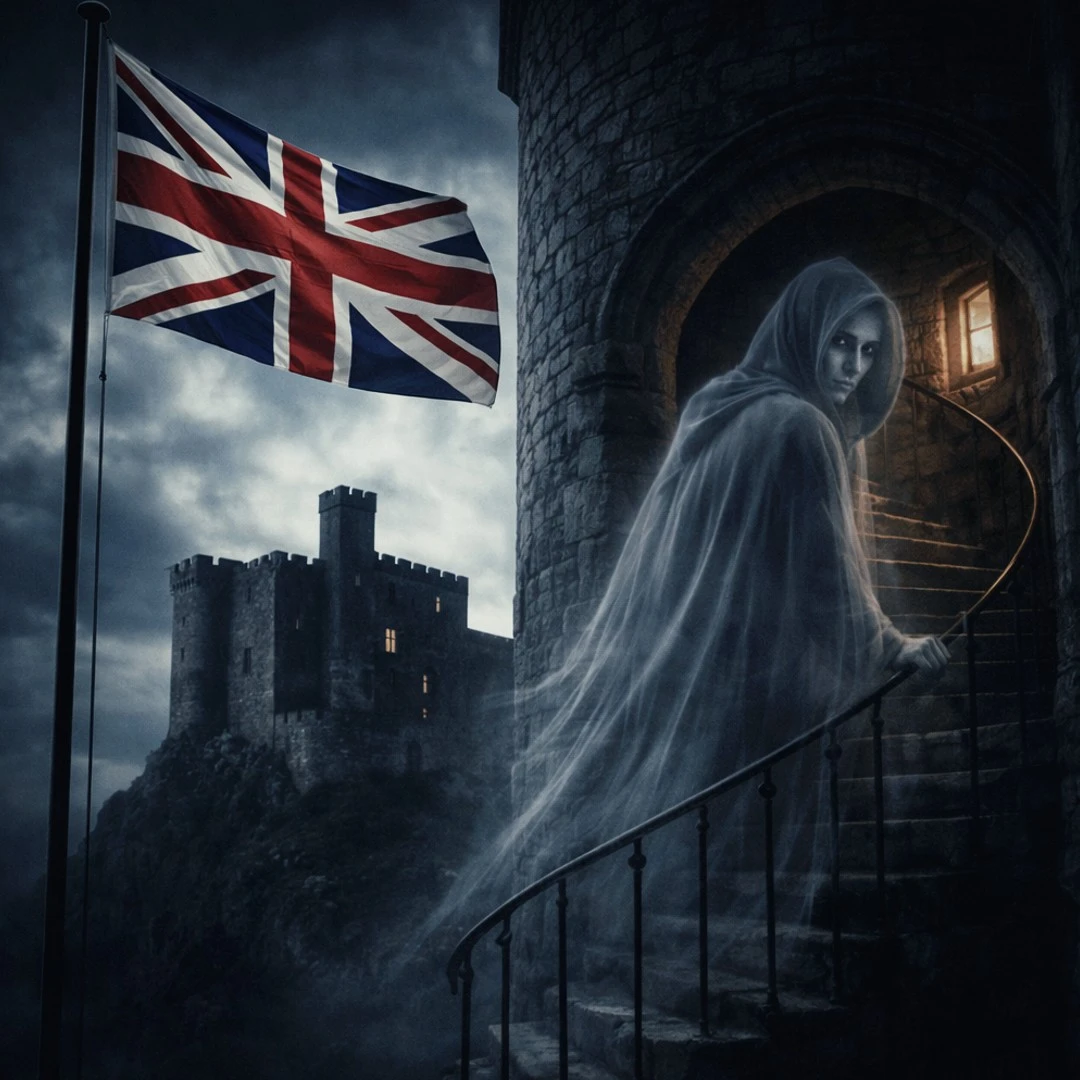
When we think of British castles, we do not summon history alone, another shadow rises with it… the shadow of stories that speak of whispers in corridors, footsteps with no visible owner, and faces that appear briefly before dissolving into stone and mist.
Over the centuries, these castles have come to resemble a permanent stage for ghost stories, to the point that Britain appears to dominate this genre more than the rest of Europe, if not the world. But does this stem from some hidden mystery yet to be uncovered ? Or is the matter deeper than mere tales passed down through generations ?
In this investigation, we attempt to approach an answer by tracing multiple threads that connect bloody history, ancient architecture, folklore, and the role played by culture and media in cementing this image. Perhaps the story does not lie in the abundance of ghosts… but in how their stories were preserved, and how they gradually became embedded in collective memory.
1) The Exceptional Density of Castles
One of the most striking features of the British Isles is the overwhelming presence of castles and fortifications, particularly in Wales, which has the highest density of castles per square kilometer in Europe.
This landscape filled with towers, gates, ruins, and fortresses is not merely architectural heritage, but a physical record of prolonged conflict: civil wars, feudal disputes, sieges, imprisonments, and executions.
In such an environment, every stone becomes capable of telling a tragic story or being linked to a historical figure. As the number of these sites increases, so too does the number of “stone stages” upon which legends can unfold. It is therefore unsurprising that ghost stories flourish where there are so many places capable of giving them a convincing dramatic backdrop.
2) Preserving and Reproducing Stories
Britain did not merely possess these locations, it developed a strong tradition of documenting and circulating ghost stories.
Research by Paul Cowdell on belief in ghosts in post-war England found that such beliefs are socially widespread, and that ghost narratives are not isolated personal experiences, but are continually reshaped within familiar cultural frameworks, allowing them to persist across generations.
This is crucial: British ghost stories do not remain confined to oral tradition or local environments. They are consistently collected, republished, and reframed, gaining a form of cultural legitimacy that ensures their survival and continued influence.
3) The Influence of Gothic Literature
Literature has been one of the most powerful forces behind cementing the image of “haunted” castles. Britain was a major birthplace of Gothic literature and modern ghost stories, particularly during the Victorian era.
Studies show that the 19th century witnessed a massive boom in this genre, driven by rising literacy rates, the spread of periodicals, increasing demand for sensational stories, and a revived fascination with the medieval past.
In this context, castles and monasteries ceased to be merely historical sites, they became narrative templates for collective horror. Their repeated presence in literature firmly established them in the public imagination as natural habitats for ghosts.
4) From Literature to Tourism
While castles and ghost legends exist across Europe, what distinguishes Britain is its ability to fuse these elements into a coherent cultural identity.
The image of the “haunted castle” moved seamlessly from literature to theatre, then to radio, television, and eventually heritage tourism.
Even official bodies such as English Heritage acknowledge that many stories associated with certain sites are not entirely ancient; some were reshaped or even created later, inspired by the evocative power of ruins and ivy-covered structures that captured the imagination of 18th- and 19th-century writers.
This is a significant admission: not every British castle ghost is ancient, but the cultural environment has been highly effective at preserving, reshaping, and sustaining these narratives as part of national identity.
5) The “Haunted Heritage” Economy
Another important factor is what might be called the “ghost economy.”
Recent studies on ghost tourism in England and Wales show that many historical sites and nighttime tours actively incorporate these narratives as part of the visitor experience.
Research on ghost tours in cities such as York, Edinburgh, and London also indicates that the element of “strangeness” allows guides to present history in a more engaging and vivid way than traditional narration.
In other words, Britain does not simply have ghost stories, it has an entire system that continuously recycles and sustains them.
6) The British Climate
As for the climate, accuracy requires us to say that it does not create ghosts but it strongly contributes to the feeling of them.
There is no scientific evidence that British weather generates more paranormal phenomena than elsewhere. However, environmental psychology research suggests that conditions such as low lighting, sensory ambiguity, unclear sounds, architectural complexity, and expectation all increase the likelihood of interpreting ambiguous experiences as supernatural.
A scientific review published in Frontiers in Psychology concluded that the characteristics of a place itself combined with human expectations play a key role in such experiences.
Within this framework, the British climate becomes a supporting factor. Grey skies, fog, humidity, early twilight, wind moving through stone corridors, and the cold of thick castle walls all create an ideal sensory stage for unease.
This does not prove the existence of ghosts but it helps explain why British castles appear, psychologically and aesthetically, more “ready” to host ghost stories than similar structures in bright, open Mediterranean settings.
7) Memory, Violence, and Ruin
Folklore and heritage studies suggest that a “haunted place” does not arise by chance, it emerges at the intersection of memory, violence, decay, and collective imagination.
In Britain, castles are not perceived merely as stone structures, but as containers of a long history of conflict and events, making them fertile ground for storytelling.
For this reason, a British castle often feels “haunted” even before any specific story is told about it. Its form, its ruin, and its associations with war, imprisonment, and power all make it inherently open to ghostly interpretation.
About the Author