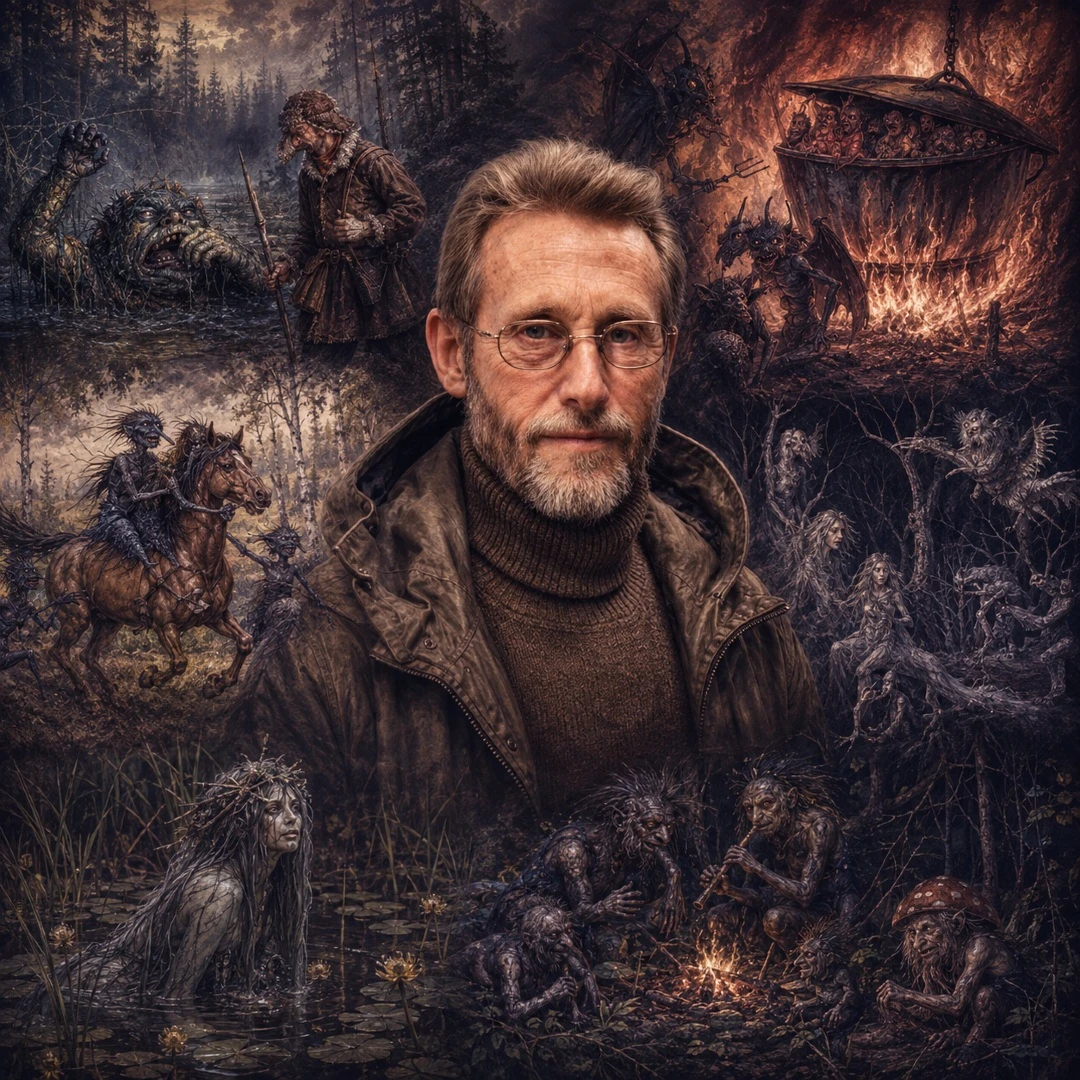
In a quiet forest, a lone traveler stands as tiny creatures peer at him from between the trees. In another swamp, a thin, wrinkled-skinned being emerges from the mud, as if it were part of the earth itself. Inside a country house, a shaggy creature might sit near a sleeping child's bed, while other spirits slip between fields, lakes, and barns.
These aren't scenes from a modern horror film, but from the strange artistic world of Belarusian artist Valery Slauk, one of the country's leading graphic artists and book illustrators. For much of his career, Slauk has brought to life the demons, spirits, and creatures of Belarusian and Slavic folklore, giving form to beings that had existed for centuries only in stories and legends.
Looking at his work, it's sometimes hard to tell where folklore ends and the artist's imagination begins.
Who is Valery Slauk?
Valery Petrovich Slauk was born in 1947 in the Vitebsk region of Belarus. He graduated in 1977 from the Belarusian State Institute of Theatre and Arts, later becoming a professor of graphic arts at the Belarusian Academy of Arts. He has focused mainly on book and graphic art, working with pen drawing and printmaking especially etching, a technique that has become a hallmark of his style. His works are held in the National Art Museum of Belarus as well as in collections and museums across Europe.
Ironically, his path to art wasn't straightforward. He initially studied to become a mechanical technician and worked in jobs unrelated to art before his talent for drawing led him to art school. Yet the seeds of his future artistic world may have been planted much earlier.
As a child, his family couldn't afford many books, so he borrowed them from the school library or friends. Among the books that left a lasting impression were the Brothers Grimm tales illustrated by Gustave Doré. He recalls studying Doré's engravings even before he could read well, trying to guess the stories from the pictures alone.
Perhaps that's why, for Slauk, an image became more than just an illustration , it was a way to give a legend a life of its own.
When the Artist Discovered the World of Spirits
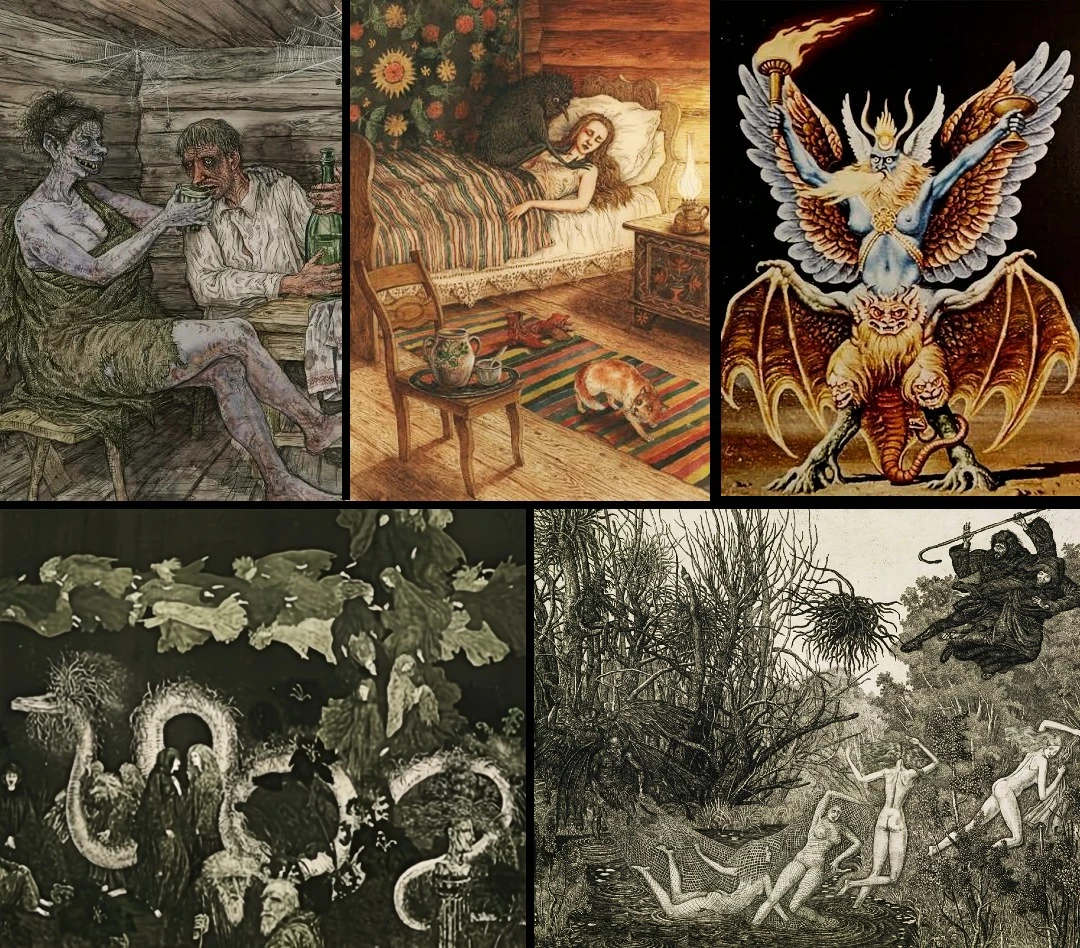
The real turning point came when he was commissioned to illustrate books about Belarusian folklore and legends, and later asked to work on a two-volume encyclopedia of folk traditions.
There, he found himself immersed in an endless world of beings: house and forest spirits, swamp dwellers, field demons, water spirits, witches, werewolves, vampires, goblins, and nocturnal creatures.
Slauk recalls that some officials objected to what they called 'demons' on the encyclopedia's cover, arguing that folklore should be portrayed in a more positive light. But he stood his ground; for him, drawing the sun or pretty ornaments wasn't enough to represent folklore. Characters like the house spirit Domovik and the forest spirit Lesovik felt far more alive and real.
In a recent interview, he said something to the effect that What people have created can't be erased from history even if these creatures seem strange or frightening to modern generations. That's why Belarusian and Slavic mythology has become a central theme in his work.
Not All of Them Are 'Demons'
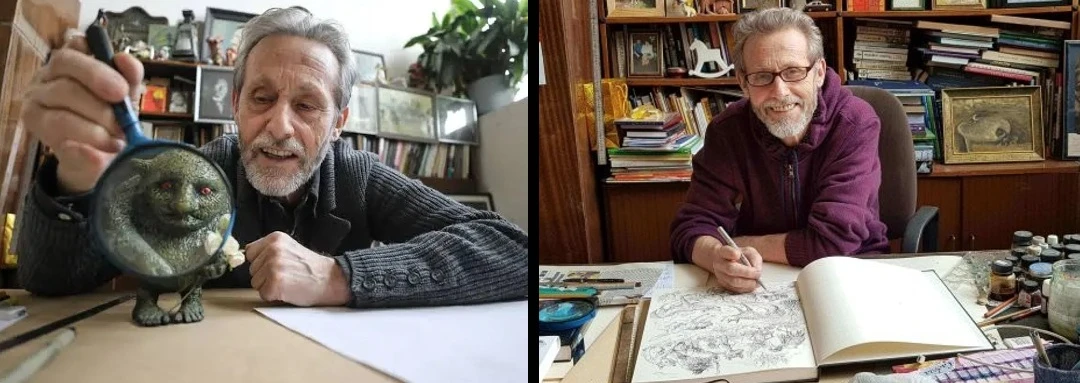
The word 'demons' needs to be used carefully here. In ancient Slavic folklore, the world wasn't simply divided into good and evil forces. Nature itself was inhabited by all kinds of beings, each with its own home and habits: something living under the roof, another behind the trees, a third in the water, and a fourth in the swamp. Some might help people, some might play tricks, and others might punish those who cross certain boundaries.
With the spread of Christianity, these beliefs didn't disappear entirely. Instead, over time, they blended with ideas about evil spirits and demons. As a result, Belarusian mythology today is a fascinating mix of ancient pagan traditions, rural superstitions, folk tales, and later Christian influences.
Slaŭk depicts this entire world without trying to organize it into a clear religious system. His creatures aren't always evil, but they rarely offer comfort.
A visual encyclopedia of strange entities
This artistic project reached its peak with the renowned book 'The Enchanted World' (Чароўны свет – Charouny Svet), published in 2008. The book explores Belarusian myths and legends and features a wealth of Slaŭk's illustrations. An English edition was later released.
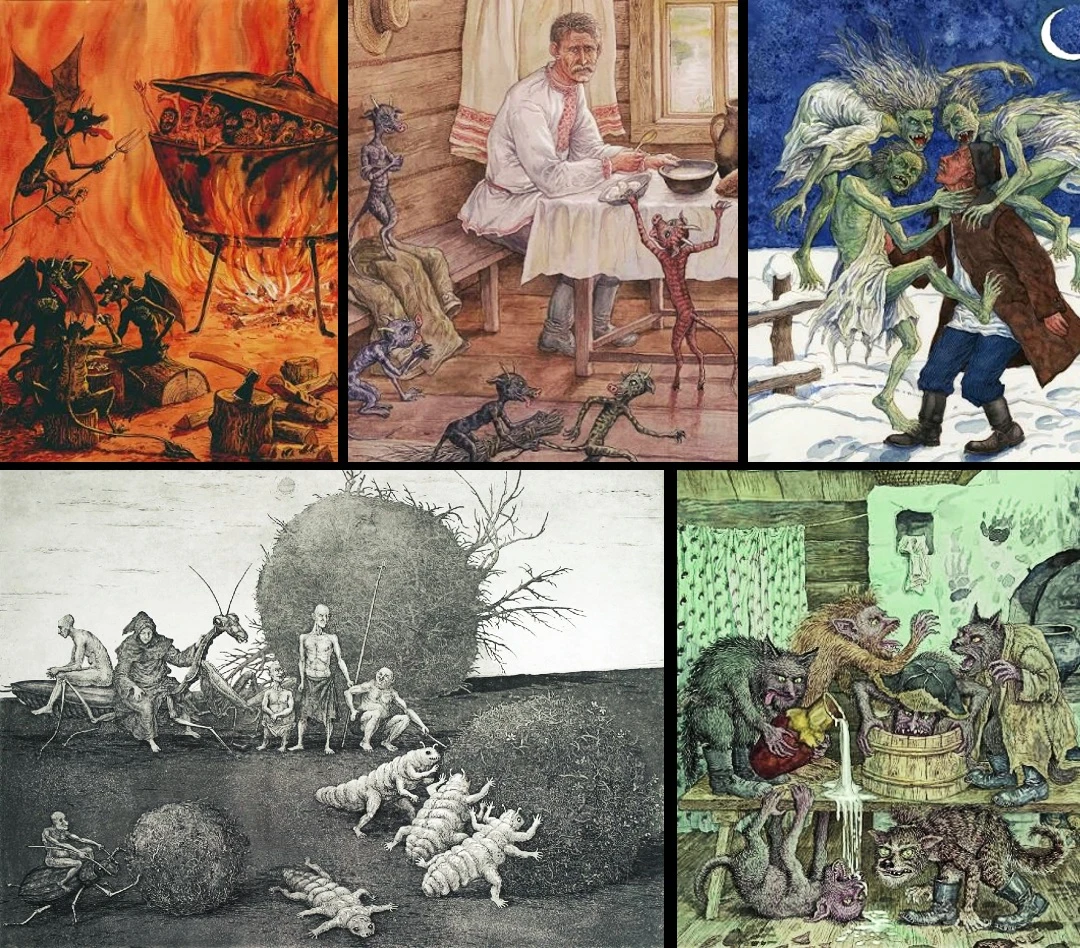
The book resembles a bestiary, a compendium of fantastical creatures.
Readers encounter beings like the swamp spirit Balotnik, the water spirit Vodyanik, the household guardian Domovik, the misfortune-bringing Zlydni, Striga, Hapun, Valasen, Baba Yaga, as well as witches, werewolves, vampires, and other figures less familiar outside Eastern Europe.
Without Slaŭk's illustrations, many of these names would remain little more than brief descriptions in folklore books for modern readers.
The artist gave them faces.
What would the devil look like if he were born in a swamp?
What makes Slawuk's art so fascinating is the way he imagines his creatures. He doesn't picture them as Hollywood-style monsters with exaggerated muscles and fangs. Instead, he implicitly asks: If this being really lived here, what would it actually look like?
The swamp spirit, for example, resembles the swamp itself, its skin is damp and wrinkled, its limbs are long, and its colors blend in with the mud, grass, and stagnant water. The forest spirit might look as if tree bark has become skin, roots have turned into fingers, and moss has become hair. Household spirits often have features reminiscent of elderly farmers: scruffy beards and hair, rustic clothes, simple shoes, and small, twisted bodies. This is where the strength of his illustrations lies: the fantastical grows out of the real.
You don't get the sense that the monster has dropped in from another planet; instead, it feels like it's been hiding all along behind the tree that the farmer passes every evening.
Between Horror and Humor
Still, it's not quite accurate to call Slawuk's work 'horror art' in the traditional sense. Some of his creatures are frightening, some are ugly, and others are even funny or oddly endearing. He sometimes uses a touch of caricature and anatomical exaggeration: long noses, skinny legs, hunched backs, and sly smiles. This is one of the things that sets folk demonology apart from modern horror monsters.
The folk devil can be terrifying, but he can also be foolish, greedy, lazy, or easily tricked. In many folk tales, people manage to outwit him.
That's why there's something unusual in Slawuk's work: you might be looking at a creature from another world, yet it feels like it has a familiar human personality.
Anger, greed, laziness, fear, curiosity, and cunning, all these emotions are written on the faces of his creatures, as if the legend is using the monster to talk about people.
When Nature Itself Becomes Haunted
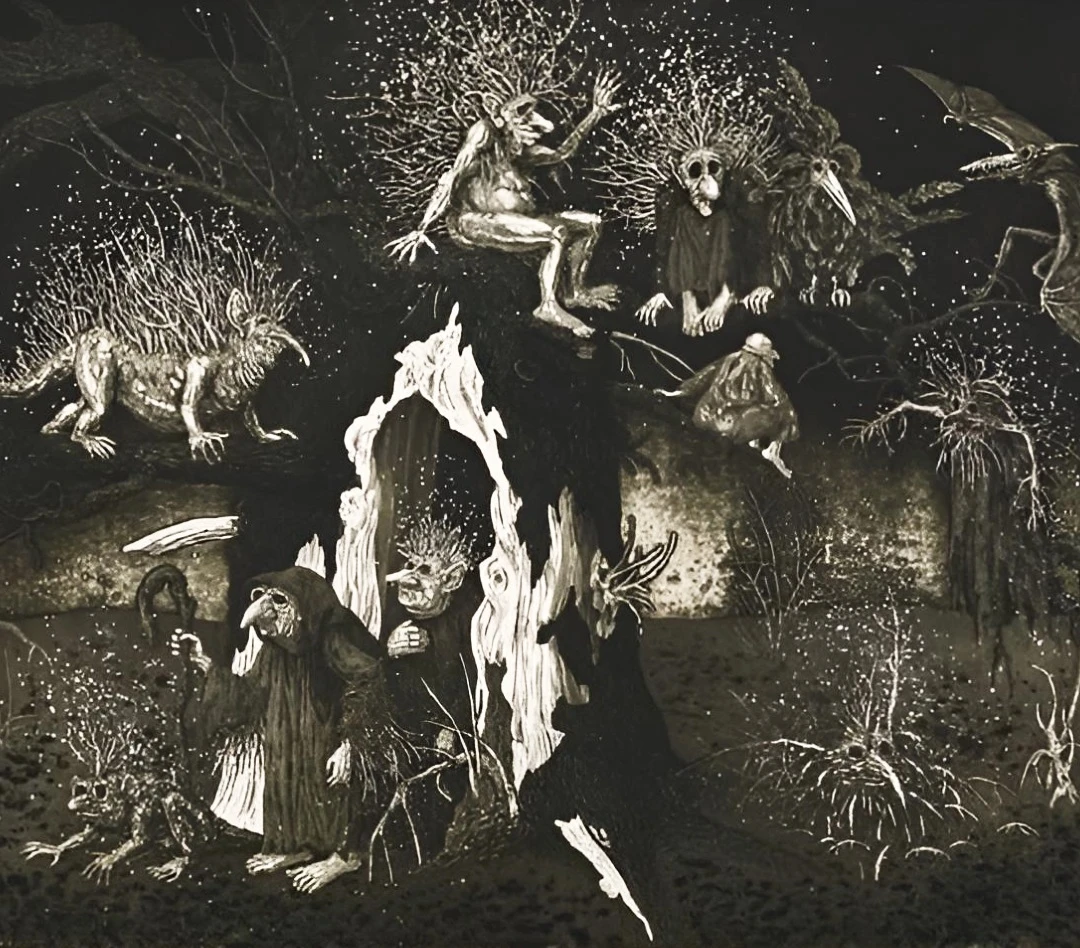
One of the most striking things about Slawuk's paintings is that the creature isn't always the main focus. The forest, swamp, field, or old house aren't just backgrounds—they're part of the myth themselves.
The trees are twisted, the water is eerily still, the horizon is distant and open, and the strange creature might only occupy a small corner of the scene.
This relationship between the environment and the creature reflects something deep in old folklore: people didn't see nature as lifeless matter, but as a place inhabited by hidden forces.
The forest could lead you astray, the river could take you, the house could become angry with you, and the swamp might be hiding something watching your every step.
In communities that spent centuries living near dense forests and vast swamps in Belarus and Eastern Europe, it's easy to see how such beliefs could arise.
Are all these creatures really ancient ?
Not everything labeled today as 'ancient Slavic mythology' is equally well-documented. Some Belarusian folklore researchers have pointed out that certain 19th-century writers may have exaggerated descriptions of some gods and creatures, or even invented characters that were later presented as authentic folk beliefs.
One of the most debated cases involves characters described by writer and ethnographer Pavel Shpilevsky. Researchers note that beings like the Gartsuki, which he described as spirits connected to the god Perun, don't appear independently in later ethnographic records.
Interestingly, Slawuk himself carefully researched folk descriptions before illustrating his characters. But even for the artist, it's not always clear where oral tradition ends and where the additions of earlier writers and collectors begin.
Unintentionally, his paintings become a new layer of legend: an old tale recorded by a researcher, read by an artist, and then transformed into a creature whose image becomes part of modern popular imagination.
The artist who gave legends a visual memory
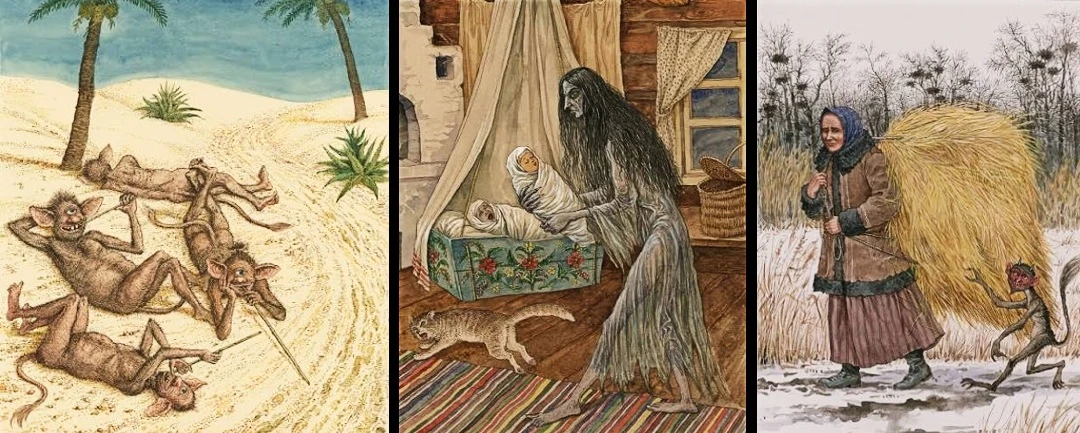
This is perhaps Valery Slauk’s true significance. He didn’t invent most of these creatures, but he did something just as important: he showed us what they might look like. Before his work, there was only a name—'the spirit of the swamp.' After Slauk, there’s a face, a body, eyes, hands, and a way of sitting on the water.
His illustrations helped shape a modern visual identity for Belarusian folklore. Some of his art projects were even turned into sculptures and 3D exhibitions, using his drawings as blueprints to bring legendary figures from the pages of books into the real world. It’s no surprise that today he’s seen as one of the artists most closely associated with depicting the mythical creatures of his country.
A world on the edge of reality
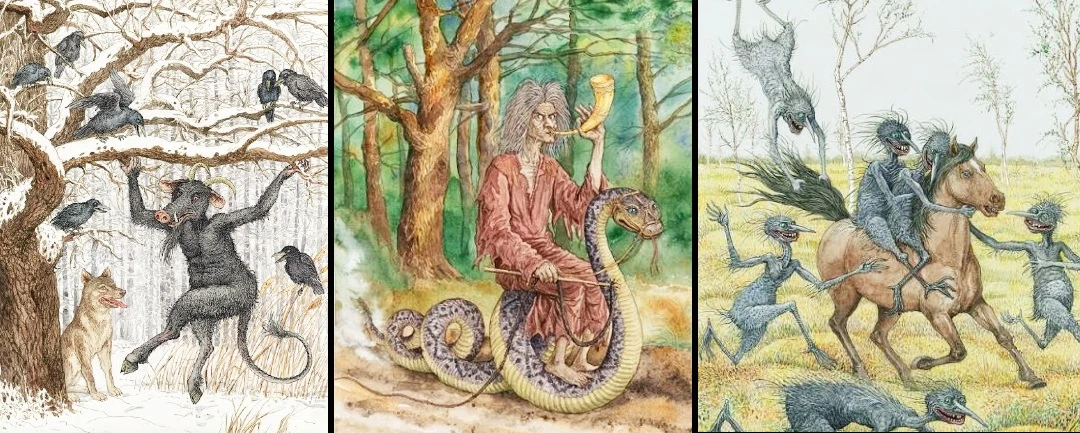
The power of Slauk’s work doesn’t lie so much in the appearance of his monsters, but in how believable they feel within their own world. His art doesn’t claim that swamp demons and forest spirits are real, but it does succeed in recreating the world where the ancestors of those regions once imagined them.
Beyond the last house lies the forest, beyond the forest the swamp, and after sunset, people are no longer truly alone. Through pen strokes, etchings, and muted colors, Valery Slauk opens a window to that era—a time when every sound from the trees needed an explanation, shadows on the water could become spirits, and nearly every place had its own invisible inhabitant.
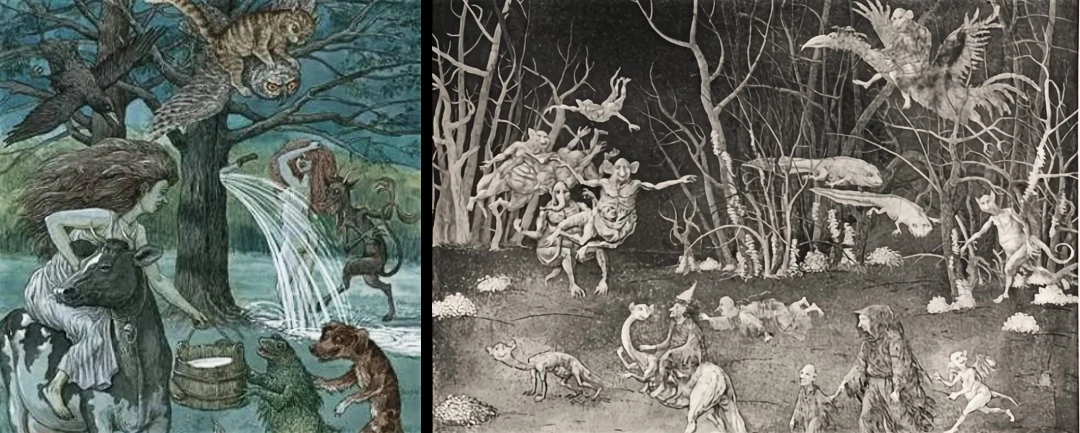
That’s why his work is more than just illustrations of old tales. It’s an attempt to recover the hidden imagination of an entire people, turning what lived for centuries in stories, fears, and whispered conversations by the fire into clear images before our eyes.
Even though we know these creatures belong to legend, Slauk leaves us with a small, unsettling question after each painting:
If those stories were ever true... isn’t this almost exactly how we’d expect them to look?
About the Author