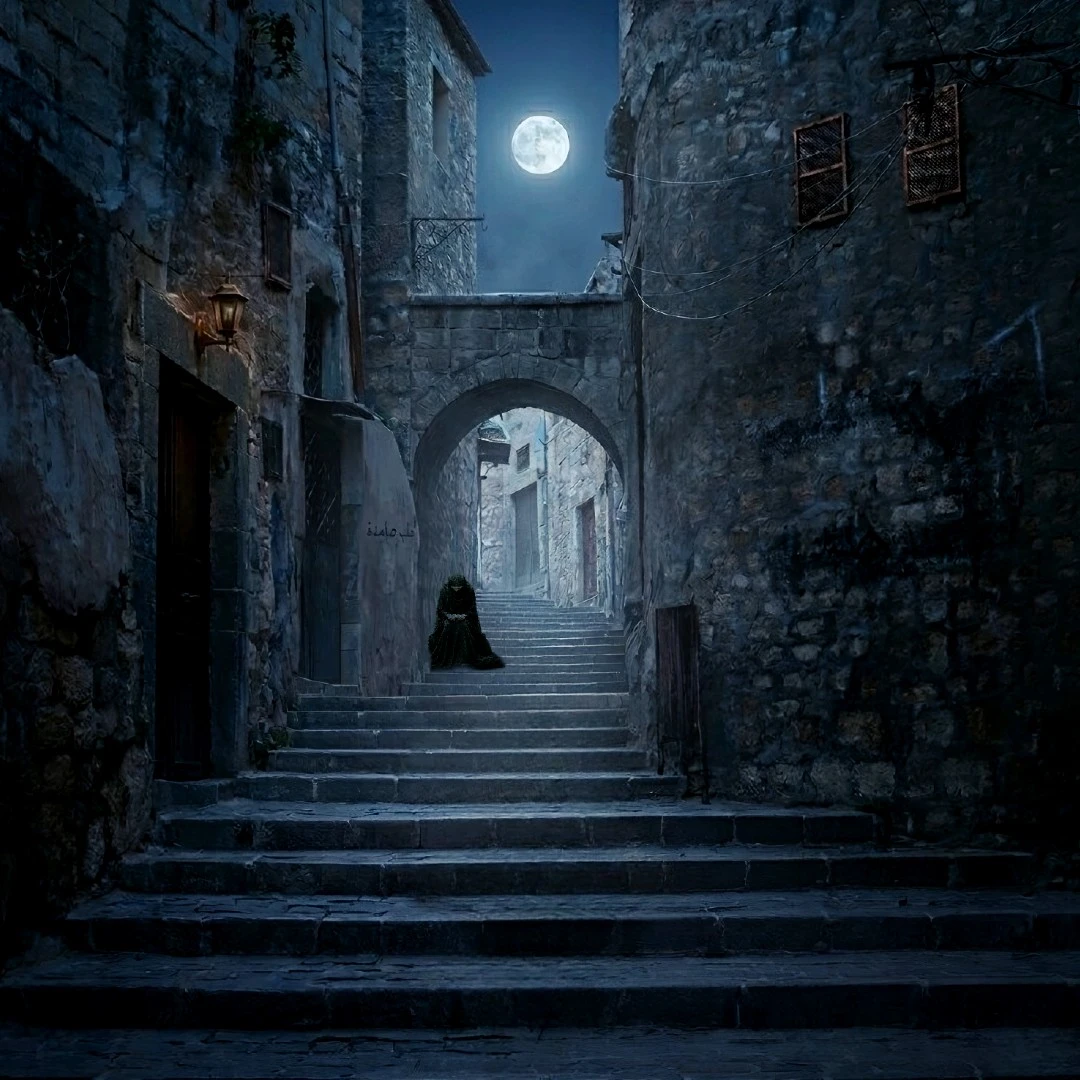
In one of the narrow alleys branching off from the Jalloum district in old Aleppo city, there was a small stone staircase well known to the locals.
About twenty-four steps made of ancient limestone connected two narrow lanes lined with old Arab houses, their heavy wooden doors and tall, half-shuttered windows always giving off an air of secrecy.
During the day, there was nothing remarkable about the stairs.
Children climbed them on their way to school, women descended carrying bags of bread, and men passed by returning from the market or the nearby mosque.
But after midnight, the stairs seemed to lose their familiar character.
Or at least, that's what people started to say.
The Beginning
The earliest known accounts date back to late 1998, when several residents began to quietly notice something strange happening again and again.
There was a woman in a long, dark dress, sometimes seen sitting in the middle of the stairs, sometimes standing, as if waiting for someone who was very late.
From a distance, she didn't stand out.
In fact, quite the opposite...
At first glance, she seemed almost too ordinary.
But those who got close all said nearly the same thing:
She never moved.
She never spoke.
And there was nothing about the way she sat or stood that suggested she was waiting for a living person.
And there was an unspoken agreement among those who saw her:
Her presence was anything but ordinary.
Repeated accounts... with no explanation.
The first person to speak about her openly, as far as the neighborhood remembers, was a young man named Nizar Khaddour, who was a student at the University of Aleppo's College of Engineering at the time.
Nizar said he returned to the neighborhood on a cold January night in 1999, just after midnight.
As he reached the stairs, he noticed a woman sitting in the middle of them.
He didn't stop.
Assuming she was one of the neighbors, he walked past her without saying a word.
But before he reached the top of the stairs, he suddenly felt a sharp chill hit his back, as if a door had opened behind him for a split second.
He turned around immediately.
There was no one there.
The staircase was completely empty.
He didn't hear any footsteps.
There was no sound of movement.
Not even the faint rustle of fabric against stone.
Even years later, he insisted that what terrified him most wasn't her disappearance...
It was the way she vanished, as if her entire presence had been erased from the place in an instant.
An incident that brought the story out of whispers.
In the summer of 1999, something happened that turned the story from hushed rumors into a topic people discussed—albeit in low voices.
Abu Firas the pharmacist was heading home late at night after closing his shop near the Zahrawi market.
He was known for being level-headed, not one to exaggerate or believe in tall tales.
As he approached the stairs, he saw her.
But this time, she wasn't sitting.
She was standing right in the middle of the staircase, as if she were waiting for him.
He stopped.
For reasons he couldn't explain later, he felt compelled to speak to her.
He asked, "Who are you waiting for?"
She didn't answer.
But then he noticed something that immediately unsettled him.
He said her face wasn't as clear as it should have been.
Not because it was dark...
But because her features seemed strangely blurred, as if even the light refused to settle on her.
He stared at her for a few seconds.
Then—
She vanished.
She didn't move.
She didn't go up or down the stairs.
She vanished...
As if she had never existed at all.
He returned home deeply unsettled,
and for days, he refused to go near that place.
Since that night...
the woman was no longer just a passing story.
What lingered after the tale
No one openly admitted their fear.
But without any agreement,
the staircase was left empty after sunset.
People would hurry past it.
Children were sent along a longer route.
No one stopped in the middle anymore,
especially not on the twelfth step or beneath the archway.
Over time, small details began to emerge—not enough to explain anything, but enough to unsettle everyone:
the faint rustle of a dress at dawn...
a sudden chill on still nights...
and a recurring feeling among some passersby, as they neared the stairs,
They wait for something that has nothing to do with them.
A line that was never forgotten
Years ago, an elderly woman from the neighborhood made an offhand remark that no one paid attention to at the time:
— The problem isn’t that we saw her…
The problem is, she was here before any of us.
No one argued with her.
No one asked what she meant.
An ending left unresolved
Many years passed, and people stopped talking about her.
But the staircase stayed the same.
The last time I walked by, on a cold evening that felt like winters from long ago,
I didn’t look at it directly.
I knew it was empty.
I kept repeating that to myself as I walked on.
And yet…
When I drew level with it,
I found myself slowing down without realizing it.
Not out of fear…
It was that strange, inexplicable feeling—
the sense that the place hadn’t been completely empty just a moment ago.
I kept walking.
I didn’t look back.
But just before I reached the end of the alley,
I heard it—so faint, like the sound of fabric brushing against stone...
It felt as if a woman had just sat down.
- End
Note
The short story above is a work of fiction inspired by the spirit of folktales and oral traditions associated with the old houses and alleyways of my city, Aleppo. It is not a literal retelling of a documented story or an excerpt from a published novel.
About the Author