Throughout history, major scientific revolutions rarely begin in laboratories. Sometimes, they start with a dream, not just any dream, but a mysterious vision that haunts its dreamer for years. It lingers, impossible to forget, feeling too significant to dismiss as mere fantasy, yet too elusive to prove as reality.
This was the case for the Swiss psychiatrist Carl Gustav Jung (1875–1961), one of the most influential thinkers of the twentieth century.
As a child, Jung had a dream that stayed with him for decades. He didn’t reveal its full details until nearly forty years later, in his autobiography, Memories, Dreams, Reflections. This dream wasn’t just a frightening childhood memory, it became the seed for his groundbreaking ideas about the collective unconscious, archetypes, the shadow, and psychological complexes—concepts that continue to spark debate among psychologists, spiritual seekers, and enthusiasts of the paranormal.
But what exactly did that child see that haunted him for so many years?
Descent into the Earth
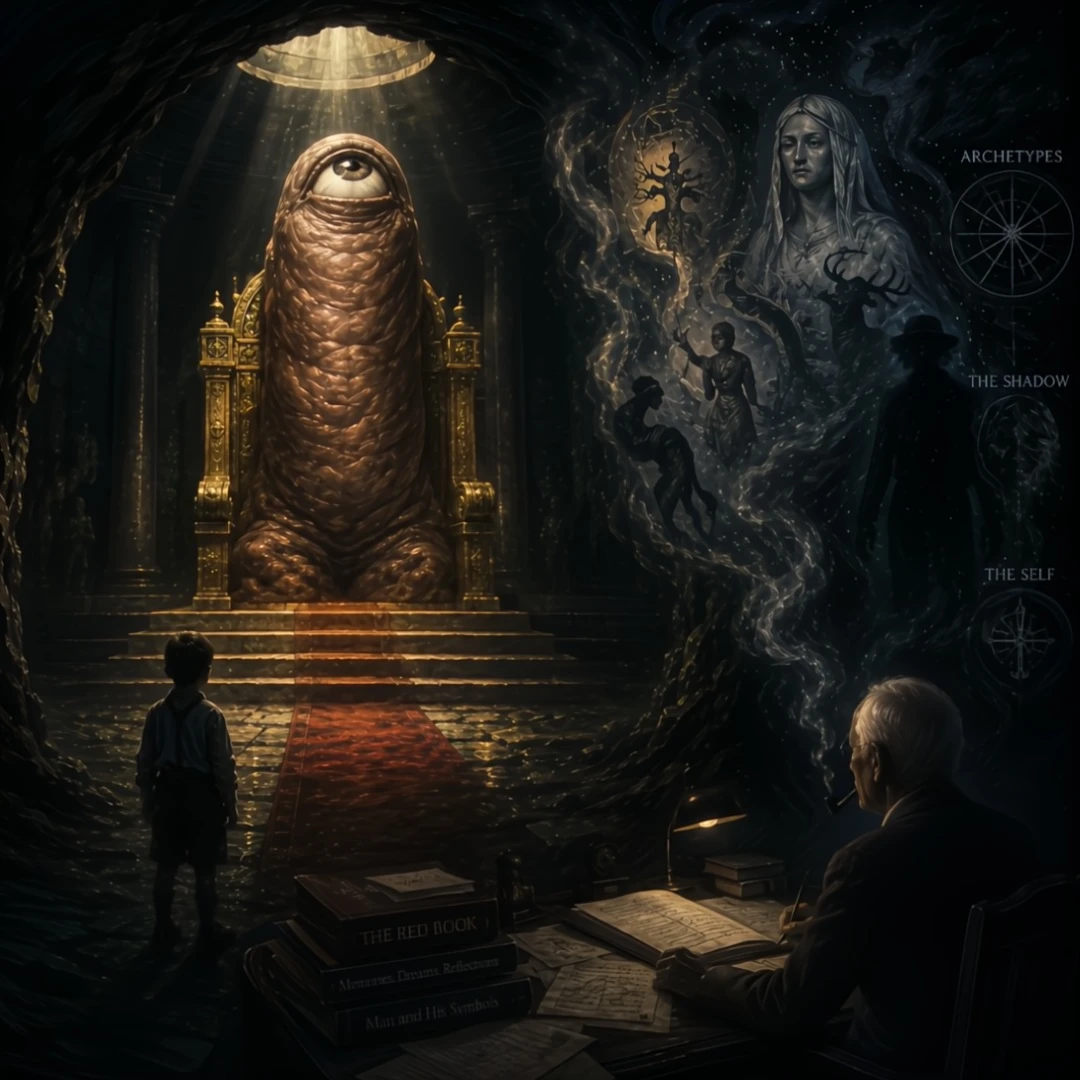
Jung was just three or four years old when he dreamed he was standing in a peaceful green meadow. Suddenly, he noticed a dark opening in the ground—like a well or an entrance leading deep underground. Nothing compelled him to approach, yet he felt an irresistible pull he couldn’t explain.
He descended a stone staircase that led downward, eventually reaching a corridor veiled by a heavy curtain. Pushing the curtain aside, he entered a dimly lit room with a red carpet stretching toward a golden throne.
At first, he expected to see a king or a holy figure. But what awaited him on the throne was unlike any human being.
The One-Eyed Creature
Seated on the throne was a strange being, difficult to describe. It resembled a massive, cylindrical hunk of flesh—no arms, no face topped with a single, enormous eye staring upward, unblinking.
Jung later wrote that the terror he felt wasn’t just because of the creature’s appearance, but the sense that it might suddenly move toward him. At that moment, he heard his mother’s voice calling from far away:
"Look at it... It’s a man-eater."
The child woke up in terror, convinced for years that he had witnessed something forbidden, something no one was meant to see.
Forty Years to Understand a Single Dream
As a child, Jung never tried to interpret the dream. Instead, he kept it buried deep inside, as if it were a heavy secret for which he had no key. He later wrote that this dream "preoccupied me throughout my life." Its meaning only began to reveal itself when he was past fifty, while he was reading about the history of religions and ancient rituals.
It was only then that he realized the creature he saw wasn’t a literal monster, but what he called the "ritual phallus"—an ancient religious symbol associated with creation, fertility, and cosmic energy in many civilizations, long before it took on a purely sexual meaning in modern times.
This was a shock to him. How could a young child, with no knowledge of myths or religious symbols, dream of something so complex?
The Question That Changed Psychology
Instead of simply interpreting the dream, Jung began to ask a different question:
Where did this image come from? If he hadn’t learned about it, hadn’t read about it, and had never seen anything like it in his life, how did it appear in his dream?
This question became the spark for his most famous idea: the "collective unconscious."
Do We Inherit Memories We Haven’t Lived?
Freud believed that dreams stemmed mainly from repressed desires and personal experiences. Jung, however, thought the human psyche was much deeper than that.
In his view, people aren’t born as blank slates. Instead, we inherit a shared psychological layer that contains symbols, images, and archetypes shaped by thousands of years of human experience. This layer isn’t memory in the usual sense, but rather an innate readiness to produce similar images.
That’s why caves, journeys to the underworld, heroes, the great mother, the wise old man, the sacred tree, and the flood appear in the myths of cultures that never knew each other. Jung saw his dream as his first personal encounter with this deep layer of the psyche.
A Journey to the Underworld—or Into the Depths of the Psyche?
In ancient myths, transformation often begins with a descent. The Sumerian goddess Inanna descended to the underworld, Orpheus journeyed to the land of the dead, Virgil guided Dante through hell, and in shamanic rituals, the quest for wisdom is preceded by a symbolic journey into the depths.
What’s striking is that Jung’s dream follows the same pattern. The pit isn’t just a hole in the ground—it’s a gateway. The steps aren’t just stone stairs, but a passage from the conscious world to another realm. The throne doesn’t represent political power, but the center of hidden strength within the self.
Many scholars have noted that Jung’s dream resembles what esoteric traditions call a spiritual initiation, where a person faces a frightening symbol before beginning a journey of transformation. Still, this remains a symbolic interpretation, not a proven historical or scientific fact.
"My intellectual life began there"
In his autobiography, Jung wrote words that reveal just how deeply that dream affected him:
"That dream was my first glimpse into the mysteries of the earth—it marked the beginning of my unconscious intellectual journey."
Elsewhere, he wondered:
"Who spoke to me then? Who came from both above and below, laying the foundation for everything that would shape the second half of my life?"
These statements have led some researchers to believe that the dream was more than just a childhood memory—it was the formative experience that inspired his entire intellectual project.
From the dream to the concept of the 'Shadow'
Over the years, another idea became central to Jung’s philosophy: the Shadow. The Shadow represents everything a person refuses to acknowledge within themselves.
Jealousy, anger, selfishness, the desire for control, fear, and suppressed desires.
These aspects don't just disappear because we dislike them.
Instead, they continue to operate behind the scenes which is why he famously said:
""Until you make the unconscious conscious, it will direct your life and you will call it fate.""
Why do we dislike certain people?
Jung believed that people often notice their own flaws in others before recognizing them in themselves.
If you find yourself thinking that everyone around you is arrogant, selfish, or hypocritical...
It might be that some of your anger comes from traits within yourself that you don't want to acknowledge.
Jung called this psychological mechanism 'projection.'
He summed it up with this idea:
""Everything that irritates us about others can lead us to an understanding of ourselves.""
Psychological Complexes: When Your Inner Child Takes the Wheel
Another concept that emerged from Jung’s interest in the unconscious is the idea of psychological complexes. He didn’t mean 'complex' in the everyday sense, but rather clusters of memories and emotions that develop a life of their own within us. A person might be successful and rational, but in certain situations, they react as if they were a four-year-old child.
They might fall apart at the first sign of failure, have an overwhelming fear of rejection, or keep repeating the same toxic relationships.
According to Jung, these aren’t just coincidences they’re old complexes taking control of our behavior without us realizing it.
Dreams: Messages from the Hidden Parts of Ourselves
Jung didn’t believe that every dream was a prophecy or a supernatural message, but he saw dreams as playing a crucial role: they compensate for what our conscious mind ignores.
So if someone convinces themselves they’re fine while they’re actually falling apart inside, a dream might reveal that inner collapse before they’re ready to admit it. That’s why Jung encouraged his patients to keep dream journals and pay attention to recurring symbols—they can reveal psychological patterns that the conscious mind can’t see.
Working with the Shadow
Jung introduced a meditative practice now known as Shadow Work. If you find yourself reacting with intense anger over a minor mistake someone else made, don't be quick to blame them.
First, ask yourself:
Why did I react so strongly?
If you keep repeating the same failures, find yourself in the same kinds of relationships, or have the same conflicts with different people...
The problem might not be the world around you, but a psychological pattern you haven't recognized yet.
Was the dream a psychological experience, or something paranormal?
To this day, there's no consensus about the nature of that dream. Psychologists see it as a profound symbolic experience that helped shape one of the greatest minds in the history of psychology.
Meanwhile, those interested in mysticism, Hermeticism ,and the paranormal view it as an early moment of revelation, or a journey to a level of consciousness beyond ordinary awareness.
Interestingly, Jung himself never settled the debate.
He didn't claim his dream was a supernatural encounter, but he also didn't reduce it to random neural activity.
Instead, he saw it as a window into a world of symbols that goes beyond the individual. Some researchers believe Jung's journey in The Red Book was a continuation of that early dream. The descent into the depths of the psyche and the confrontation with mysterious symbols that began in his childhood reached their peak in the visions and dialogues recorded in that book.
The dream that never ended
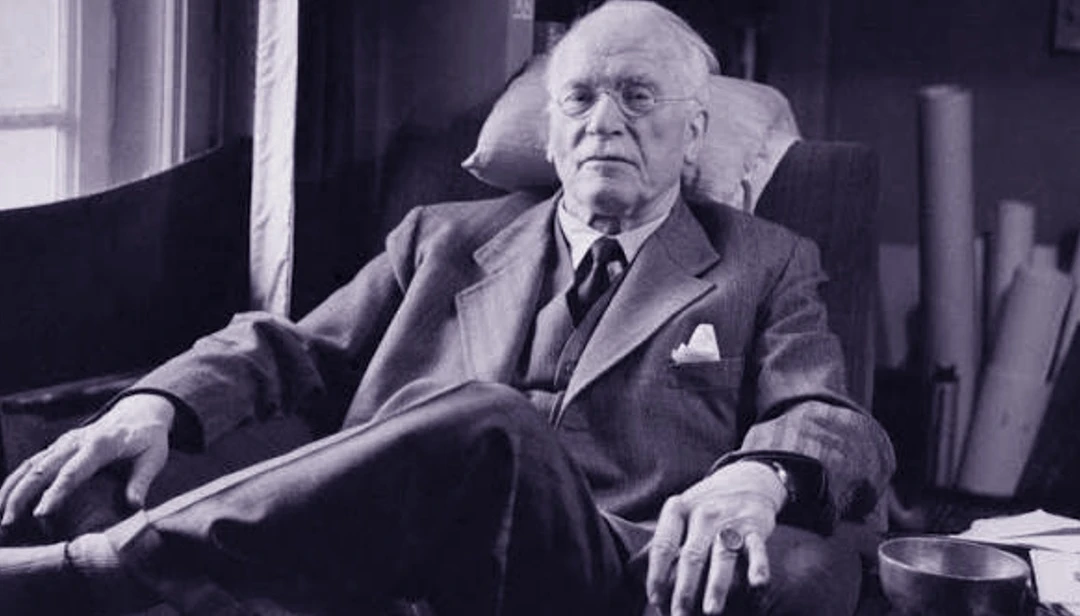
Perhaps what fascinated Carl Jung It wasn't the one-eyed creature, the golden throne, or the pit he descended into.
The real revelation came later:
That the human psyche is far more expansive than we imagine.
In his view, consciousness is just a small, lit room beyond its door lies an entire city of memories, instincts, symbols, fears, desires, and inherited experiences.
Perhaps the most unsettling part of this idea is that this city never sleeps.
It watches, influences, and sometimes even makes choices for us, while we believe we're the ones in control.
This, perhaps, is the true legacy of that dream that remained unspoken for forty years: not because it revealed a secret about the world to Jung, but because it led him to believe that humanity's greatest mysteries might be hidden deep within ourselves, not outside.
About the Author