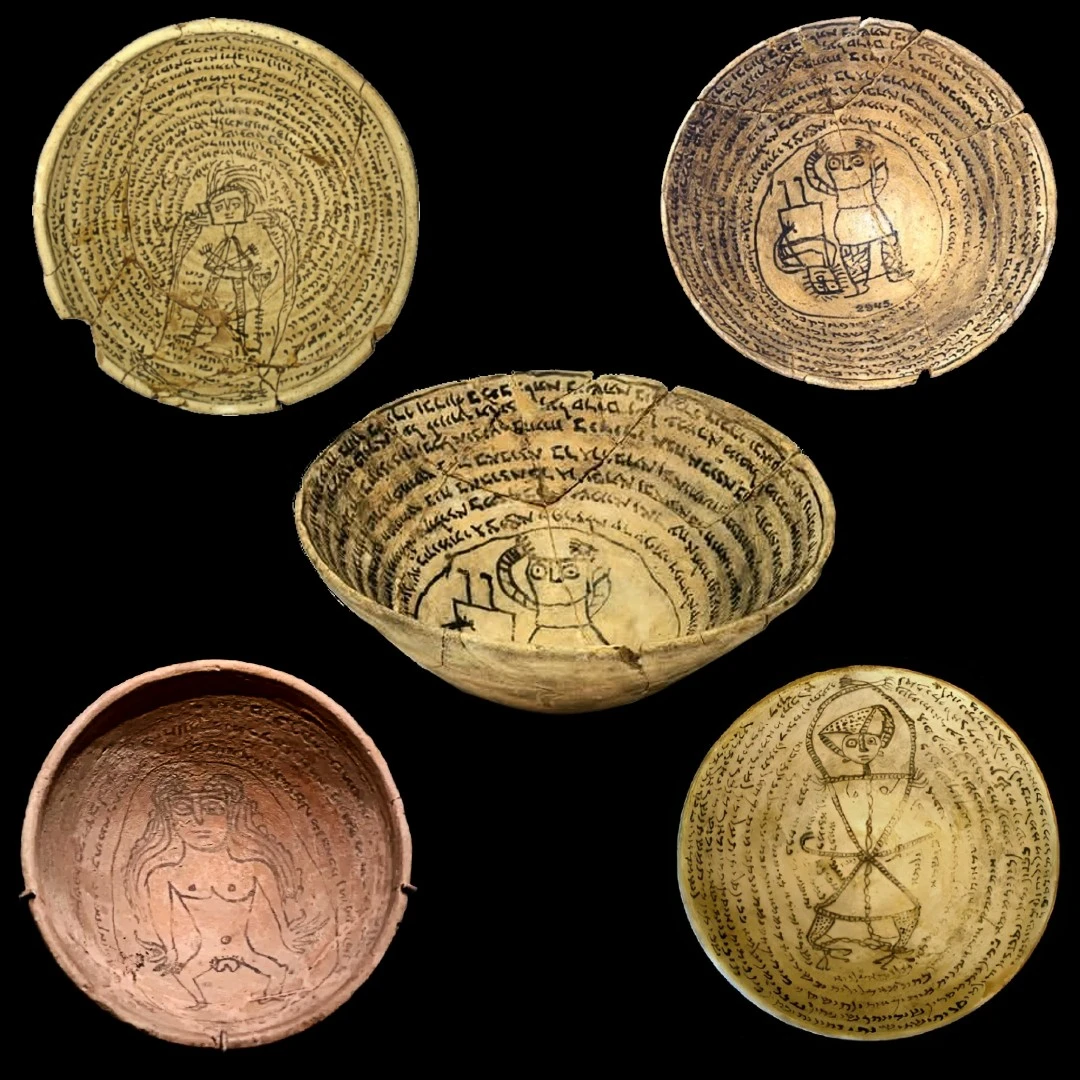
In the civilizations of the ancient Near East, a house was not merely walls and a roof, it was the first line of defense against the unknown. People in ancient Mesopotamia believed that illness, infertility, nightmares, night suffocation, mysterious conflicts, and even sudden death might not always be natural occurrences, but rather the result of unseen entities slipping into human life through invisible cracks.
Among the strangest remnants of that world are clay bowls inscribed with spells, buried upside down beneath homes at corners and thresholds as if they were spiritual traps designed to capture demons and malevolent spirits.
Today, researchers refer to them as Aramaic Incantation Bowls, but in popular imagination, they are best described as: ancient demon traps.
Were They Really Tools to Imprison Evil Entities?
These objects are relatively simple clay vessels, often made of fired pottery, inscribed inside with long texts arranged in spirals from the rim toward the center—or sometimes the reverse, so that the writing itself resembles a vortex enclosing something within. Many have been discovered across Iraq, Iran, and Syria, within the cultural sphere of Mesopotamia during Late Antiquity, particularly in the late Sasanian period (approximately the 5th to 7th centuries CE). They were written in various Aramaic dialects, including Jewish Babylonian Aramaic, Mandaic, and Syriac.
This is not merely “Babylonian magic” in the cinematic sense, but a complex intersection of cultures and religions, involving Jewish, Mandaean, and Eastern Christian communities all living in a worldview where the unseen directly interfered with daily life.
Why Were They Buried Beneath Houses?
One of the most fascinating aspects of these bowls is their placement. They were not meant for display or daily use, but were buried upside down beneath house floors, often at room corners, under thresholds, or in locations believed to be entry points for evil. In some cases, two bowls were placed face-to-face, as if sealing something between them.
To the ancients, the home was not entirely safe, it was a space that required magical protection. A threshold was not just an entrance, but a symbolic boundary between inside and outside. Corners were not just architectural details, but places of stillness and concealment. When a spell was buried in these locations, it did not function merely as a prayer—but as an ambush.
In other words, the goal was not always to repel evil, but sometimes to lure it, bind it, immobilize it, or imprison it within a textual and magical circle.
The Meaning of the Texts
The inscriptions were not general words of protection, they often contained explicit legal and magical commands:
binding, sealing, expulsion, banishment, separation, divorce, restraining orders, nullification of harm, and forcing the harmful entity to leave or lose its power over the targeted person. Some texts treat demons as legal adversaries—offenders who must be restrained spiritually and legally. Some even resemble a “divorce contract” between a human and a female spirit.
Thus, people of that era did not view demons as vague ghosts, but as social agents with names, influence, and supposed rights that could be revoked through ritual and text.
The bowl, therefore, functioned as: a document of expulsion, a restraining order, a magical restraint, a linguistic trap.
It was not merely an incantation, but a written technology designed to confine an unseen entity.
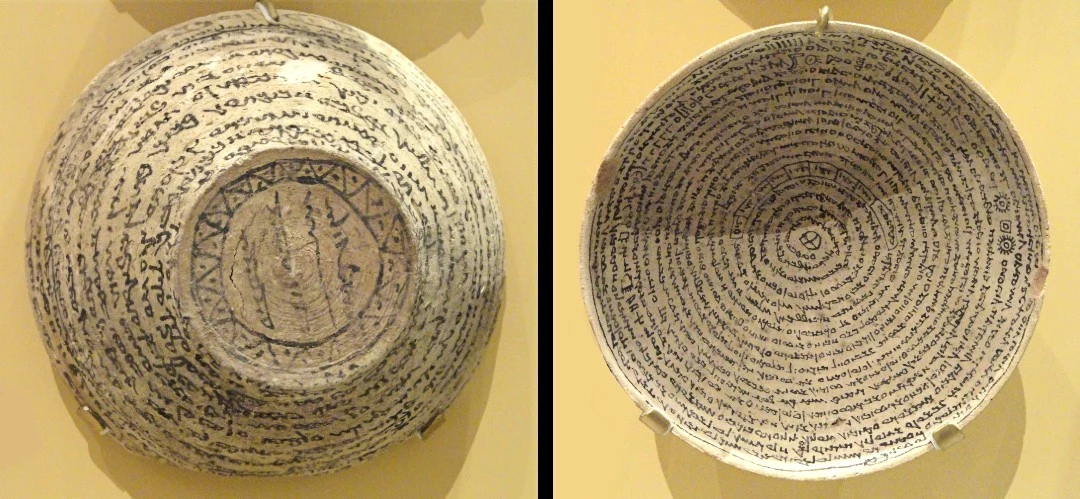
Spiral Writing
One of the most intriguing aspects is the spiral structure of the writing. Scholars suggest this was not merely aesthetic—it may have had a magical function: to confuse the entity, trap it within a visual and symbolic maze with no exit.
In other words: the words did not just tell the demon to leave… they built it a cage.
Depicted Demons
The texts refer to a wide range of harmful entities—not necessarily “Satan” in the later religious sense, but night spirits, female demons, beings causing illness, entities attacking children, or forces linked to infertility and nightmares.
Were They Related to Jinn?
Historically, these bowls predate Islam, so they are not directly linked to the Islamic concept of jinn. However, they strongly resemble later cultural ideas of unseen harmful beings : jinn, spirits, or entities believed to possess, harm, or dwell among humans.
For Common People or Elites?
Evidence suggests they were not exclusive to elites, but widely used in ordinary households—reflecting intimate fears: a mother protecting her child, a family fearing unseen harm, a household trying to seal itself from invisible threats.
Anthropological and Psychological Reading
Many symptoms attributed to spirits then resemble what we interpret today as sleep paralysis, anxiety, hallucinations, or unexplained illness.
Thus, these bowls can be understood both as:
Anthropological tools for protection, and Psychological mechanisms to cope with fear and uncertainty.
When humans cannot explain what harms them, they give it a name, and then try to trap it.
In modern terms, these bowls were like a spiritual security system for the home—not cameras or alarms, but barriers against the unseen.
And perhaps most hauntingly… they remind us that the human struggle with the invisible is ancient.
We may never know if these bowls truly imprisoned a single demon… but they certainly preserved the memory of a very real human fear.


